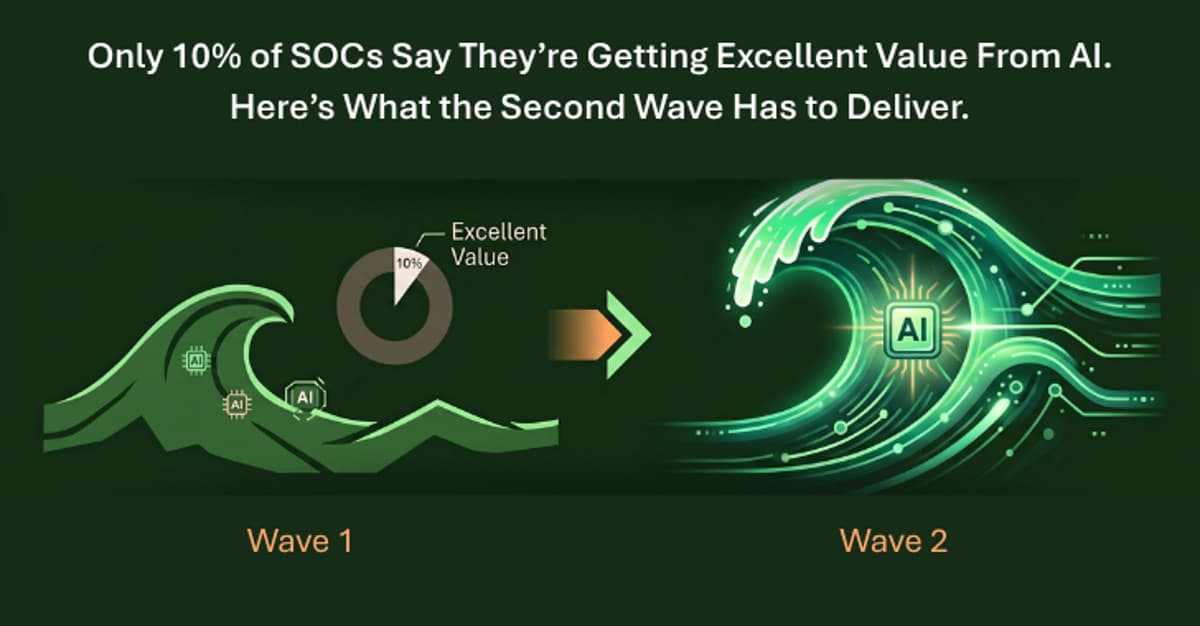
Only 10% of SOCs Say They’re Getting Excellent Value From AI. Here’s What the Second Wave Has to Deliver
Companies Mentioned

Why It Matters
Fragmented point‑AI tools inflate spend but fail to improve critical handoffs, leaving most SOCs vulnerable and inefficient. Integrated, agentic AI can dramatically boost detection speed, investigation quality, and overall cyber‑risk reduction.
Key Takeaways
- •AI adoption in SOCs up 55% to 145% YoY across categories
- •65% of SOCs use off‑the‑shelf AI, reporting lowest value
- •Only 10% achieve excellent AI value via integrated fabric architecture
- •Best‑practice gaps and process complexity rose 17% and 11%
- •Second‑wave AI demands cross‑stage context, institutional knowledge, and governance
Pulse Analysis
The SOC‑CMM 2026 report shows that AI spending in security operations has exploded, with off‑the‑shelf large‑language models rising 55 % year‑over‑year, AI co‑pilots 145 %, and AI agents 118 %. Yet only 10 % of surveyed SOCs claim excellent value, while 71 % see modest or no benefit. The root cause is architectural: most organizations bolt point‑AI features onto existing SIEM, EDR, and ticketing tools, creating five isolated assistants that accelerate individual tasks but leave handoffs untouched. This siloed approach inflates tool counts without improving the process or people domains that drive true productivity.
Second‑wave AI promises a fabric‑style platform that spans the entire SOC lifecycle—threat intel, hunting, detection, investigation, and remediation—and continuously shares context. By ingesting institutional knowledge such as critical assets, analyst judgments, and historical incident outcomes, the agents can tailor investigations to the specific environment rather than delivering generic internet‑average responses. Built‑in governance adds auditable reasoning trails and staged autonomy, fostering analyst trust and enabling safe escalation. Vendors like Conifers’ CognitiveSOC™ illustrate this model, overlaying a connective layer on top of legacy stacks instead of replacing them, and delivering over 60 integrations without rip‑and‑replace migrations.
For CISOs, the shift from first‑ to second‑wave AI is less a budgetary decision than a strategic redesign. Organizations that adopt an integrated, agentic architecture can expect faster investigations, higher detection precision, and automated remediation that respects defined guardrails—advantages that translate into reduced breach dwell time and lower overall cyber‑risk costs. Vendors that continue to sell point solutions risk obsolescence as buyers demand fabric‑level value. The window is narrowing; adversaries already leverage AI‑generated exploits, making the move to a connected SOC not just a competitive edge but a defensive necessity.
Only 10% of SOCs Say They’re Getting Excellent Value From AI. Here’s What the Second Wave Has to Deliver
Comments
Want to join the conversation?
Loading comments...