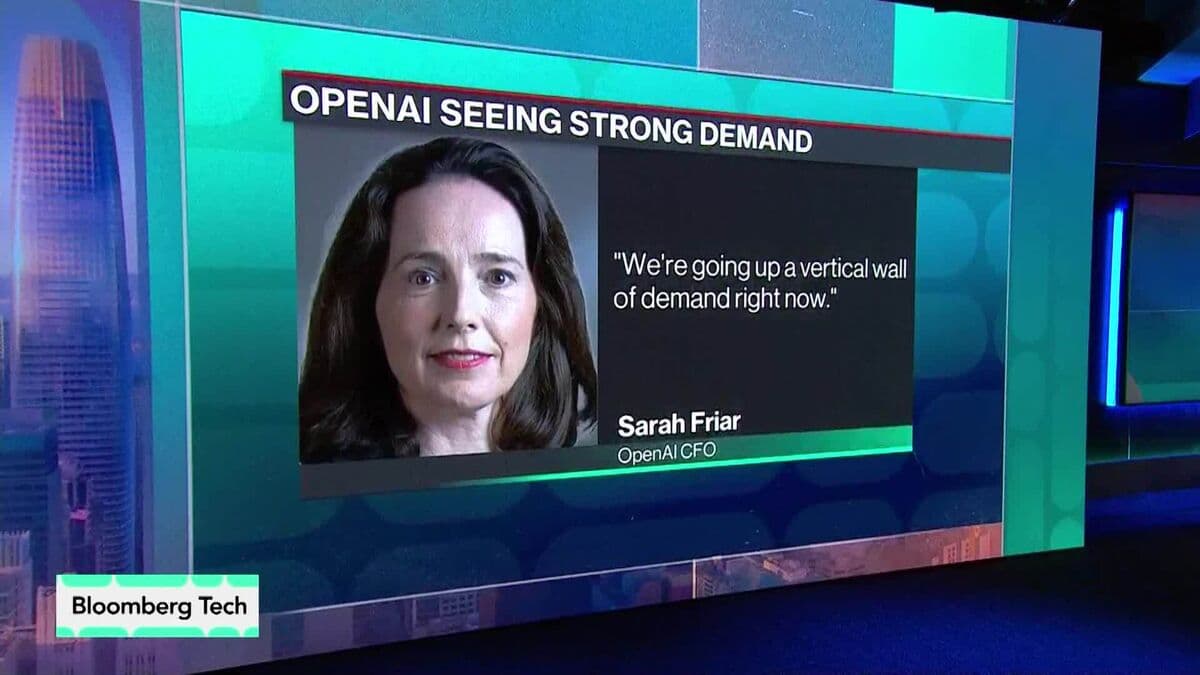
OpenAI CFO Sees ‘Vertical Wall of Demand’ for Products
Companies Mentioned

Why It Matters
The statement signals strong market appetite for OpenAI’s services, but highlights compute scarcity as a critical growth bottleneck that could affect its competitive edge and investor confidence.
Key Takeaways
- •OpenAI reports strong product demand despite missing some internal revenue targets
- •CFO cites “vertical wall of demand” indicating robust market appetite
- •Compute capacity remains primary bottleneck for scaling ChatGPT, Codex, image models
- •Company exploring additional compute deals to unlock broader product rollout
- •Regional pullbacks in Norway and UK reflect shifting deployment strategy
Pulse Analysis
OpenAI’s latest earnings commentary underscores a paradox that many AI firms face: soaring customer interest alongside hard‑wired infrastructure limits. Sarah Friar’s description of a "vertical wall of demand" suggests that enterprises, developers, and consumers are eager for more sophisticated models, yet the company’s internal metrics reveal gaps, such as falling short of a billion weekly active ChatGPT users and missing short‑term revenue targets. This blend of optimism and caution signals to investors that while top‑line growth remains viable, the firm must navigate forecast volatility inherent in a rapidly evolving AI market.
The crux of OpenAI’s growth challenge lies in compute. Advanced language and multimodal models consume massive GPU hours, and the current supply chain for high‑end chips is strained. As the CFO noted, the firm is "scouring for more compute," a sentiment echoed across the industry where cloud providers and chip manufacturers are scrambling to meet demand. Securing additional compute capacity will be pivotal for scaling flagship products like Codex, which powers code generation, and the newly launched image‑generation engine. Without it, OpenAI risks throttling user access, delaying feature rollouts, and ceding ground to rivals that have secured larger hardware allocations.
Strategically, OpenAI’s regional adjustments—such as scaling back in Norway and the United Kingdom—illustrate a pragmatic approach to balance demand with resource constraints. By reallocating compute to higher‑margin markets or flagship services, the company can preserve revenue momentum while it negotiates larger compute contracts. For investors and enterprise customers, the CFO’s outlook offers reassurance that demand will continue to outpace supply, but it also flags compute as a decisive factor in the next wave of AI adoption. Companies that can partner with OpenAI to provide dedicated infrastructure may capture a share of this expanding market, while OpenAI itself must accelerate its hardware procurement to sustain its growth trajectory.
OpenAI CFO Sees ‘Vertical Wall of Demand’ for Products
Comments
Want to join the conversation?
Loading comments...