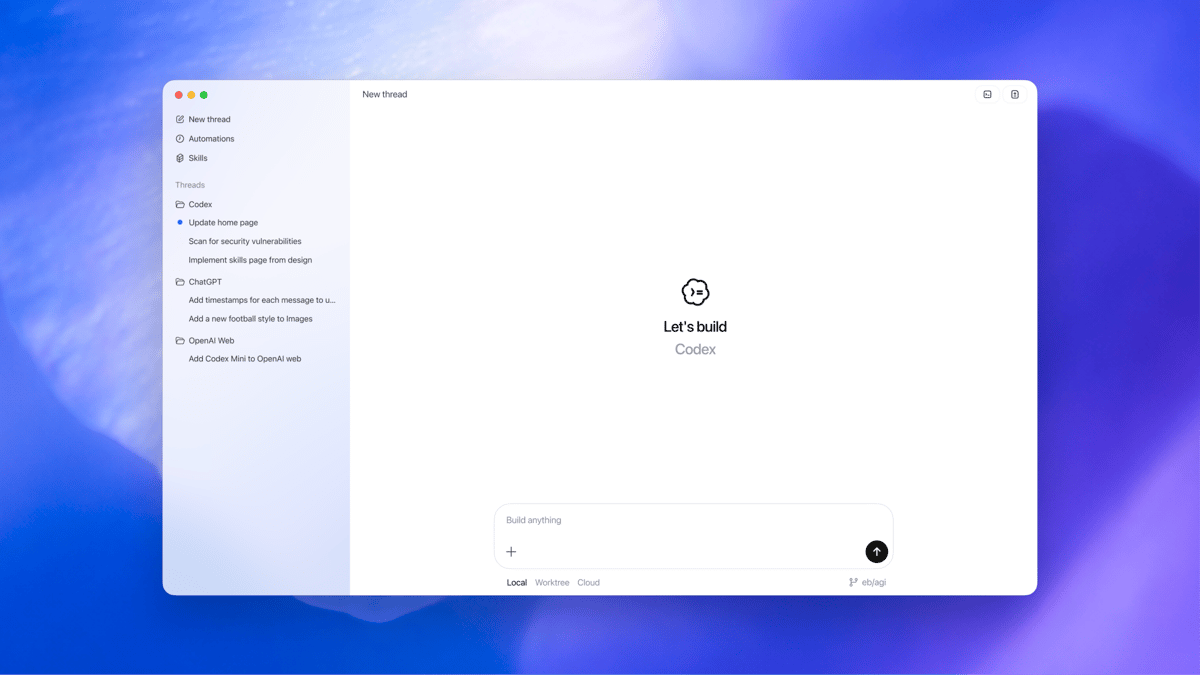
OpenAI Launches Codex App for macOS to Manage Multiple AI Agents
•February 2, 2026
0


Why It Matters
By simplifying multi‑agent management, Codex accelerates complex workflow automation for developers and enterprises, strengthening OpenAI’s foothold in the burgeoning AI‑agent market.
Key Takeaways
- •Codex enables parallel AI agent execution on macOS
- •Integrates CLI, IDE, and cloud under single account
- •Supports ChatGPT Plus, Pro, Business, Enterprise, Edu
- •Doubling usage limits for paid subscription tiers
- •Agents can be linked to external tools via skills
Pulse Analysis
OpenAI’s Codex app marks a strategic shift from command‑line‑only interactions toward a more visual, developer‑friendly environment for orchestrating AI agents. By allowing multiple agents to run concurrently on macOS, Codex reduces the friction of managing separate processes, letting engineers focus on higher‑level logic rather than low‑level scripting. The app’s seamless integration with existing CLI tools, IDE extensions, and cloud platforms means teams can adopt it without overhauling their current toolchains, fostering faster prototyping and deployment of agent‑driven solutions.
The launch arrives amid intensifying competition in the agentic AI space, notably Anthropic’s Claude Code, which has captured attention for its knowledge‑worker capabilities. OpenAI’s decision to double usage limits for paid plans signals an aggressive response to growing demand for scalable, multi‑agent workflows. By bundling Codex with all major ChatGPT subscription tiers and offering a limited free trial, OpenAI lowers the barrier to entry, encouraging broader experimentation and cementing its position as the default platform for developers seeking robust agent orchestration.
For enterprises, Codex’s ability to connect agents to external tools via "skills" opens new avenues for automating repetitive tasks, integrating with legacy systems, and maintaining context across complex projects. This could translate into measurable productivity gains and reduced operational overhead. However, organizations must also consider governance, security, and model alignment as they scale agent deployments. As AI agents become more autonomous, tools like Codex will be pivotal in providing the oversight and flexibility needed to harness their potential responsibly.
OpenAI launches Codex app for macOS to manage multiple AI agents
0
Comments
Want to join the conversation?
Loading comments...