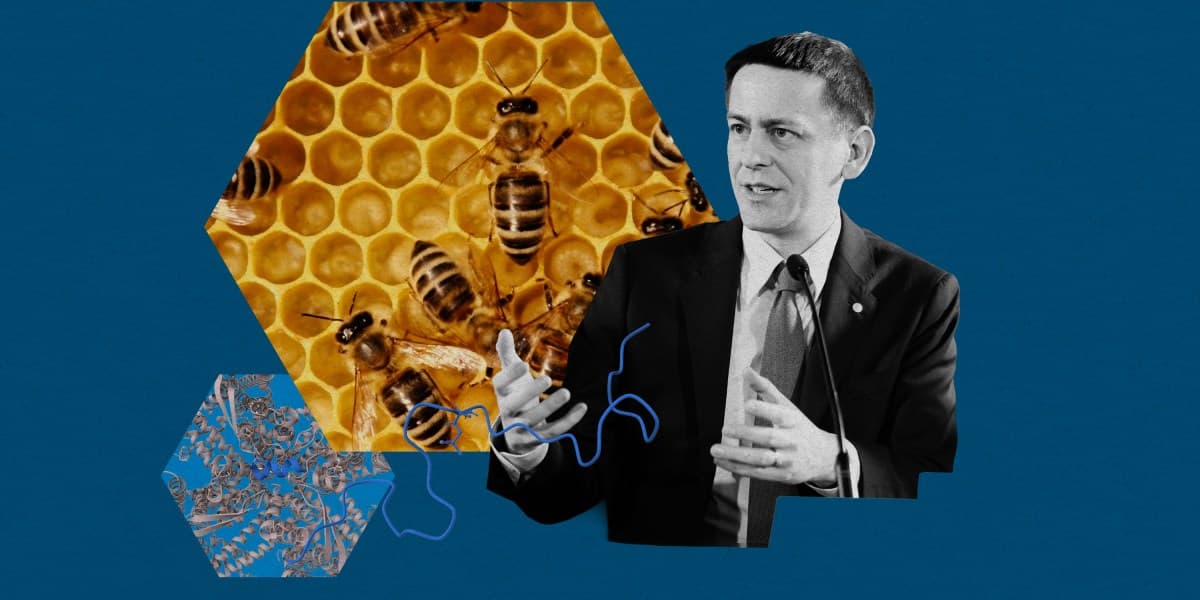
What’s Next for AlphaFold: A Conversation with a Google DeepMind Nobel Laureate
•November 24, 2025
0
Companies Mentioned


Why It Matters
AlphaFold’s breakthrough has transformed protein science, cutting months‑long experiments to hours and enabling faster drug design, while its open database fuels a burgeoning AI‑driven biotech ecosystem that could accelerate therapeutic development and other biotech innovations.
Key Takeaways
- •AlphaFold2 predicted ~200 million protein structures worldwide
- •AlphaFold Multimer enables multi‑protein complex predictions
- •Researchers use AlphaFold for synthetic protein design acceleration
- •Limitations persist for protein‑protein interactions and dynamics
- •New AI models integrate binding affinity predictions for drug discovery
Pulse Analysis
AlphaFold’s emergence in 2020 marked a paradigm shift for structural biology, leveraging transformer‑based neural networks to infer three‑dimensional protein shapes from amino‑acid sequences. By matching the precision of X‑ray crystallography and cryo‑EM in hours rather than months, the system earned its creators a Nobel Prize and prompted DeepMind to scale predictions across UniProt’s entire catalog. This massive, open‑access database has become a foundational resource for academic labs and industry alike, democratizing insights that were once confined to specialized facilities.
Beyond its headline‑grabbing accuracy, AlphaFold has sparked a wave of off‑label applications that reshape experimental workflows. Teams designing synthetic enzymes use the model to vet dozens of candidates in a single day, cutting design cycles by an order of magnitude. Researchers probing complex biological questions—such as sperm‑egg binding or honey‑bee disease resistance—have turned AlphaFold into a searchable structural engine, rapidly narrowing down thousands of possibilities to a handful of testable hypotheses. Yet the technology is not a panacea; predictions for multi‑protein assemblies and dynamic conformations remain less reliable, prompting scientists to treat results as probabilistic guides rather than definitive answers.
The next frontier blends AlphaFold’s structural prowess with predictive pharmacology. Startups and university labs are training hybrid models, like MIT’s Boltz‑2, that couple protein geometry with ligand‑binding affinity scores, enabling virtual screening of drug candidates at unprecedented speed. As these integrated platforms mature, they promise to compress the early phases of drug discovery, reduce reliance on costly wet‑lab assays, and open pathways for tackling previously intractable targets. In a landscape where AI‑driven insights are becoming a competitive differentiator, AlphaFold’s legacy is evolving from a singular breakthrough to the backbone of a broader, AI‑enhanced biotech ecosystem.
What’s next for AlphaFold: A conversation with a Google DeepMind Nobel laureate
0
Comments
Want to join the conversation?
Loading comments...