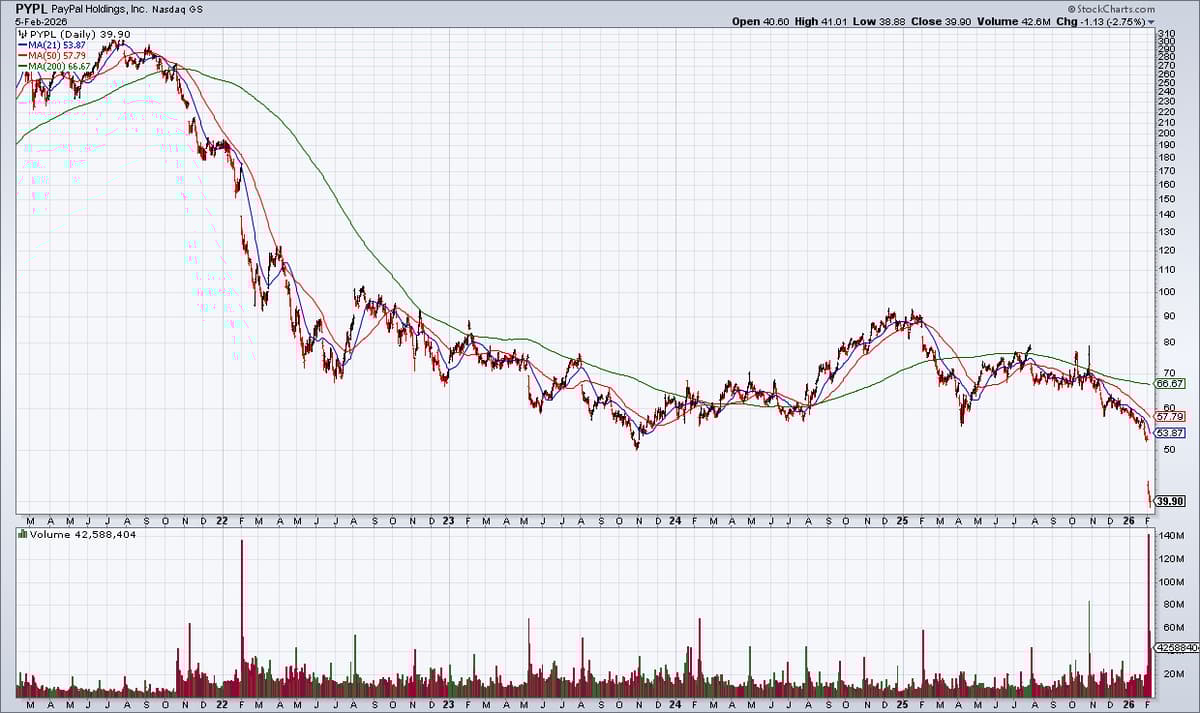
PYPL Is Too Cheap And Will Reward Patient Shareholders
Key Takeaways
- •PayPal trades at ~7.6x earnings
- •$6B buyback could retire 16% of shares
- •Intrinsic value estimated around $60 per share
- •4Q25 TPV rose 8.5% to $475B
- •EPS rise stems from repurchases, not profit growth
Summary
PayPal (PYPL) is trading at a steep discount, with its stock price near $40 representing a 7.6‑times earnings multiple. The company plans a $6 billion share‑repurchase program in 2026 that could retire roughly 16% of its diluted shares, boosting earnings per share for remaining holders. Despite modest revenue and TPV growth, analysts estimate an intrinsic value of $60 per share, suggesting a sizable upside. The article argues that patient investors could reap significant rewards as the market undervalues this low‑quality, Graham‑style stock.
Pulse Analysis
The current market environment heavily favors momentum strategies, leaving classic value opportunities largely ignored. PayPal’s stock, hovering near $40, reflects a 7.6‑times forward earnings multiple—well below peers and historical averages. This valuation gap is amplified by the company’s guidance of a low‑single‑digit EPS decline for 2026, suggesting earnings stability despite broader fintech headwinds. For investors accustomed to growth narratives, PayPal presents a rare quantitative discount anchored in tangible financial metrics.
Central to PayPal’s appeal is its aggressive share‑repurchase agenda. After spending $6 billion to retire 86 million shares in 2025, the firm plans another $6 billion buyback in 2026. At a $40 share price, that program could eliminate roughly 150 million shares, shrinking the diluted count from 939 million to about 789 million—a 16% reduction. This dilution mitigation directly lifts earnings per share and aligns the market price closer to an estimated intrinsic value of $60, derived from a $50 billion enterprise valuation divided by the post‑buyback share count.
For long‑term investors, the combination of a deep discount, robust cash flow, and a disciplined capital return strategy creates a compelling risk‑adjusted return profile. While PayPal’s growth metrics—8.5% TPV expansion and modest revenue gains—are modest, the firm’s cash generation supports continued buybacks without jeopardizing operations. The primary risk lies in sustained earnings pressure and competitive fintech dynamics, which could erode the intrinsic value premise. Nonetheless, the sizable upside potential positions PayPal as a strategic holding for patient capital seeking exposure to a financially sound, yet undervalued, payments platform.
PYPL Is Too Cheap And Will Reward Patient Shareholders


Comments
Want to join the conversation?