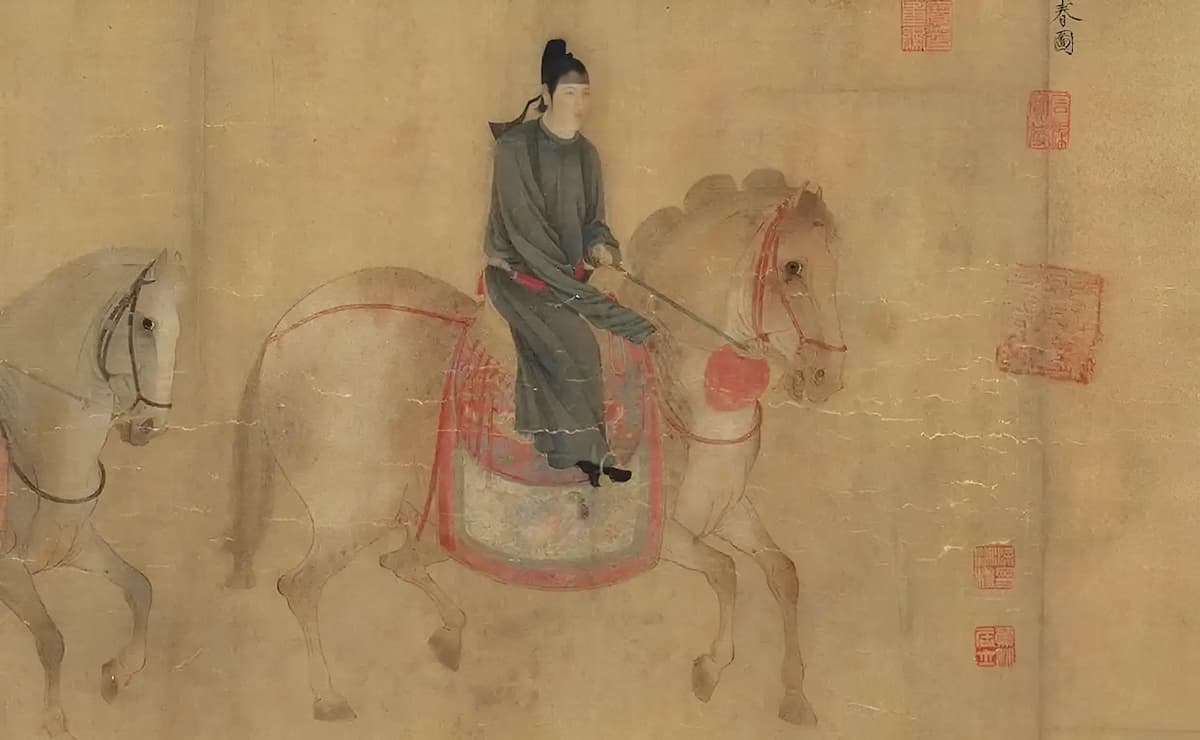
Why It Matters
The scroll bridges art, gender, and political history, illustrating how cultural artifacts can endure upheaval and inform our understanding of Tang society and heritage preservation.
Key Takeaways
- •Song copy preserves lost Tang original of Guoguo Spring Outing
- •Front rider likely Lady Guoguo, highlighting Tang gender fluidity
- •Three‑flower mane and red tassel denote elite court status
- •Painting survived Puyi’s escape, Soviet seizure, and museum transfer
- •Feng Zhonglian’s 1954 copy kept the visual lineage alive
Pulse Analysis
Tang China’s early eighth‑century court was a cosmopolitan hub rivaling Constantinople and Baghdad, and its artistic output reflected that confidence. *The Court Lady Guoguo’s Spring Outing* captures this world in a minimalist yet powerful composition: a procession of aristocrats on horseback moving through an empty silk field. The lack of landscape forces viewers to focus on posture, attire, and the subtle hierarchy encoded in the arrangement, offering scholars a rare glimpse into the visual language of Tang elite leisure and power.
One of the most compelling debates centers on the front rider, who dons male clothing and leads the group. If the figure is indeed Lady Guoguo, the painting subtly subverts traditional gender expectations, showcasing how high‑ranking Tang women could occupy public, even commanding, spaces. The three‑flower mane and red tassel on her horse are not decorative flourishes; they signal rank and ceremonial privilege, reinforcing the notion that visibility was a form of authority for court women. This nuanced portrayal adds depth to our understanding of gender fluidity and status display in medieval China.
The scroll’s survival story is as dramatic as its imagery. After the original vanished, a Song copy entered the Qing imperial collection, only to be whisked away by the last emperor Puyi during his 1945 flight. Soviet forces seized it, and it eventually found a home in the Liaoning Provincial Museum. In 1954, master copyist Feng Zhonglian recreated the work with meticulous fidelity, preserving both technique and cultural memory. The painting’s layered provenance underscores the resilience of cultural heritage amid political turmoil, reminding modern audiences of the importance of safeguarding artistic legacies.
A Tang spring that survived an emperor’s flight
Comments
Want to join the conversation?
Loading comments...