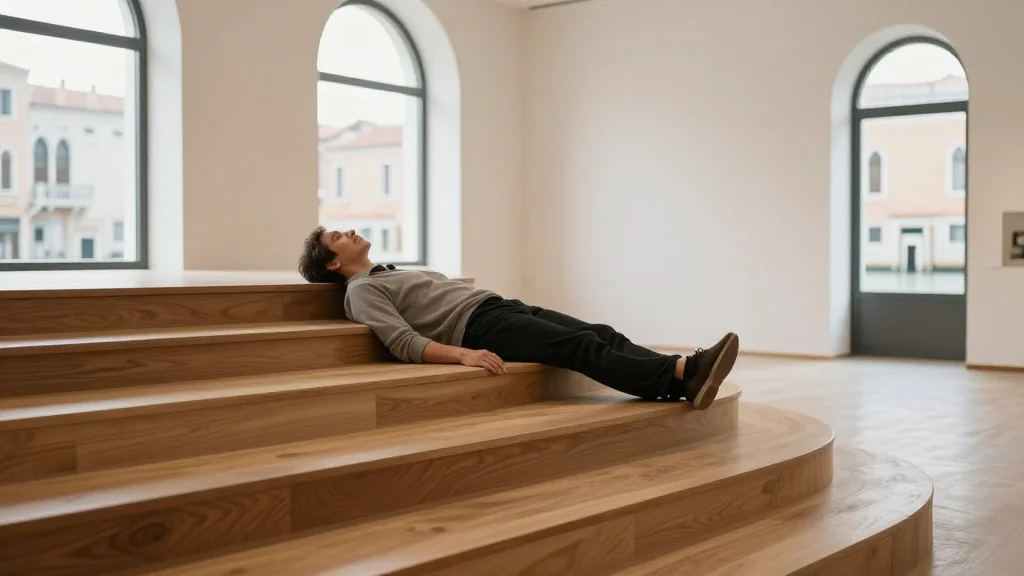
Amanda Heng’s ‘A Pause’ Offers Restful Oasis at Singapore Pavilion, Venice Biennale

Why It Matters
‘A Pause’ foregrounds rest as a cultural intervention, positioning the body’s need for stillness against the hyper‑connected pace of contemporary life. By making rest a visible, shareable experience, the work expands the vocabulary of social practice art, encouraging institutions to consider wellbeing as a curatorial objective. The installation also underscores the relevance of aging artists in shaping global discourse. Heng’s personal reflection on her ageing body adds a layer of intergenerational dialogue, prompting audiences to reconsider assumptions about vitality, productivity, and artistic relevance in later life.
Key Takeaways
- •Amanda Heng transforms Singapore Pavilion into ‘A Pause’, a step‑filled installation inviting rest.
- •Installation opened on May 5, 2026, during the 61st Venice Biennale.
- •Wooden steps are 10 cm high and range from 50 cm to 4 m wide, made from larch wood matching the Arsenale’s floorboards.
- •Curator Selene Yap emphasizes the design’s role in slowing visitor movement and integrating with historic architecture.
- •The work continues Heng’s four‑decade practice of body‑centric social interventions.
Pulse Analysis
Amanda Heng’s intervention arrives at a moment when the art world is increasingly interrogating the mental and physical toll of relentless productivity. By converting a national pavilion into a sanctuary, she not only redefines the visitor experience but also challenges the Biennale’s competitive showcase model. Historically, pavilions have been arenas for visual spectacle; ‘A Pause’ flips that script, suggesting that the absence of visual overload can be equally provocative.
The choice of larch wood, sourced from the same material as the Arsenale’s original floorboards, signals a subtle yet powerful alignment with heritage. This material continuity bridges the gap between the 16th‑century shipyard and a 21st‑century meditation on rest, reinforcing the notion that contemporary art can be both site‑specific and universally resonant. As other nations observe the quiet buzz generated by Heng’s steps, we may see a ripple effect where pavilions incorporate experiential, low‑tech installations that prioritize audience wellbeing over spectacle.
Looking ahead, the documentation of visitor behavior could provide empirical data for museums seeking to embed mindfulness into their programming. If successful, ‘A Pause’ could become a template for future cultural interventions that blend architecture, social practice, and health‑focused design, reshaping how institutions conceive of audience engagement in an age of overstimulation.
Amanda Heng’s ‘A Pause’ Offers Restful Oasis at Singapore Pavilion, Venice Biennale
Comments
Want to join the conversation?
Loading comments...