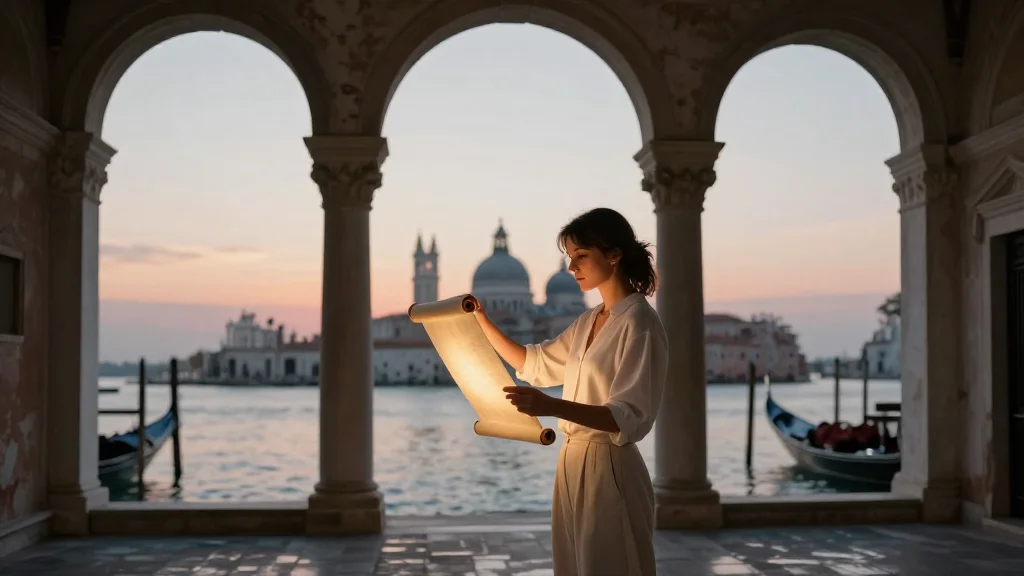
Arch Hades Debuts $525K Poetry‑Inspired Installation “Return” On Venice’s Grand Canal

Companies Mentioned
Why It Matters
Arch Hades’ “Return” illustrates how contemporary art is increasingly embracing literary forms to deepen audience engagement. By turning personal journal entries into public sculpture, the work challenges traditional hierarchies between ‘high’ poetry and visual art, suggesting a new model where narrative content drives both critical discourse and market valuation. The installation’s placement on the Grand Canal during the Venice Biennale also highlights the power of iconic public spaces to amplify an artist’s reach, potentially reshaping how institutions program interdisciplinary projects. Moreover, the record $525,000 sale of Hades’ poem “Arcadia” underscores a burgeoning market for poet‑artists, signaling that collectors are expanding beyond paintings and sculptures to acquire narrative works that can be experienced in multiple formats. This could prompt auction houses and galleries to develop new valuation frameworks for text‑based art, influencing pricing structures across the broader art market.
Key Takeaways
- •Arch Hades opened the three‑floor installation “Return” on Venice’s Grand Canal during the Biennale.
- •The work occupies the historic Scoletta Battioro e Tiraoro di Venezia, a former gold‑thread workshop.
- •Hades’ poem “Arcadia” sold for $525,000 at Christie’s, making her the world’s highest‑paid living poet.
- •Installation features acrylic clouds, mirrored Sphinx, soundscapes, and concrete slabs with journal excerpts.
- •Hades says every artwork begins with poetry, highlighting a trend toward interdisciplinary art practices.
Pulse Analysis
Arch Hades’ emergence as both a poet and visual artist reflects a broader shift in the contemporary art ecosystem, where narrative depth is becoming a commodity as valuable as aesthetic innovation. Historically, poets have occupied a peripheral market niche, but Hades’ $525,000 Christie’s sale demonstrates that collectors now prize the emotional immediacy that confessional writing can bring to a visual context. This convergence is likely to spur auction houses to create dedicated categories for text‑based works, much as they did for performance art in the early 2000s.
The choice of Venice’s Grand Canal as a backdrop is strategic. The city’s built heritage offers a built‑in narrative that amplifies the work’s themes of history, labor, and human fragility. By situating “Return” in a deconsecrated gold‑thread workshop, Hades taps into a lineage of craftsmanship while subverting it with contemporary melancholy. This juxtaposition resonates with Biennale audiences seeking immersive, contemplative experiences, and it may encourage other biennials to commission site‑specific installations that fuse literary content with architectural heritage.
Looking ahead, Hades’ model could inspire a new generation of interdisciplinary creators who leverage personal archives as raw material for public art. As the market adapts, we may see a rise in hybrid pricing models that account for both the literary provenance and the visual execution of a piece. For institutions, the challenge will be to curate programs that honor the integrity of the text while delivering the sensory impact expected by modern audiences. Hades’ “Return” is a proof‑of‑concept that such a balance is not only possible but also commercially viable.
Arch Hades Debuts $525K Poetry‑Inspired Installation “Return” on Venice’s Grand Canal
Comments
Want to join the conversation?
Loading comments...