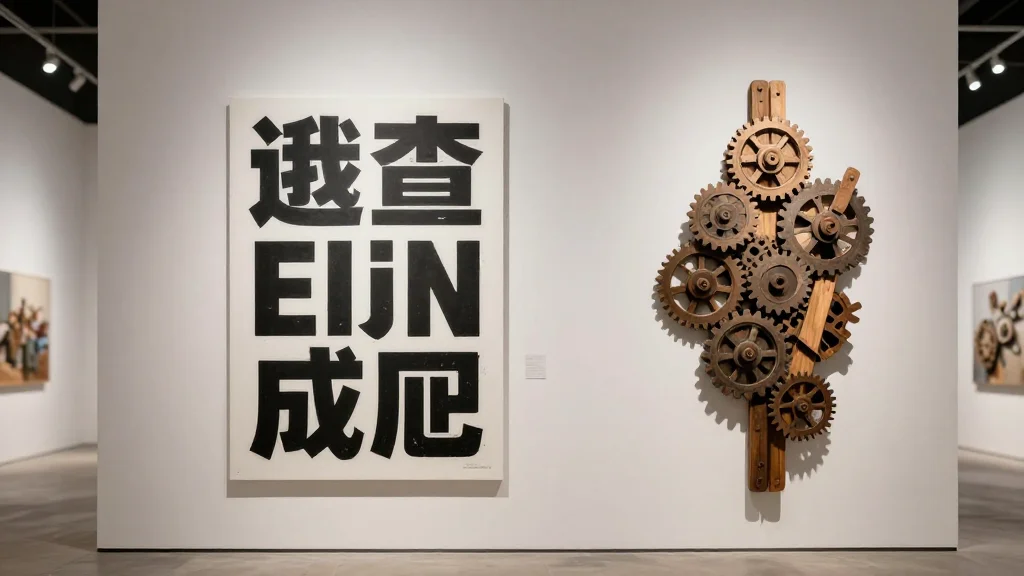
Ben Blount and Catherine Jacobi Launch ‘Good Trouble’ at Riverside Arts Center

Why It Matters
The launch of “Good Trouble” signals a growing appetite for art that directly addresses civil‑rights issues within the Midwest, a region traditionally seen as less politically charged than coastal art hubs. By foregrounding letterpress—a medium historically linked to dissent—from Gutenberg to the Guerilla Girls, the exhibition reaffirms the potency of print as a tool for mass communication. Moreover, Jacobi’s use of found objects bridges the gap between high art and everyday life, encouraging audiences to see activism in the material world around them. Together, the show challenges galleries to balance commercial viability with socially responsible programming, a dilemma that will shape curatorial strategies across the country. Beyond the immediate community, “Good Trouble” contributes to a broader narrative that positions regional artists as key players in the national conversation about race, immigration, and human rights. As more institutions adopt similar models, the exhibition could catalyze a network of activist art spaces that amplify marginalized voices while redefining the economic parameters of contemporary art.
Key Takeaways
- •Ben Blount and Catherine Jacobi opened the collaborative exhibition “Good Trouble” on April 19, 2026, at Riverside Arts Center in Illinois.
- •Blount’s letterpress prints include the Juneteenth‑themed “Stop Killing Black People” and the “Dream Deferred” series.
- •Jacobi’s reinterpretations of Picasso’s “Guernica” link historic trauma to recent ICE actions in Minnesota.
- •The show features live press demonstrations, a panel with the Illinois Arts Council, and plans for a traveling program.
- •A forthcoming book will compile the exhibition’s works and essays on protest art history.
Pulse Analysis
The emergence of “Good Trouble” reflects a strategic shift among mid‑tier galleries toward programming that merges aesthetic innovation with explicit political commentary. Historically, activist art thrived in avant‑garde circles of New York and Los Angeles; now, the Midwest is cultivating its own ecosystem, leveraging local histories of labor and civil‑rights movements. This geographic diversification expands the market for socially engaged art, offering collectors new entry points that are less saturated than coastal markets.
From a commercial perspective, the exhibition’s hybrid model—combining sellable prints, limited‑edition books, and public programming—creates multiple revenue streams while maintaining a clear activist stance. The live letterpress demonstrations serve both as educational outreach and as a marketing tool, turning the production process into a performative experience that can be monetized through workshops and merchandise. However, the overt political messaging may deter traditional buyers who prefer neutral aesthetics, suggesting that galleries must develop nuanced acquisition strategies that balance activist content with collector expectations.
Looking ahead, the success of “Good Trouble” could inspire a wave of similar collaborations, prompting institutions to invest in artists who can translate social critique into compelling visual forms. As regional galleries adopt this model, they may collectively reshape the national art market, positioning the Midwest as a crucible for the next generation of protest art.
Ben Blount and Catherine Jacobi Launch ‘Good Trouble’ at Riverside Arts Center
Comments
Want to join the conversation?
Loading comments...