Why It Matters
The project demonstrates how dense city sites can deliver multigenerational, climate‑responsive homes, reducing operating costs and meeting sustainability goals. Its blend of raw materials and passive systems sets a benchmark for future urban residential developments.
Key Takeaways
- •Three‑story layout maximizes space for large family.
- •Semi‑buried social floor integrates indoor living with garden.
- •Cobogó panels provide natural light and cross‑ventilation.
- •Green roof functions as rainwater sponge and thermal regulator.
- •Design uses raw materials, exposing industrial aesthetic.
Pulse Analysis
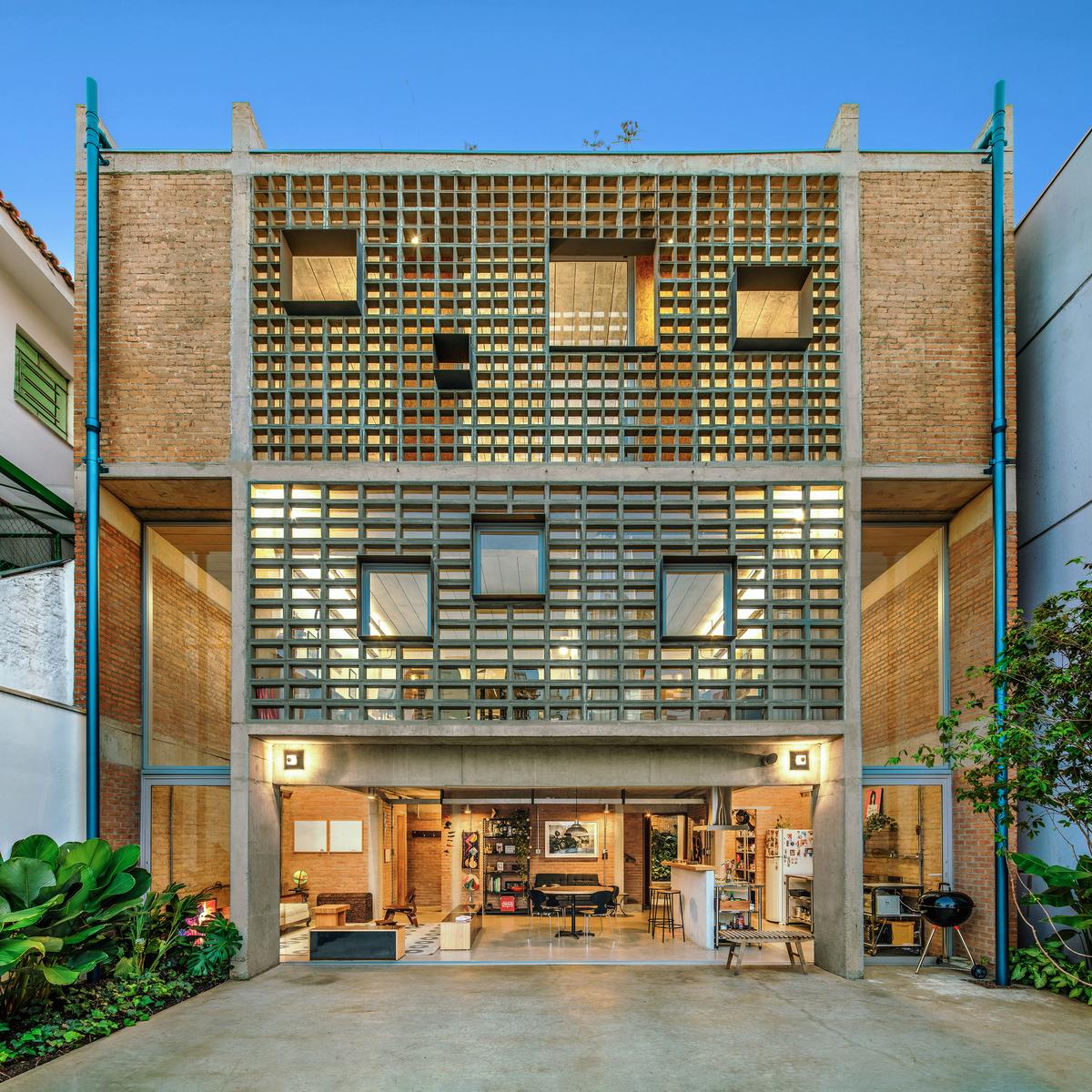
Casa Caetés exemplifies a growing trend in dense urban environments where mixed‑use parcels demand flexible, multigenerational dwellings. Designed by Gabriel Rodrigues Grinspum, the three‑story residence packs 243 m² into a compact volume that serves a couple and five children. The layout separates work, social, and intimate zones across street‑level, semi‑buried, and upper levels, allowing the household to coexist with nearby commercial activity while preserving privacy. This spatial hierarchy reflects a shift toward adaptable floor plans that accommodate remote work and extended family living.
The project’s technical strategy centers on passive performance and water stewardship. A garden‑slab roof acts as a “green sponge,” retaining rainwater for irrigation and providing high thermal mass that reduces cooling loads. Perforated concrete cobogó panels line the bedroom hallway, delivering abundant daylight and cross‑ventilation without mechanical assistance. Semi‑buried social spaces open to longitudinal voids, enhancing natural airflow while shielding interiors from street noise. These measures, combined with exposed brick and prefabricated slabs, illustrate how raw material palettes can coexist with high‑efficiency building systems.
From a market perspective, Casa Caetés signals how architects are responding to the demand for resilient, climate‑responsive homes in compact city blocks. The integration of a future‑ready solar platform and water‑saving roof aligns with municipal sustainability targets, potentially lowering operating costs for occupants. Moreover, the raw, industrial aesthetic resonates with contemporary buyers seeking authenticity and craftsmanship, a narrative increasingly leveraged in branding residential projects. As urban density rises, such adaptable, environmentally attuned designs are likely to influence zoning policies and set new benchmarks for multi‑family housing.
Caetés House / Ateliê GR
0
Comments
Want to join the conversation?
Loading comments...