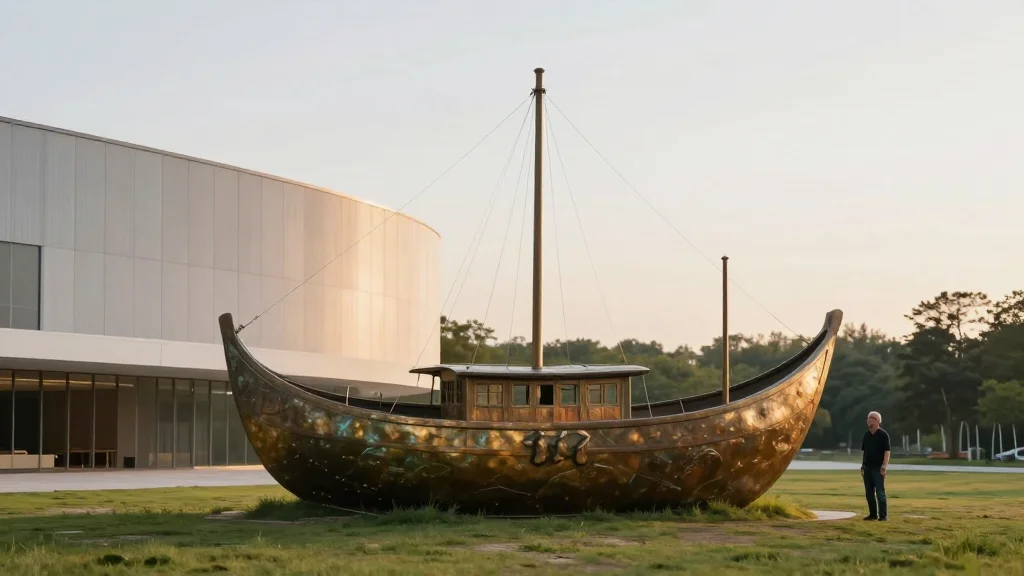
Dana Schutz Unveils 12‑Ton Bronze ‘Blind Boat’ at Norway’s Kistefos Museum

Why It Matters
Blind Boat expands the vocabulary of public art by translating Dana Schutz’s painterly language into a massive, tactile bronze installation. Its presence at Kistefos demonstrates how contemporary artists can leverage monumental sculpture to engage with environmental and societal narratives, inviting audiences to confront pressing issues in an immersive setting. The work also signals a broader shift in the art market, where institutions are increasingly willing to invest in large‑scale, site‑specific commissions that blur the line between fine art and public monument. For emerging artists, Schutz’s transition from canvas to a 12‑tonne bronze underscores the importance of interdisciplinary practice and the potential career impact of securing high‑profile public commissions. Museums and collectors may view such projects as both cultural statements and strategic assets that attract tourism, media attention, and donor interest, reshaping funding models for contemporary sculpture.
Key Takeaways
- •Dana Schutz unveiled Blind Boat, a 7 m tall, 9 m long bronze sculpture weighing over 12 tonnes, at Kistefos Museum on May 9.
- •Blind Boat is Schutz’s first monumental outdoor work, created specifically for the Norwegian museum.
- •The sculpture depicts a boat with blind figures, a stylised sun, hollowed‑out eyeballs, and a carrion bird, echoing mythic and contemporary themes.
- •Schutz, known for expressive figurative paintings, began sculpting in 2018; this commission marks a major expansion of her practice.
- •The work integrates with Kistefos’s waterfall and forest, exemplifying the trend of site‑specific public art that addresses climate and refugee crises.
Pulse Analysis
Dana Schutz’s Blind Boat arrives at a moment when the boundaries between painting, sculpture, and public installation are increasingly porous. Historically, artists like Jeff Koons and Anish Kapoor have leveraged monumental bronze to cement their market stature, but Schutz’s approach is distinct: she retains the gestural, hand‑crafted texture of her paintings, allowing the bronze to function as a three‑dimensional canvas. This hybridization challenges the conventional hierarchy that often privileges ‘pure’ sculpture over painterly extensions, suggesting a new model where materiality and narrative are inseparable.
From a market perspective, the commission signals confidence from European institutions in American contemporary talent, reinforcing transatlantic cultural exchange. Kistefos’s investment in a work that weighs over 12 tonnes reflects a willingness to allocate substantial resources toward experiential art that can draw international visitors. As museums compete for foot traffic in a post‑pandemic landscape, such iconic pieces become both cultural signifiers and economic drivers. For collectors, the permanence of Blind Boat at a high‑profile venue may enhance the secondary market value of Schutz’s smaller bronze works and related paintings, creating a feedback loop that encourages further large‑scale projects.
Looking ahead, Blind Boat could catalyze a wave of similar commissions, prompting artists to consider how their two‑dimensional vocabularies might translate into public monuments. The work’s thematic engagement with blindness and climate anxiety also positions it within a lineage of socially engaged art that seeks to provoke dialogue beyond aesthetic appreciation. As audiences increasingly demand relevance and immediacy, sculptures that embody both visual spectacle and critical commentary—like Blind Boat—are likely to become central to the future programming strategies of major museums worldwide.
Dana Schutz Unveils 12‑Ton Bronze ‘Blind Boat’ at Norway’s Kistefos Museum
Comments
Want to join the conversation?
Loading comments...