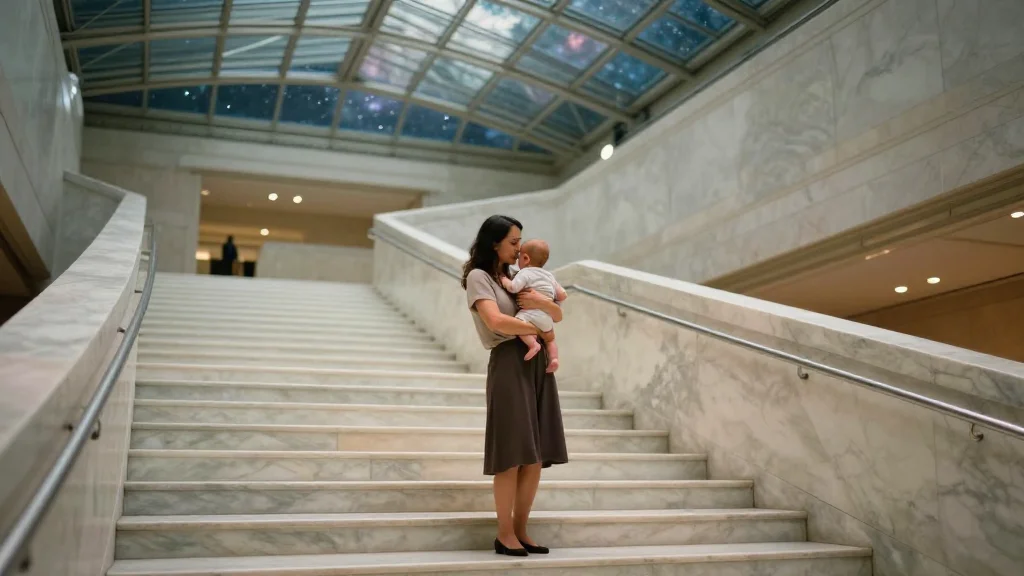
Elena Megalos’s Illustrated Essay Marries Motherhood with Cosmic Scale at the AMNH

Why It Matters
Megalos’s essay illustrates a growing appetite for interdisciplinary experiences that merge art, science, and personal narrative. By embedding a mother’s perspective within a museum designed to convey the immensity of the cosmos, the work challenges visitors to reconsider the relationship between individual lives and universal time scales. This approach not only enriches the museum experience but also expands the audience for contemporary art, positioning artists as interpreters of scientific spaces. The piece also underscores the power of visual storytelling to humanize abstract concepts. In an era where museums compete with digital media for attention, integrating emotive art can deepen engagement, fostering a sense of wonder that is both intellectual and affective. As more cultural institutions adopt similar collaborations, the boundaries between disciplines may continue to dissolve, reshaping how society consumes knowledge and experiences art.
Key Takeaways
- •Elena Megalos presents an illustrated essay at the American Museum of Natural History, published in Longreads.
- •The museum’s 360‑foot ramp serves as a physical metaphor for 13 billion years of cosmic history.
- •A single strand of hair, a tenth of a millimeter wide, symbolizes the entirety of human history and moves Megalos to tears.
- •Megalos’s narrative links motherhood to the vastness of the universe, highlighting a paradox of scale.
- •The project reflects a broader trend of cross‑genre collaborations between artists and scientific institutions.
Pulse Analysis
Megalos’s essay arrives at a crossroads where museums are redefining their educational mandate. Traditionally, natural history institutions have relied on static displays and didactic panels to convey scientific facts. By inviting an artist to overlay a personal, maternal narrative onto the museum’s architecture, the American Museum of Natural History is experimenting with affective pedagogy—using emotion as a conduit for learning. This strategy aligns with recent research suggesting that emotional engagement can improve retention of complex scientific concepts.
Historically, the integration of art into scientific venues has been sporadic, often limited to decorative commissions. Megalos’s work signals a shift toward co‑creation, where artists are not merely embellishing spaces but actively shaping interpretive frameworks. This model could inspire other institutions to commission similar interdisciplinary projects, potentially leading to a new genre of museum‑based narrative art that blurs the line between exhibition and performance.
Looking ahead, the success of Megalos’s essay may encourage funding bodies and cultural policymakers to allocate resources toward hybrid projects that marry visual art with scientific storytelling. As audiences increasingly seek immersive, emotionally resonant experiences, the art‑science partnership could become a staple of museum programming, redefining how we collectively understand our place in the cosmos.
Elena Megalos’s Illustrated Essay Marries Motherhood with Cosmic Scale at the AMNH
Comments
Want to join the conversation?
Loading comments...