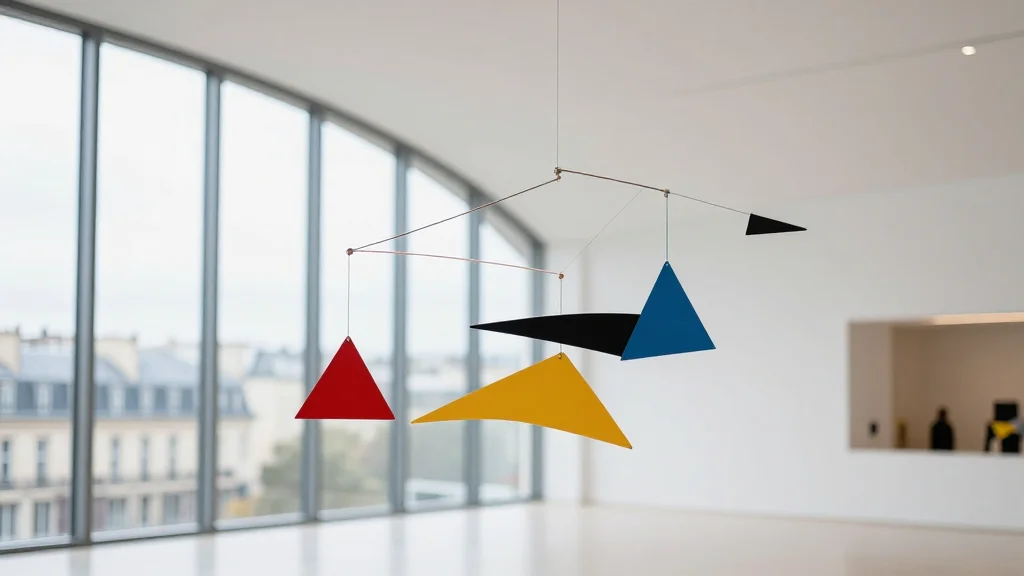
Fondation Louis Vuitton Unveils Largest Alexander Calder Retrospective in Decades

Why It Matters
The Calder retrospective underscores a broader shift in the art world toward immersive, interdisciplinary exhibitions that blend scholarship with spectacle. By assembling an unprecedented number of works, the Fondation Louis Vuitton not only honors Calder’s kinetic legacy but also demonstrates how major institutions can leverage international collaborations to create cultural events that attract global audiences. The exhibition’s emphasis on movement, light, and sound resonates with contemporary interests in experiential art, potentially influencing how museums design future shows. Beyond the artistic implications, the project has economic ramifications for Paris’s cultural tourism sector. A high‑profile exhibition of this magnitude can drive increased visitor spending, support local hospitality businesses, and reinforce the city’s reputation as a hub for cutting‑edge modern art. The success of this retrospective may encourage other institutions to pursue similarly ambitious loan programs, reshaping the dynamics of museum partnerships worldwide.
Key Takeaways
- •Nearly 300 Calder works displayed across 3,000 sq m at the Fondation Louis Vuitton
- •Exhibition runs until August 16, 2026, marking Calder’s centenary in France and 50th death anniversary
- •Features a rare loan of the Cirque Calder from the Whitney Museum, absent from France for 15 years
- •Curators Dieter Buchhart and Anna Karina Hofbauer highlight Calder’s introduction of time as a fourth dimension
- •Shows alongside works by Arp, Hepworth, Klee, Mondrian, and Picasso, contextualizing Calder within the avant‑garde
Pulse Analysis
The launch of “Calder. Rêver en Équilibre” reflects a strategic pivot by major European museums toward blockbuster retrospectives that can command both scholarly attention and mass appeal. Historically, Calder exhibitions have been fragmented, often limited to single works or modest surveys. By consolidating three hundred pieces, the Fondation creates a narrative depth that rivals the most comprehensive surveys seen in New York or London. This scale not only elevates Calder’s market visibility but also reasserts Paris’s capacity to orchestrate complex, cross‑institutional projects.
From a market perspective, the exhibition could catalyze renewed interest in Calder’s works on the secondary market, potentially driving auction prices upward as collectors seek pieces that were highlighted in the show. Moreover, the successful coordination with the Whitney Museum signals a growing willingness among American institutions to lend marquee works abroad, a trend that could reshape loan negotiations and insurance frameworks. If the exhibition meets its projected visitor targets, it will provide a financial blueprint for other museums aiming to balance ambitious curatorial visions with fiscal responsibility.
Looking ahead, the retrospective’s planned catalogue and potential traveling iteration suggest a long‑term lifecycle that extends beyond the Parisian dates. This approach aligns with a broader industry move toward multi‑venue exhibitions that maximize the return on loan investments. For the Fondation Louis Vuitton, the Calder show may serve as a template for future retrospectives of other 20th‑century innovators, reinforcing its role as a leading platform for modern art scholarship and public engagement.
Fondation Louis Vuitton Unveils Largest Alexander Calder Retrospective in Decades
Comments
Want to join the conversation?
Loading comments...