Why It Matters
The exhibition spotlights how contemporary art can interrogate narrative absence and expose market biases that undervalue the craftsmanship behind conceptual projects, influencing future curatorial and collecting practices.
Key Takeaways
- •Einarsson's *Closed Caption* uses black gouache sheets with sparse text
- •Kitamura's woodblock prints reference WWII US Army test houses
- •Exhibition highlights tension between conceptual art value and craft labor
- •Works create claustrophobic atmosphere through absent narratives and darkness
- •Collaboration blurs national identities: Norwegian artist, Japanese craft, US history
Pulse Analysis
The latest show at Maureen Paley, titled *Music Playing Over Speech*, places Gardar Eide Einarsson’s minimalist “nonimages” at the centre of a stark, dim gallery. Ten black gouache sheets, each labeled *Closed Caption*, present only a fragment of white text—phrases such as “music playing over speech” or “footsteps departing”—extracted from film and television scripts but stripped of any visual anchor. By foregrounding the absence of image, Einarsson forces viewers to construct narrative in the dark, turning ordinary sound cues into cryptic signposts. The work interrogates how language can both reveal and conceal meaning within contemporary art.
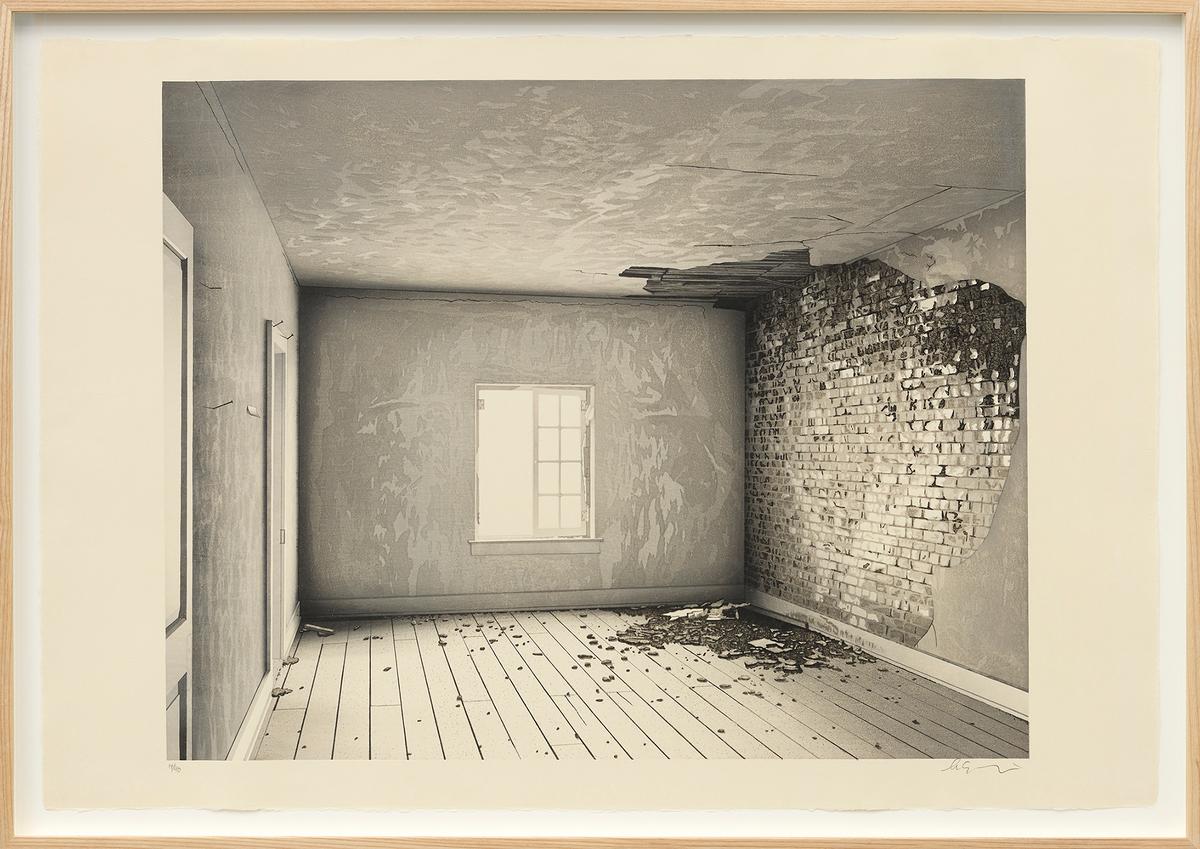
Flanking the captions, three woodblock prints by Shoichi Kitamura—produced in partnership with the artist—re‑create the skeletal interiors of the US Army’s Dugway Proving Ground test houses, built during World II for chemical and biological weapons trials. Rendered in a hyper‑realistic style, the prints depict empty rooms littered with rubble, echoing the eerie stillness of Vilhelm Hammershøi’s interiors. The juxtaposition of minimalist black sheets with detailed Japanese prints underscores a paradox: structures designed for annihilation are preserved as aesthetic objects, and a Japanese craftsman’s hand is subsumed under a Norwegian conceptual framework.
The exhibition also surfaces a persistent market bias that privileges concept over material labor. Kitamura’s contribution is noted only as an aside, highlighting how the art world often marginalizes the physical craftsmanship that enables conceptual projects. This erasure fuels ongoing debates about authorship, cultural appropriation, and the valuation of cross‑disciplinary collaborations. For collectors and institutions, *Music Playing Over Speech* serves as a reminder that the economics of contemporary art are as much about narrative framing as about the objects themselves, prompting a reassessment of how credit and price are allocated across mediums.
Gardar Eide Einarsson Leaves You in the Dark
Comments
Want to join the conversation?
Loading comments...