He Couldn’t Choose Between Dance And Visual Art. He’s Ended Up Putting Dancers In His Art Installations.
Why It Matters
Fernandes’ fusion of dance and visual art redefines museum programming, attracting new audiences seeking experiential, boundary‑pushing cultural content. The project demonstrates how institutions can leverage interdisciplinary practice to stay relevant in a competitive arts market.
Key Takeaways
- •Fernandes blends dance, visual art, and design in immersive installations
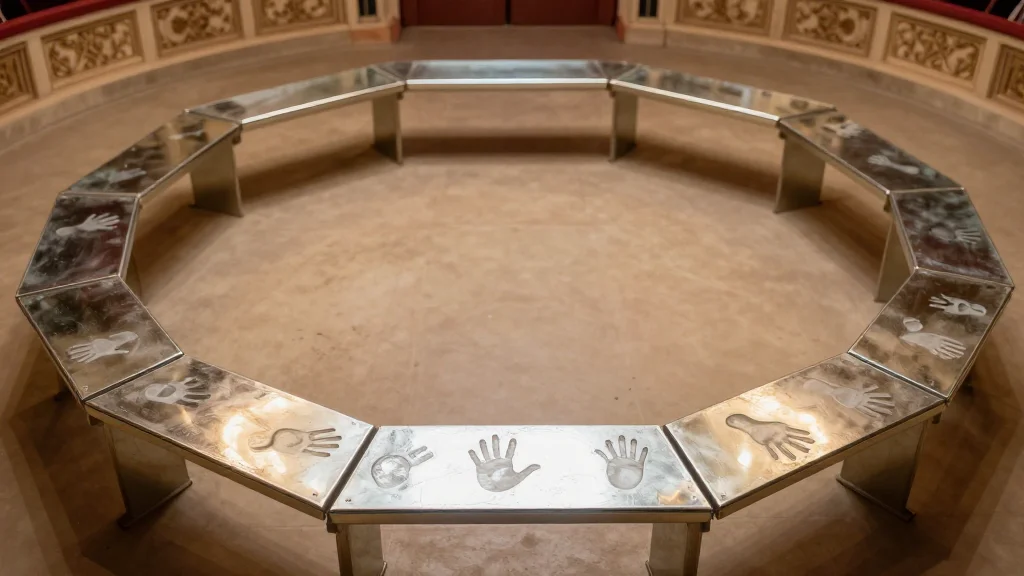
- •In the Round uses mirrored benches to capture performers’ traces
- •Residency invites public to view rehearsals beyond scheduled performances
- •Queering space concept challenges traditional museum architecture norms
Pulse Analysis
Brendan Fernandes, a Kenyan‑born, Toronto‑trained artist, has built a reputation for erasing the borders between visual art and movement. After studying ballet, earning a BFA in both disciplines, and completing the Whitney Independent Study Program, he embraced a practice that treats choreography as sculpture and vice‑versa. His past works, such as “Encomium” and the pandemic‑era “72 Seasons” in Chicago’s Lurie Garden, already hinted at this hybrid approach, but the Driehaus residency amplifies it within a historic, church‑like auditorium, turning the space itself into a living canvas.
“In the Round” centers twelve mirrored benches arranged in a twelve‑sided polygon, each becoming a record of dancers’ bodies through handprints, footprints, and even humidity. Performers move in semi‑improvisational patterns, sometimes wielding quilted textiles, while original music streams through the organ console. The audience experiences the work as a moving sculpture rather than a conventional performance, entering a space that constantly evolves. Curator Stephanie Cristello describes it as “queering architecture,” a term Fernandes uses to signal fluidity beyond gender and artistic binaries, inviting visitors to reconsider how museums house and present art.
The installation signals a broader shift in cultural institutions toward immersive, interdisciplinary experiences that attract younger, experience‑driven patrons. By integrating dance, design, and sound into a historic venue, the Driehaus Museum demonstrates how legacy spaces can be revitalized without compromising their architectural integrity. As art fairs and museums compete for attention, projects like Fernandes’s provide a template for programming that blurs categories, encourages repeat visitation, and opens new revenue streams through extended residencies and public‑access hours. This model may inspire other institutions to commission works that function simultaneously as performance, sculpture, and interactive environment, reshaping the economics of contemporary art presentation.
He Couldn’t Choose Between Dance And Visual Art. He’s Ended Up Putting Dancers In His Art Installations.
Comments
Want to join the conversation?
Loading comments...