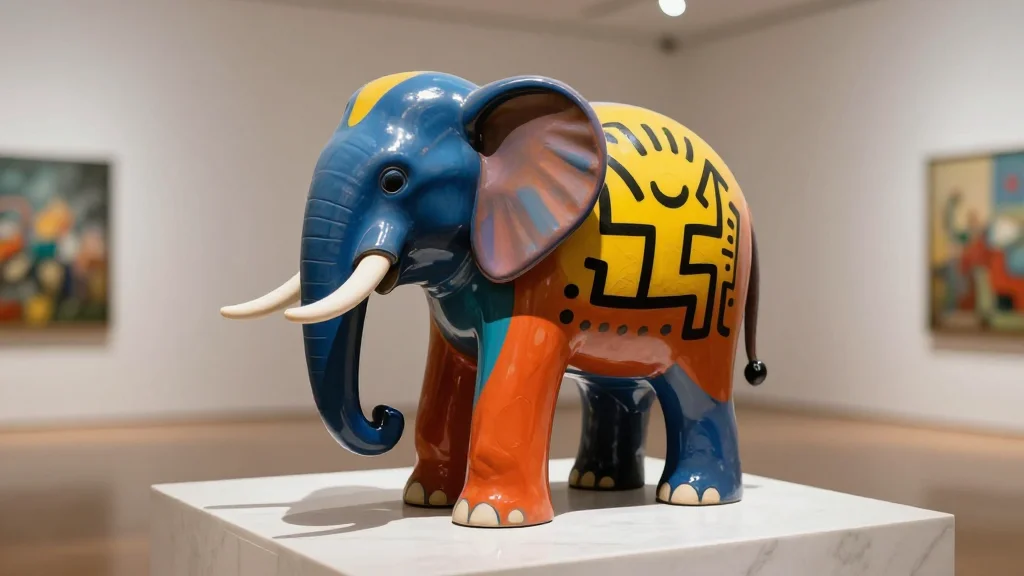
Keith Haring in 3D Exhibition Opens at Crystal Bridges, Showcasing Rare Sculptural Works

Why It Matters
The exhibition expands public understanding of Keith Haring beyond his well‑known street murals and prints, highlighting his capacity to work in three dimensions and reinforcing his role as a cultural activist. By presenting pieces that have rarely left private hands, the show offers scholars new material for research and provides collectors with a clearer view of the market potential for Haring’s sculptural work. Moreover, the partnership between Crystal Bridges and major institutions signals a shift toward collaborative programming that can amplify the impact of socially engaged art. As museums increasingly prioritize inclusive narratives, "Keith Haring in 3D" serves as a template for how legacy artists can be re‑contextualized to address contemporary issues.
Key Takeaways
- •Crystal Bridges Museum opens "Keith Haring in 3D" exhibition featuring over a dozen rare sculptural works.
- •"Untitled (Elephant)" (1985) previously owned by Andy Warhol is a centerpiece of the show.
- •Curator Kaywin Feldman emphasizes the bridge between street art and high‑culture collecting.
- •Art historian Dr. Melissa R. Huber links the three‑dimensional pieces to Haring’s activist legacy.
- •Exhibition runs through September with plans for a traveling component to MoMA.
Pulse Analysis
Keith Haring’s three‑dimensional oeuvre has long been a footnote in his biography, largely because the pieces have been scattered across private collections. By consolidating these works in a single, publicly accessible venue, Crystal Bridges is not only filling a scholarly gap but also reshaping market dynamics. The exhibition arrives at a time when collectors are actively seeking works that combine aesthetic appeal with a clear social narrative, a niche Haring occupies uniquely. This convergence of rarity, activism, and brand recognition is likely to push auction estimates for his sculptural pieces upward, potentially establishing a new price ceiling for non‑canvas works.
Historically, museums have used retrospective exhibitions to revive interest in under‑appreciated aspects of an artist’s practice—think of the 2015 MoMA show that re‑examined Barbara Kruger’s early installations. "Keith Haring in 3D" follows that model, but with a distinct advantage: Haring’s name already carries significant cultural capital, and his activism resonates strongly with today’s socially conscious collectors. The exhibition’s ancillary programming, especially the panel on activism and materiality, further cements Haring’s relevance and may inspire a new generation of artists to explore three‑dimensional media as a vehicle for social commentary.
Looking ahead, the traveling component to MoMA could amplify these effects, exposing a broader audience to Haring’s sculptural work and prompting institutions worldwide to reassess their own holdings. If the market response mirrors the early buzz, we may see a cascade of acquisitions, museum loans, and scholarly publications that finally bring Haring’s three‑dimensional legacy into the mainstream art historical canon.
Keith Haring in 3D Exhibition Opens at Crystal Bridges, Showcasing Rare Sculptural Works
Comments
Want to join the conversation?
Loading comments...