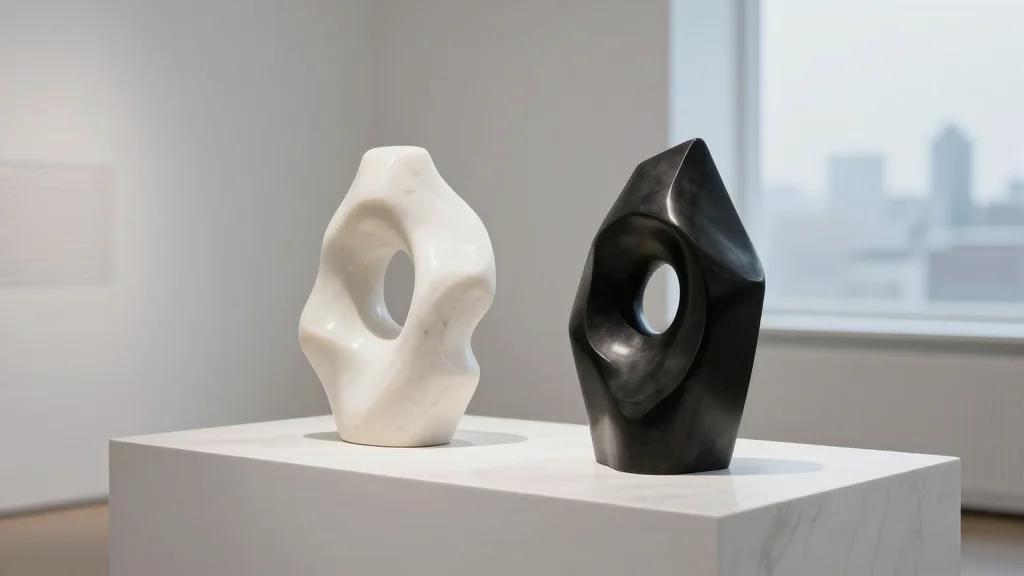
London's Bowman Sculpture Launches Century‑Spanning 'Modern British' Survey

Why It Matters
The exhibition repositions British sculpture within a global context, emphasizing both its historical depth and its contemporary relevance. By pairing iconic works with those of emerging artists, the show challenges traditional hierarchies and encourages collectors, curators, and scholars to reconsider the narratives that have long defined the field. Furthermore, the public programming attached to the exhibition expands access to scholarly discourse, fostering a more informed audience. This educational component can stimulate demand for British sculpture in both museum acquisitions and private collections, potentially reshaping market trends for the next decade.
Key Takeaways
- •Bowman Sculpture opens "Modern British" exhibition, on view until May 29 2026.
- •Features Henry Moore’s *Small Seated Figure* (c. 1936, cast 1957) and Eduardo Paolozzi’s *Richard Rogers as Newton* (1990, 3/6).
- •Includes emerging artists Rufus Martin and Joanna Allen, highlighting new talent.
- •Curated by Michele, Robert, and Mica Bowman, reflecting a family‑led vision.
- •Accompanying public program offers talks, workshops, and a forthcoming catalogue.
Pulse Analysis
Bowman Sculpture’s decision to mount a century‑spanning survey signals a strategic pivot toward narrative-driven exhibitions that blend marketable heritage with forward‑looking talent. Historically, British sculpture has been perceived as a niche within the broader European canon, often eclipsed by painting. By foregrounding sculptural milestones alongside fresh voices, the gallery not only revitalizes interest in the medium but also creates a commercial ecosystem where emerging artists benefit from the halo effect of established masters.
The timing aligns with a broader resurgence of interest in mid‑20th‑century British art, as recent auction results have shown heightened demand for works by Moore and his contemporaries. This exhibition leverages that momentum, positioning the gallery as a conduit between high‑value secondary‑market sales and primary‑market opportunities for younger creators. The public program further cements Bowman’s role as an educational hub, potentially attracting institutional partnerships and funding for future research.
Looking ahead, the catalogue and any subsequent programming could serve as reference points for museums seeking to diversify their collections. If the exhibition succeeds in generating critical buzz and sales, it may encourage other galleries to adopt similar cross‑generational models, reshaping how British sculpture is curated, collected, and studied worldwide.
London's Bowman Sculpture Launches Century‑Spanning 'Modern British' Survey
Comments
Want to join the conversation?
Loading comments...