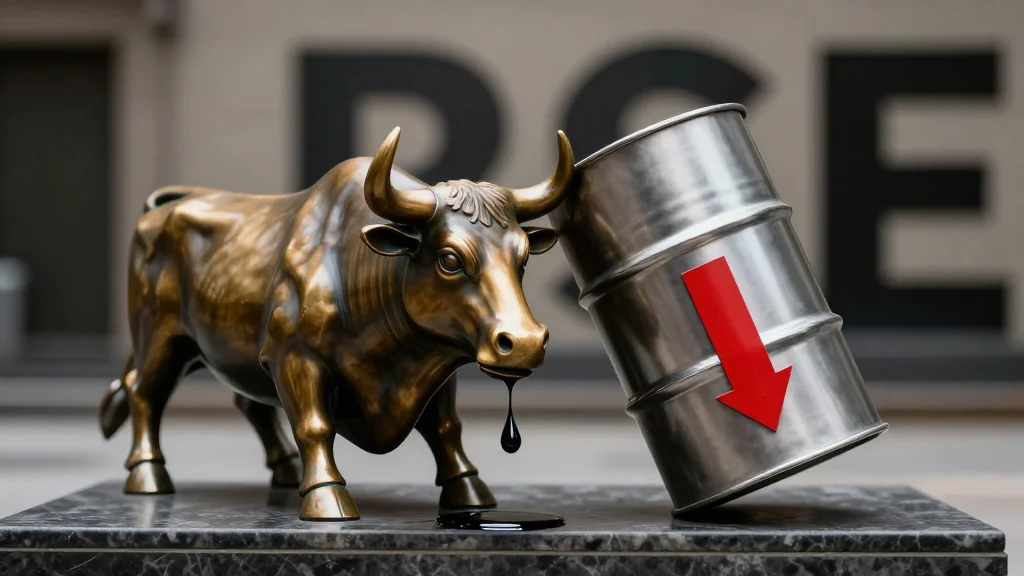
India’s Sensex and Nifty Drop ~500 Points as Oil Rises and US‑Iran Tensions Loom

Companies Mentioned
Why It Matters
The sharp pullback in the Sensex and Nifty highlights how external shocks—rising oil prices and geopolitical uncertainty—can quickly erode gains in India’s fast‑growing equity market. For foreign investors, the episode serves as a reminder that capital can be withdrawn rapidly in response to global risk events, affecting liquidity and valuation multiples across sectors. Domestically, the sell‑off pressures the rupee and may prompt the RBI to adjust monetary policy to curb inflationary spillovers from higher crude costs. Moreover, the IT sector’s earnings miss signals that even high‑growth, export‑oriented companies are vulnerable to macro headwinds, potentially reshaping investor allocations toward more defensive stocks such as FMCG and banks, which have shown relative resilience.
Key Takeaways
- •Sensex fell 756.84 points (‑0.95%) to 78,516.49; Nifty dropped 198.50 points (‑0.81%) to 24,378.10
- •Brent crude rose 1.26% to $99.72 per barrel, pressuring import‑dependent Indian firms
- •FIIs sold ₹1,918.99 crore (≈ $231 million) of equities, accelerating the decline
- •HCL Tech slid 10.85% after earnings missed expectations despite a ₹4,488 crore profit
- •Rupee hovered near 94 per USD, testing the RBI’s inflation‑targeting framework
Pulse Analysis
The recent dip in India’s benchmarks is a textbook case of how intertwined global geopolitics and commodity markets are with domestic equity performance. Historically, every spike in Brent above $95 has coincided with a measurable pullback in Indian indices, as higher import bills squeeze corporate margins and erode consumer spending power. The current episode is no different, but the speed of the reversal—within a single trading session—suggests that foreign capital is now more reactive than ever.
From a structural perspective, the IT sector’s weakness is particularly noteworthy. While the broader market has benefited from a strong banking and FMCG rally, the earnings miss at HCL Tech exposed a vulnerability: many Indian tech firms rely heavily on US dollar‑denominated contracts, making them sensitive to both currency fluctuations and macro‑risk sentiment. As investors reassess earnings quality, we may see a rotation toward defensive sectors that can better weather oil‑price volatility.
Looking forward, the market’s trajectory will hinge on two variables: the resolution of US‑Iran talks and the RBI’s policy response. A credible de‑escalation could restore risk appetite and invite fresh foreign inflows, while a prolonged standoff would likely keep oil prices elevated, sustaining pressure on the rupee and inflation. In the short term, technical levels around the 24,460–24,430 zone for the Nifty will act as a barometer for market sentiment, with a breach potentially opening the door to further downside.
India’s Sensex and Nifty Drop ~500 Points as Oil Rises and US‑Iran Tensions Loom
Comments
Want to join the conversation?
Loading comments...