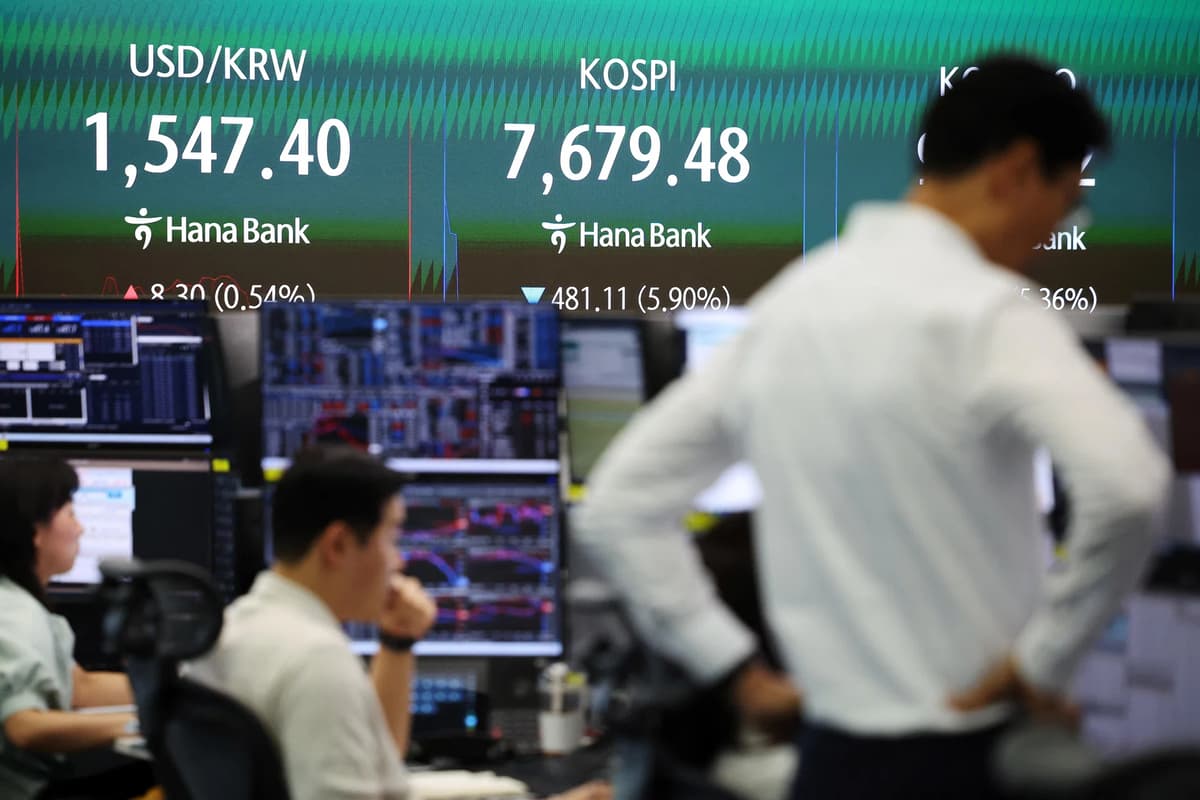
South Korean Shares Post Worst Week Since March on US Tech Selloff
Companies Mentioned

Why It Matters
The episode exposes how Korea’s chip‑centric market is vulnerable to U.S. tech sentiment, while Samsung’s massive capital commitment could reshape the global supply chain and buoy domestic growth.
Key Takeaways
- •Kospi fell 5.81% Friday, 7.1% weekly drop.
- •Samsung and SK Hynix losses drove index, together >50% weight.
- •US tech weakness and AI demand doubts sparked sell‑off.
- •Samsung Group plans $750 bn 10‑year investment, $225 bn for new fabs.
- •Retail bought $5.5 bn, foreign sold $3.5 bn in won.
Pulse Analysis
The KOSPI’s sharp correction this week highlights the fragility of a market heavily weighted toward semiconductors. Circuit breakers were triggered for the fifth time this year, a rare event that underscores heightened volatility. Samsung Electronics and SK Hynix, together accounting for over half of the index, led the decline, pulling the benchmark down 5.81% in a single session. This turbulence follows a year in which the KOSPI doubled in value, positioning South Korea as the world’s top‑performing equity market before the recent pullback.
The slump mirrors a broader retreat in U.S. technology shares, where investors are reassessing the sustainability of AI‑driven spending. Concerns over hyperscaler budgets and a potential slowdown in memory demand have pressured chip makers globally. Analysts note that while the fear may be overstated, the concentration of Korean equities in the semiconductor sector magnifies the impact of any shift in U.S. sentiment. Consequently, both Samsung and SK Hynix saw double‑digit percentage losses, dragging down related stocks such as LG Energy Solution and Hyundai Motor.
Amid the turbulence, Samsung Group’s announced $750 billion investment—about $225 billion earmarked for new chip fabs—signals a long‑term bet on domestic manufacturing capacity. The plan aims to diversify supply chains and reduce reliance on overseas fabs, a strategic move given recent geopolitical strains. Retail investors remained net buyers, injecting roughly $5.5 billion, while foreign holders sold about $3.5 billion, suggesting confidence in the underlying growth narrative despite short‑term volatility. The infusion of capital could reinforce Korea’s position in the global chip ecosystem and provide a buffer against future external shocks.
South Korean shares post worst week since March on US tech selloff
Comments
Want to join the conversation?
Loading comments...