China Passenger Vehicle Export Trends (Jan. - Feb. 2026): BYD Leads in Latin America丨Gasgoo Automotive Research Institute
Companies Mentioned
Why It Matters
The export surge highlights Chinese NEV makers gaining footholds in both mature and emerging markets, reshaping global competition and supply chains. Diversified regional exposure also buffers these firms against policy swings and currency volatility.
Key Takeaways
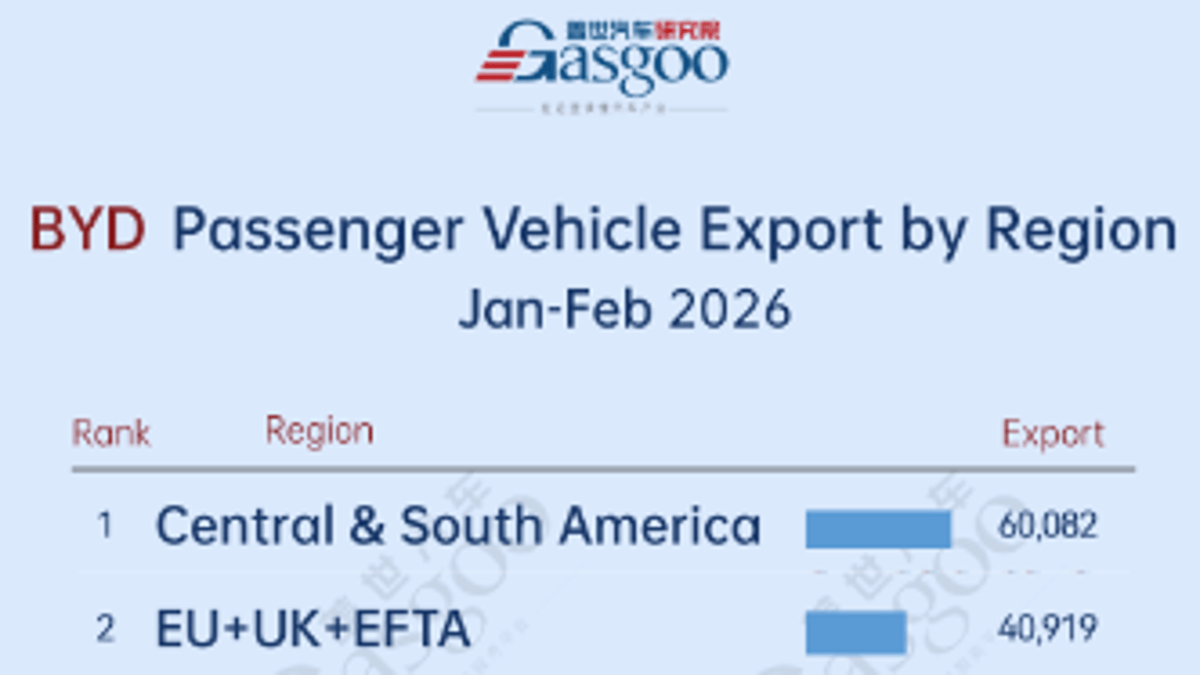
- •BYD exported 60,082 units to Central & South America, its top market.
- •BYD's EU exports fell to 40,919 units, second largest region.
- •Geely led CIS exports with 26,947 units, showing balanced market mix.
- •Chery's EU shipments topped 71,600 units, making Europe its biggest market.
- •All three automakers diversified across emerging regions, mitigating policy and currency risk.
Pulse Analysis
Chinese automakers are rapidly converting their domestic NEV momentum into overseas sales, with the first two months of 2026 delivering a clear signal of strategic maturity. BYD’s export ledger shows a decisive pivot toward Latin America, where supportive local incentives and expanding dealer networks have propelled over 60,000 units across the region. Meanwhile, its European shipments remain strong, reflecting growing consumer acceptance of Chinese electric models in mature markets, even as competition intensifies.
Geely’s balanced export profile underscores a dual‑track approach that blends deep roots in the CIS—its largest single market—with aggressive pushes into the EU and Southeast Asia. Leveraging brand synergies from Volvo and Lynk & Co, Geely is positioning its higher‑end NEVs to capture premium European demand while maintaining volume growth in emerging economies. Chery, by contrast, has vaulted Europe to the top of its export hierarchy, shipping more than 71,000 units, and is cementing a “core + multi‑polar” model that pairs strong performance in mature markets with expanding reach in the Middle East, CIS and Africa.
The broader implication for the global auto industry is a reshaping of competitive dynamics. As Chinese firms diversify across continents, they dilute reliance on any single regulatory environment, forcing legacy manufacturers to accelerate their own electrification roadmaps. Investors and policymakers should watch for continued policy alignment in key regions, as well as potential supply‑chain adjustments driven by the influx of Chinese‑made EVs. The next phase of China’s automotive export surge will likely hinge on sustained innovation, localized production partnerships, and the ability to navigate an increasingly fragmented global market.
China passenger vehicle export trends (Jan. - Feb. 2026): BYD leads in Latin America丨Gasgoo Automotive Research Institute
Comments
Want to join the conversation?
Loading comments...