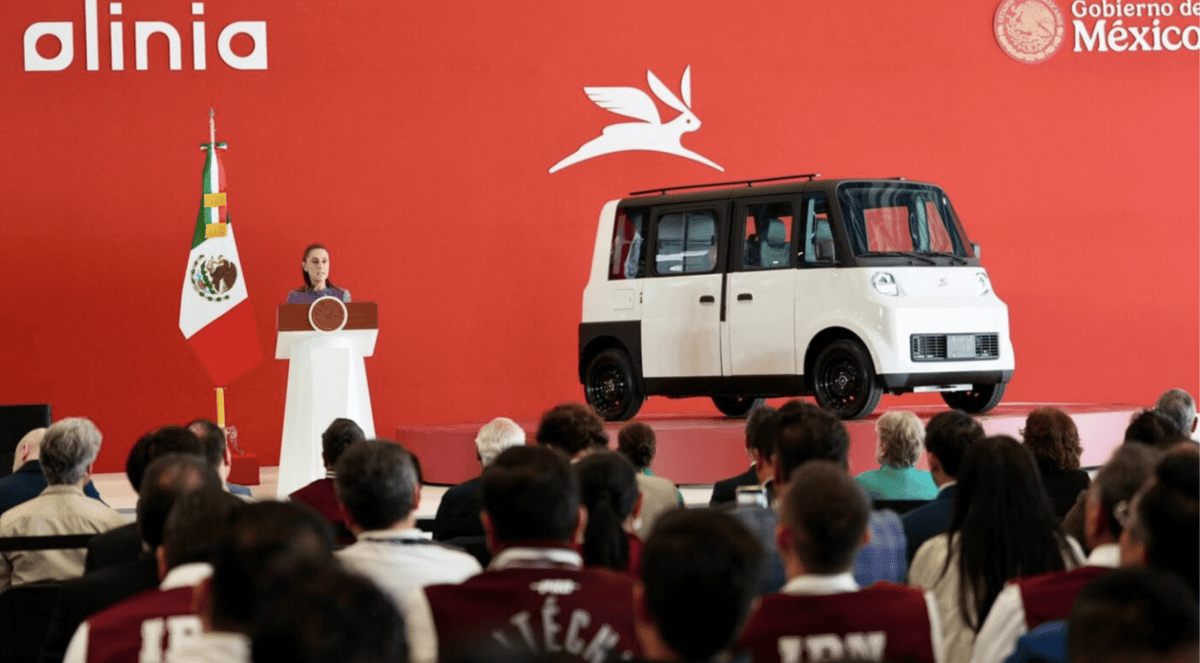
Mexico Unveils State-Backed EV Programme, Debuts Model
Companies Mentioned
Why It Matters
The Olinia project signals Mexico’s shift from a pure assembly hub to an autonomous EV developer, reshaping its trade leverage under USMCA and expanding affordable mobility for its population.
Key Takeaways
- •Olinia Uno priced at MXN 150k (~$8.6k) targeting low‑income buyers.
- •Production plant to start 2026, scaling to 100k units eventually.
- •Vehicle uses 14.7 kWh Li‑FePO4 battery, 125 km range, 50 km/h top speed.
- •Domestic content targets 50% now, 75% by 2030.
- •First‑phase rollout includes 2,000 charging stations in major metro areas.
Pulse Analysis
Mexico’s automotive sector has long been defined by foreign‑owned assembly lines, supplying global brands while generating modest value‑added activity. The USMCA renegotiations, which push for higher North‑American content, have exposed the vulnerability of a model that depends heavily on external technology and supply chains. By launching a state‑backed EV, the government is attempting to capture higher‑margin innovation, build indigenous intellectual property, and create a new export‑ready industry that can negotiate from a position of strength.
The Olinia Uno is deliberately minimalist: a 14.7 kWh lithium‑iron‑phosphate pack, 125 km range, and a 50 km/h speed limit keep costs low enough to price the vehicle at roughly $8,600. Operating expenses of MXN 0.49 per kilometre—far below the MXN 2.40 for comparable gasoline cars—make it attractive for urban commuters and rural workers alike. Compatibility with standard 110 V/220 V outlets and the NACS charging standard, plus wheelchair‑friendly design and IP67 water resistance, address practical needs in Mexico’s dense cities and rainy regions.
Beyond the prototype, the programme’s broader impact hinges on scaling domestic components and infrastructure. A phased plant rollout aims for 20,000 units in 2026, rising to 100,000 as local supplier capacity reaches 75% by 2030, while 2,000 charging stations will be operational by 2027 in Mexico City, the State of Mexico, and Puebla. The involvement of Chinese expertise and the imposition of 50% tariffs on Chinese EV imports illustrate the delicate balance between attracting foreign technology and protecting nascent domestic industry. If successful, the Olinia line could catalyze a homegrown EV ecosystem, lower transportation costs for millions, and shift Mexico’s role in the North American automotive value chain.
Mexico unveils state-backed EV programme, debuts model
Comments
Want to join the conversation?
Loading comments...