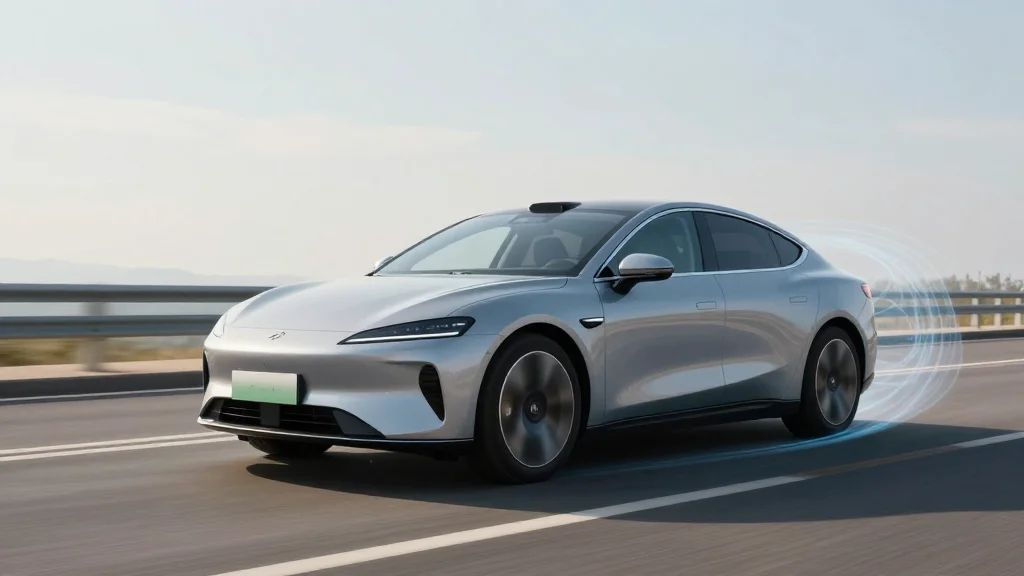
XPENG Unveils X-World Report, Detailing AI Engine Behind VLA 2.0 Autonomous Platform

Companies Mentioned
Why It Matters
The X-World technical report provides the first public, granular view of a generative video‑diffusion engine used for real‑time autonomous driving. By exposing the underlying architecture, XPENG sets a benchmark for simulation fidelity, potentially reshaping how regulators evaluate safety and how OEMs allocate R&D budgets between physical testing and virtual validation. The disclosed multi‑view consistency and long‑sequence generation capabilities could become a de‑facto standard for next‑generation autonomous stacks, influencing both Chinese and global players. Moreover, the report arrives at a moment when Chinese EV makers are under profit pressure and intense competition. Demonstrating a cost‑effective, high‑performance AI backbone helps XPENG differentiate its VLA 2.0 platform from rivals that rely on more conventional perception pipelines. If the world‑model approach scales, it could lower the total cost of ownership for autonomous fleets, accelerating the commercial rollout of robotaxis and advanced driver‑assist systems.
Key Takeaways
- •XPENG released the X-World technical report detailing its generative world model for VLA 2.0.
- •X-World uses video diffusion (WAN 2.2) with a 3D causal autoencoder and DiT denoiser for multi‑view, low‑latency generation.
- •Over 100,000 VLA 2.0 test‑drive participants reported 98% satisfaction and a 44.7% faster purchase decision.
- •XPENG’s CEO He Xiaopeng highlighted the shift toward Physical AI, while VP Jacky Gu warned cost remains the primary competitive factor.
- •Upcoming VLA 2.0 features (Campus and Underground Parking Safari) will stress‑test X-World in low‑light and unmarked‑road scenarios.
Pulse Analysis
XPENG’s decision to publish a deep‑dive technical report is a strategic gamble that could pay off by positioning the company as a thought leader in autonomous‑driving AI. Historically, Chinese OEMs have guarded their perception stacks behind patents, limiting cross‑industry learning. By opening the X-World playbook, XPENG invites peer review, potentially accelerating improvements through community contributions while also staking an early claim on a nascent standard.
From a market perspective, the report arrives as profit margins tighten across the Chinese EV sector. BYD’s recent earnings show a 55% YoY profit drop, prompting investors to scrutinize cost structures. XPENG’s emphasis on simulation‑driven validation directly addresses the high expense of on‑road testing, offering a pathway to maintain safety compliance without inflating R&D spend. If X-World can reliably generate edge‑case scenarios that were previously only observable in costly real‑world miles, XPENG could achieve a competitive cost advantage.
Looking forward, the real test will be whether the world‑model can scale to the complexities of dense urban traffic and diverse weather conditions. The upcoming Campus and Underground Parking Safari modules will be the first public litmus test. Success could trigger a wave of adoption among tier‑1 suppliers and OEMs seeking to augment their own autonomous stacks, while failure may reinforce the industry’s reliance on more conventional sensor‑fusion pipelines. Either way, XPENG’s transparency forces the broader autonomy ecosystem to confront the trade‑off between openness and proprietary advantage, a dynamic that will shape the next five years of self‑driving technology.
XPENG Unveils X-World Report, Detailing AI Engine Behind VLA 2.0 Autonomous Platform
Comments
Want to join the conversation?
Loading comments...