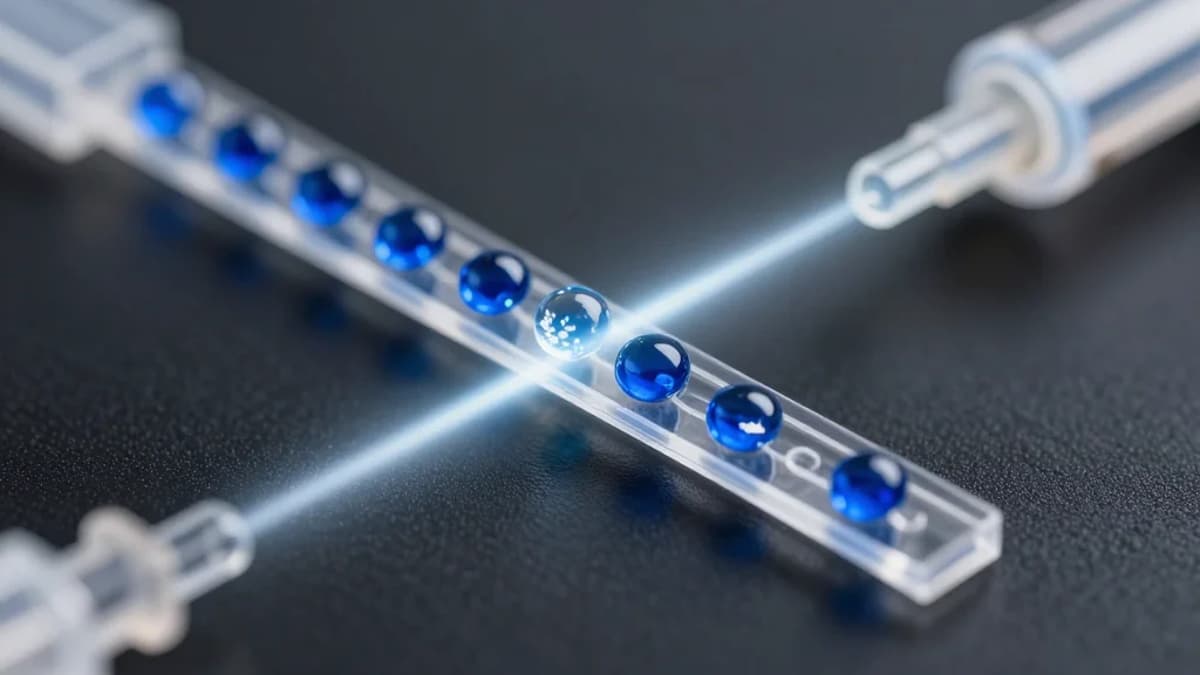
A Smarter Way to Watch Biology at Work: Microfluidic Droplet Injector Drastically Cuts Sample Consumption
•February 5, 2026
0
Why It Matters
Cutting sample waste makes XFEL studies affordable for more labs, unlocking rapid drug‑target validation and enabling research on rare or fragile proteins.
Key Takeaways
- •Droplet injector cuts XFEL sample use by 97%.
- •Synchronizes droplets with femtosecond X‑ray pulses.
- •Enables study of scarce or fragile proteins.
- •Demonstrated on human NQO1 enzyme with NADH binding.
- •3D‑printed injector works with next‑gen XFEL facilities.
Pulse Analysis
X‑ray free‑electron lasers have transformed structural biology by freezing molecular motions in femtosecond snapshots, yet the technique’s high sample demand has limited its reach. Traditional continuous‑flow injectors waste the majority of precious protein crystals, forcing researchers to produce large quantities that many labs cannot afford. The new microfluidic droplet injector addresses this bottleneck by generating discrete, nanoliter‑scale droplets that arrive only when the XFEL pulse fires, slashing consumption without sacrificing resolution.
The injector’s design leverages high‑resolution 3D printing to create intricate channel networks that mix reagents and form droplets on demand. Its timing circuitry synchronizes each droplet with the laser’s pulse train, ensuring optimal hit rates. In a proof‑of‑concept experiment at the European XFEL, the team captured the early binding steps of NADH to the human enzyme NQO1, using 97% less protein than conventional methods. This level of efficiency opens the door to studying low‑abundance targets, unstable complexes, and custom‑engineered enzymes that were previously out of reach.
Beyond the scientific payoff, the technology promises substantial economic and strategic benefits for the biotech and pharmaceutical sectors. Lower sample requirements reduce reagent costs and accelerate iterative drug‑design cycles, while broader accessibility to XFEL capabilities can democratize high‑impact structural studies. As compact XFEL sources move toward commercialization, the droplet injector positions itself as a critical enabling component, potentially reshaping the market for time‑resolved crystallography services and fostering a new wave of rapid, cost‑effective drug discovery.
A smarter way to watch biology at work: Microfluidic droplet injector drastically cuts sample consumption
0
Comments
Want to join the conversation?
Loading comments...