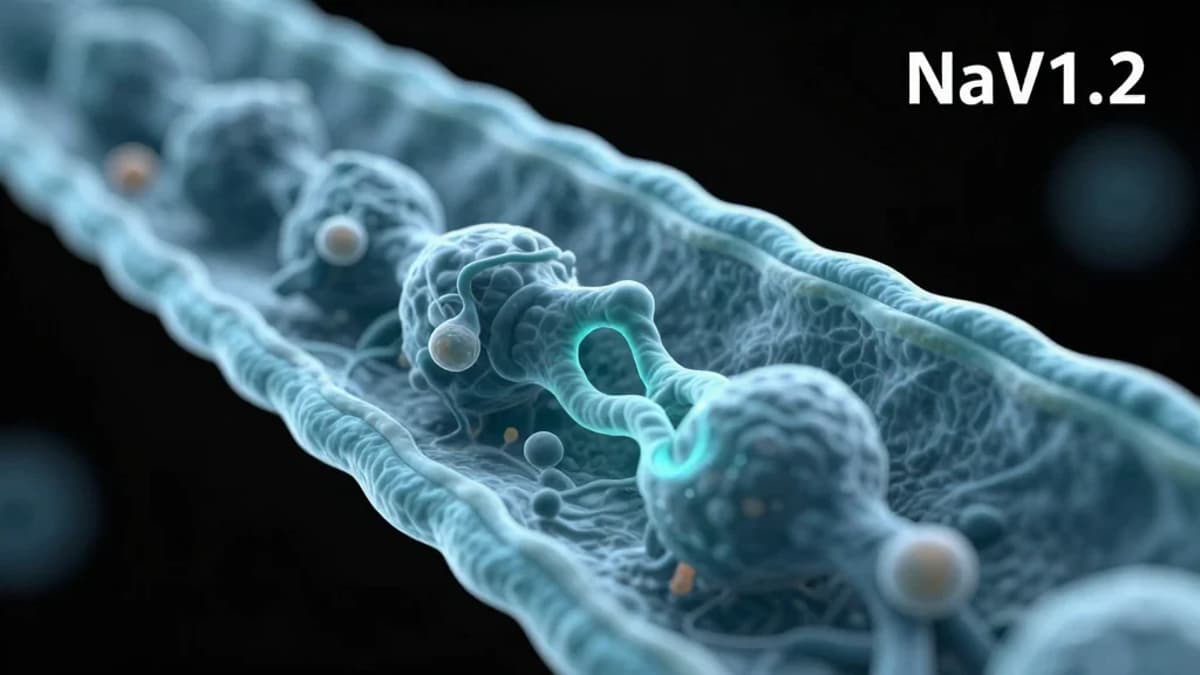
Genetic Variability of Voltage-Gated Sodium Channel NaV1.2
•February 3, 2026
0
Why It Matters
Understanding NaV1.2’s variant‑driven dynamics bridges basic neuroscience with clinical drug design, accelerating personalized treatments for epilepsy, arrhythmias, and related channelopathies.
Key Takeaways
- •NaV1.2 mutations cause epilepsy, arrhythmias, other disorders
- •Cryo‑EM and X‑ray reveal variant‑induced conformational changes
- •PTMs like phosphorylation modulate channel activity
- •Structural insights enable variant‑specific drug design
- •Integrated databases accelerate genotype‑phenotype correlation
Pulse Analysis
Voltage‑gated sodium channels underpin every electrical impulse in the nervous system, and NaV1.2 sits at the heart of cortical signaling. Recent advances in cryo‑electron microscopy and X‑ray crystallography have finally resolved the channel’s four‑domain architecture at atomic detail, exposing how even subtle amino‑acid substitutions can tilt the voltage‑sensor and pore regions. This structural clarity not only refines our biophysical models of action‑potential initiation but also provides a template for comparing NaV1.2 with its cardiac and skeletal‑muscle counterparts, fostering cross‑tissue insights.
Genetic variability emerges as a double‑edged sword: while natural polymorphisms contribute to neuronal diversity, pathogenic mutations disrupt ion flow, precipitating epilepsy, sudden cardiac death, and other channelopathies. The study underscores that post‑translational modifications—phosphorylation, glycosylation, and ubiquitination—add another regulatory layer, dynamically tuning channel kinetics in response to cellular signals. Computational modeling paired with high‑resolution structures predicts how each variant reshapes the activation gate, offering a mechanistic bridge between genotype and clinical phenotype that was previously speculative.
Therapeutically, these revelations open a path toward precision pharmacology. By pinpointing variant‑specific conformational states, drug designers can craft molecules that stabilize the desired open or closed configurations, potentially correcting the functional deficit of a given mutation. Moreover, the authors advocate for a unified, openly accessible database cataloguing NaV1.2 variants, structural impacts, and pharmacological responses. Such a resource would accelerate translational pipelines, enabling clinicians to match patients with tailored anti‑epileptic or anti‑arrhythmic agents based on their unique genetic profile, and fostering collaborative research across genetics, structural biology, and drug development.
Genetic Variability of Voltage-Gated Sodium Channel NaV1.2
0
Comments
Want to join the conversation?
Loading comments...