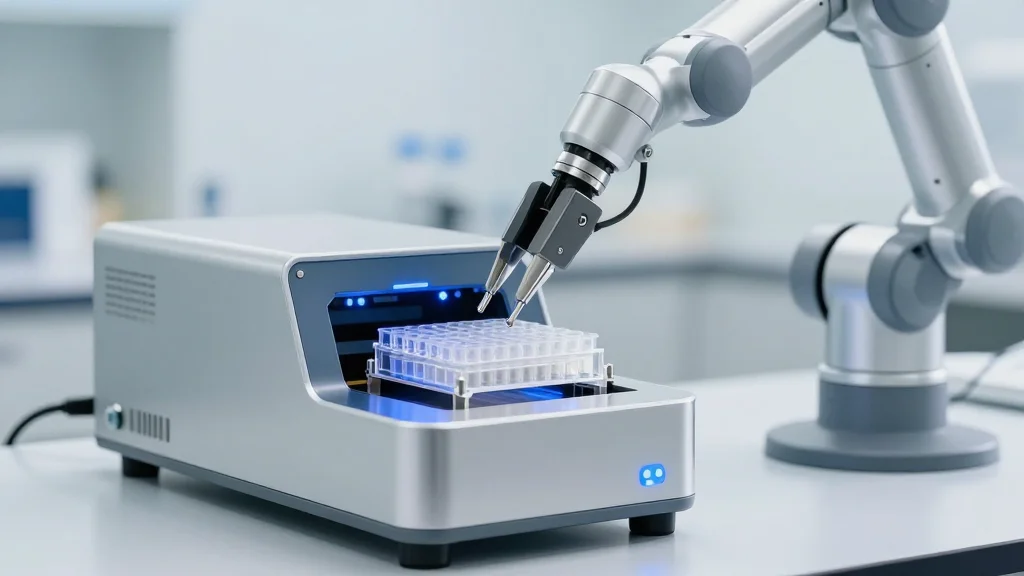
Student-Built System Unlocks Fully Autonomous Electroporation for 96- and 384-Well Workflows
Why It Matters
The automation eliminates manual steps that limited throughput, accelerating research and reducing labor costs. It also shows how student‑driven innovation can close critical gaps in biotech lab automation, paving the way for more autonomous laboratories.
Key Takeaways
- •Students automated Fisher BTX Gemini X2 electroporator for 96/384-well plates
- •Custom software bridge created API for instrument lacking public interface
- •Mechanical enclosure with actuators enables lid release and plate handling
- •Integration allows remote, fully autonomous synthetic biology pipelines
- •Project highlights automation gaps in academic biotech research workflows
Pulse Analysis
Electroporation remains a cornerstone technique for delivering DNA or RNA into cells, yet most commercial systems still rely on manual loading and lid operation. The Fisher BTX Gemini X2, prized for its twin‑wave capability, is widely used in academic and industrial labs, but its lack of an open API and physical automation interfaces creates a throughput bottleneck in high‑density plate formats. As synthetic biology moves toward fully automated pipelines, bridging this gap is essential for scaling experiments and reducing human error.
The UCLA team tackled the problem from both software and hardware angles. Biophysics student Beatrice Mihalache wrote a communication layer that translates the electroporator’s native commands into a format readable by the lab’s Laboratory Automation System, effectively giving the instrument a virtual API. Electrical engineering student Benjamin Flom, with help from his brother, fabricated a custom enclosure equipped with linear actuators to automate lid release, plate insertion, and run initiation. Safety interlocks and real‑time status feedback ensure the system can operate unattended, preserving the instrument’s manual functionality for shared‑use scenarios.
Beyond the immediate efficiency gains, the integration expands access to advanced gene‑delivery capabilities for remote collaborators, allowing experiments to be scheduled and executed without on‑site presence. This model illustrates how relatively low‑cost, student‑led engineering can address unmet automation needs in biotech, encouraging other institutions to replicate similar solutions. As autonomous labs become more prevalent, such innovations will drive faster discovery cycles, lower operational costs, and open new avenues for industrial partnerships in synthetic biology.
Student-built system unlocks fully autonomous electroporation for 96- and 384-well workflows
Comments
Want to join the conversation?
Loading comments...