
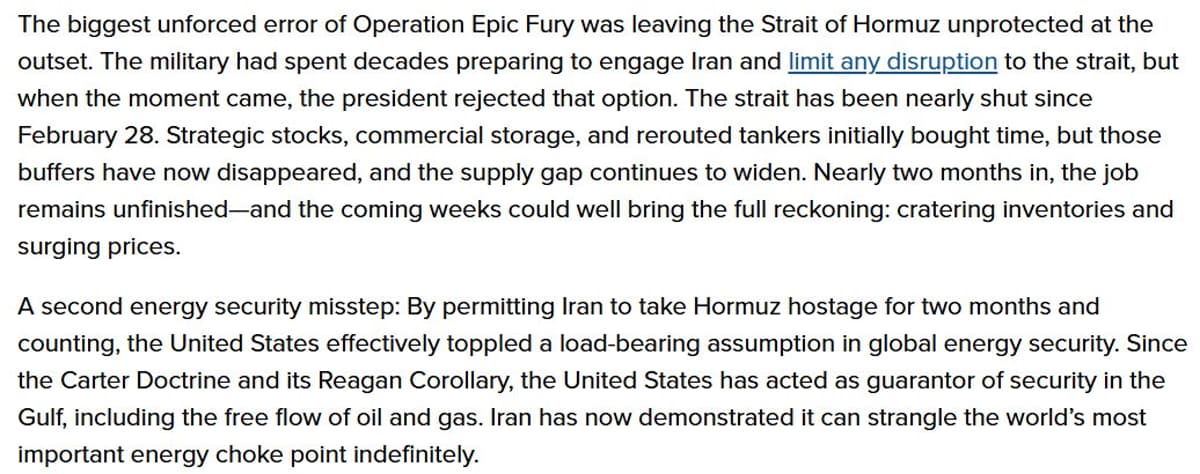
US Prioritization Assumption in Hormuz Conflict Proven Wrong
I agree 100% with @ProfTalmadge and noted this major misstep in my recent @AtlanticCouncil column on the energy security lessons so far from the Iran war. @RapidanEnergy's pre-war modeling of a Hormuz conflict assumed the US military would prioritize targets threatening shipping from day one. Hard to expect otherwise, but that proved to be an incorrect assumption. https://t.co/FG0HaoHKGd
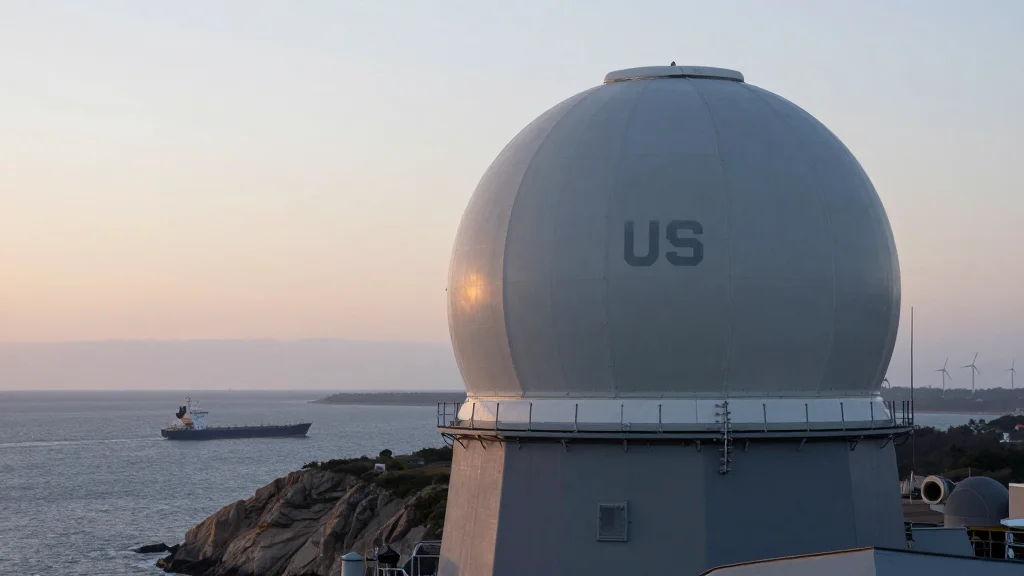
Decades of US Military Prep Face Complex, Slow Countermeasures
The US military has been preparing for decades to take countermeasures, though success would have been neither simple nor quick.
Without Supply Discipline, US Shale Faces Price Collapse
In 2015 OPEC failed to do what swing producers had done since 1932 - cut under a surplus. It allowed a glut to form. In 2020, OPEC+ disunity and ramp to max exacerbated the demand collapse. In both cases...
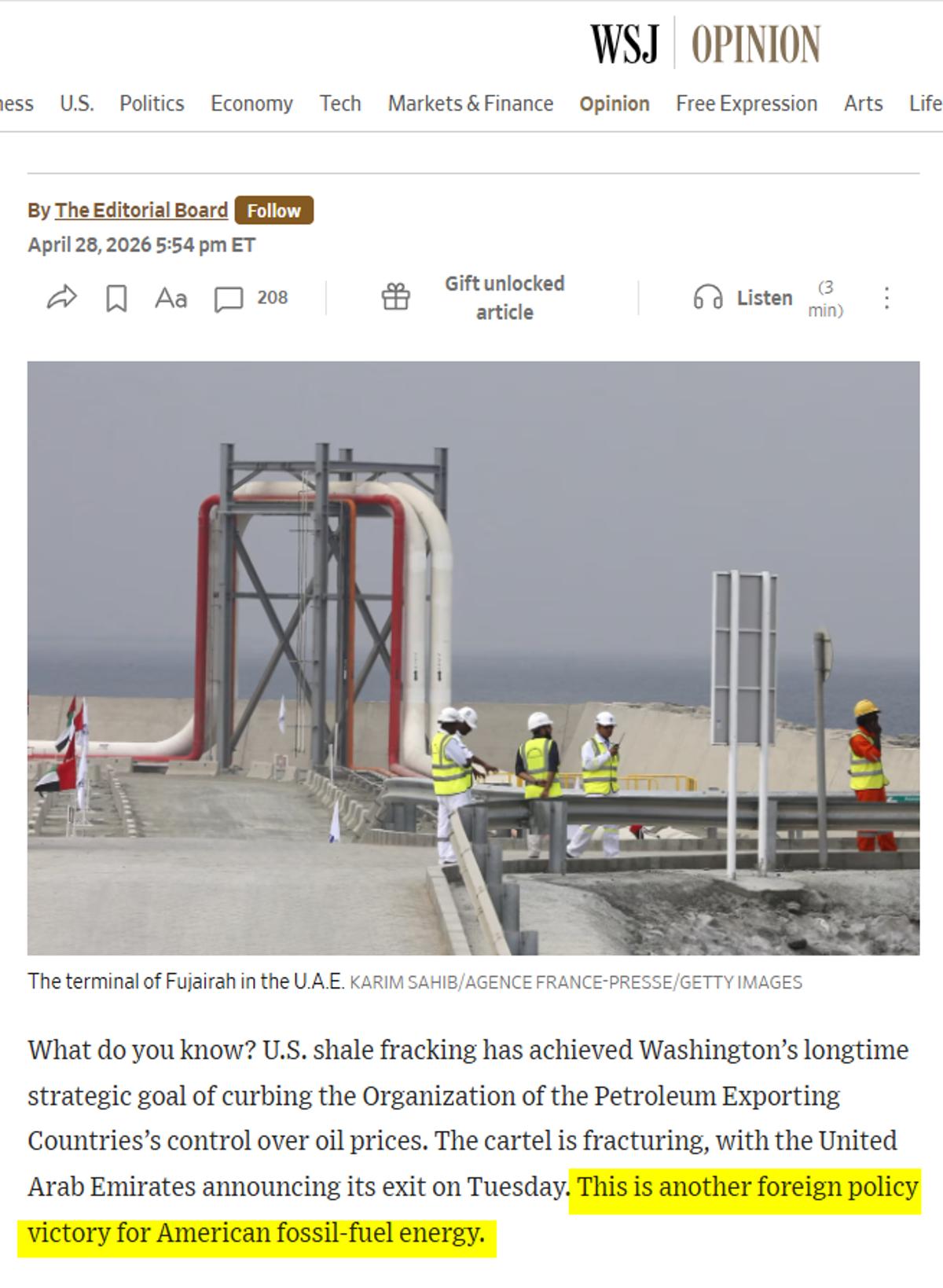
OPEC+ Collapse Threatens US Shale with Price Volatility
Au contraire, @WSJ: A fractured or absent OPEC+ is a disaster for the US oil industry and foreign policy. No OPEC+ = Wild Price Volatility = Gut punch for high-cost US shale oil, the first victim when oversupply...
Analyzing Today’s Major Oil Market and OPEC+ Developments
Thanks @SullyCNBC and @KellyCNBC for having my literal and figurative fellow traveler @CroftHelima and me on @CNBC to unpack today’s big news in oil markets and opec+.
Shale Revolution Made US Energy Arsenal—Preserve It
The shale revolution turned the United States into an Arsenal of Energy™️ and never has one been needed more than now. Let’s keep it that way. https://t.co/N1tkma5zaq
War‑Driven Supply Shock Meets Fading Peak‑Demand, Fueling Post‑Conflict Boom
Gulf War III is far from over. Long-term impacts are très TBD. But it's noteworthy that, just prior to the outbreak, the consensus peak-demand narrative for oil and gas began to crumble. Folks started to realize we're short...
No Policy Can Replace Hormuz Oil Flow Loss
I did not say there's nothing we can do to open the Strait of Hormuz. I said there are no policy options that can offset the loss of flow from the Strait of Hormuz.
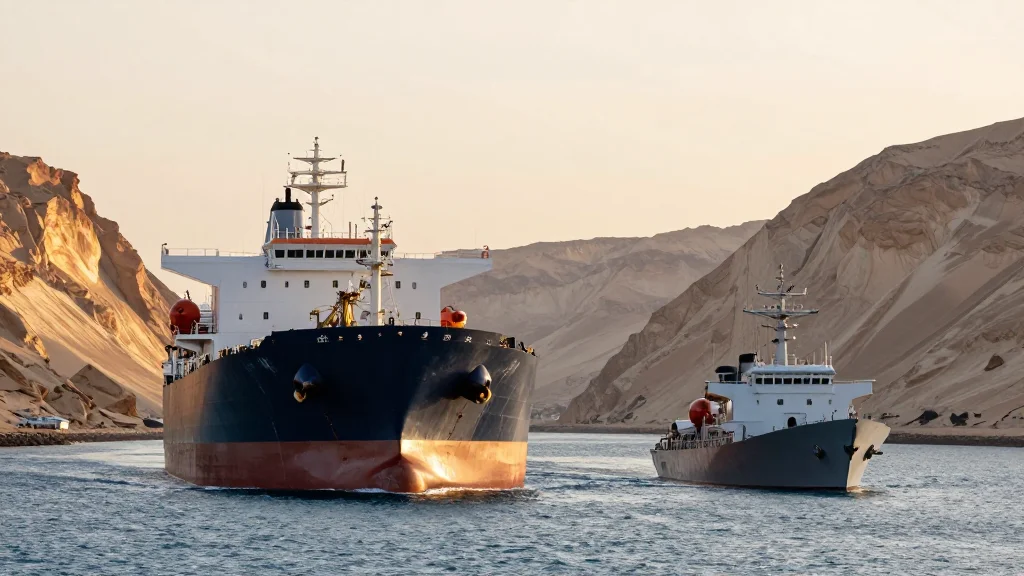
Iran Could Shut Hormuz for Weeks, Experts Warn
So to speak.... “Even the possibility that a hostile power could choke traffic in Hormuz—by far the world’s most vital energy and commodity artery—was considered to be absurd,” McNally told Fortune, largely because it hadn’t happened before. “When I would tell...
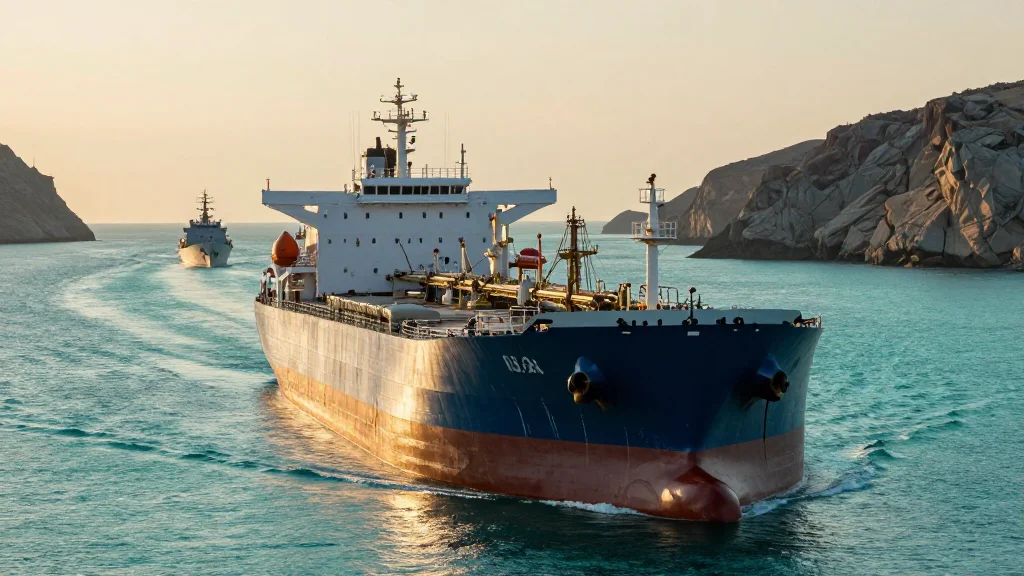
Early Hormuz Closure Modeling Shows Real Risk, Prepares Clients
Not nasty — prescient. Our Battlespace and Barrel Flow report modeled 7- and 30-day Hormuz closure scenarios (among others) in June 2025 because the risk was real and our clients needed to be prepared. No one's enjoying this.

Federal Intervention Shapes Oil Prices Amid Iran Tensions
Thank you @JMathieuReports and @tylerskendall for having me on @business Balance of Power yesterday, just before Secretary Burgum, to talk about oil, Iran, SPR, pump prices, and the federal government intervening in oil futures markets. @RapidanEnergy https://t.co/0RqDeHN4qa

Hormuz Disruption Could Persist for Up to One Month
If Hormuz flows do not resume for a month, that's the worst-case disruption duration my colleagues at @RapidanEnergy and I modeled last June when we mapped out a US-Iran conflict on global oil and LNG markets and prices. We modeled disruption...
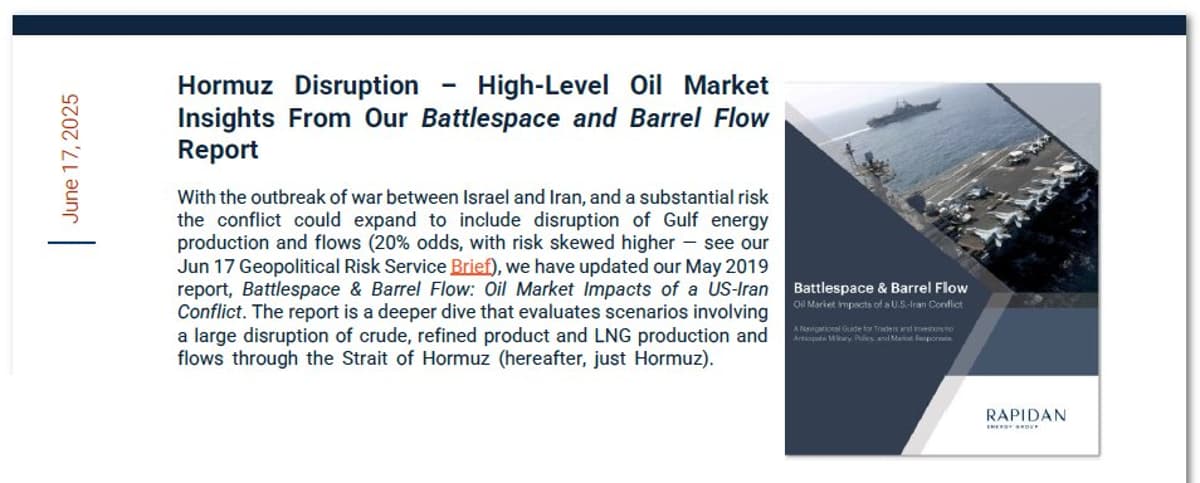
Strait of Horm
US political leaders, the oil industry, and traders are waking up to what we advised clients in June: restoring oil and LNG flow in the Strait of Hormuz won't be quick or easy. A load-bearing assumption in global energy is...
Rapidan Energy Hosts Iran Risk Update for Clients
Well attended @RapidanEnergy Iran update huddle this morning for our Geopolitical Risk Service clients. If you're managing risk in energy and macro markets and don't know us yet, this might be a good time to become acquainted. info@rapidanenergy.com. https://t.co/qRL4heI0Si
WWII U.S. Spare Capacity Went Negative, Oil Overproduced
For the history enthusiasts like my friend @Andrewtabler: During WWII US spare capacity actually went negative. In 1944, the oil industry pushed the fields beyond MSC to produce fuel for the final major offensives in the Pacific and Atlantic.