

How to Build a $10M Business with AI (Zero Employees)
The video outlines a framework for building a multi‑million‑dollar business using AI without hiring staff, emphasizing that AI must be treated as a workhorse rather than a novelty. The speaker stresses pinpointing the single bottleneck in the attention‑lead‑sale‑delivery‑retention chain, then deploying AI tools—prospecting, qualification, personalized outreach, follow‑up, and upsell—to eliminate that choke point. Real‑world examples include YourAtlas’s call‑booking automation and the “Get Revieo” lead‑scoring system. He demonstrates the “10‑80‑10” execution model: 10% ideation with AI, 80% AI‑driven execution, and 10% human integration. Recording tasks, feeding transcripts to AI, and iterating until the model handles most work is presented as a repeatable method. The implication is that founders who automate the entire sales and delivery pipeline can scale to $10 M+ revenues while reducing headcount, but they must also automate their own role or risk being displaced. Early adopters gain a decisive competitive edge before the AI talent pool saturates.
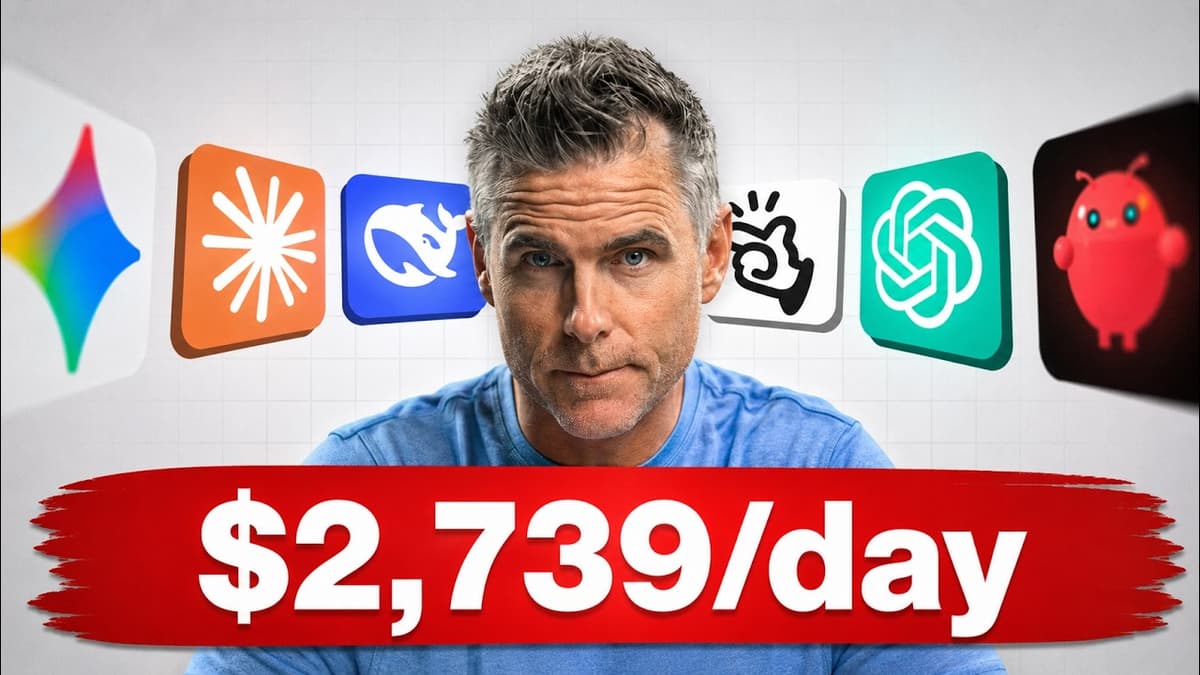
The Only AI Tools You’ll Ever Need to Get Rich in 2026
The video presents a tiered ranking of AI tools that entrepreneurs and enterprises can leverage to boost earnings in 2026. The host, running an AI venture studio, evaluates each tool on the ratio of input costs—time, money, effort—to the financial...

99% of People Have No Idea What’s About to Happen With AI
The video argues that the coming AI wave will dwarf the internet, smartphones and Bitcoin, and it breaks the evolution into three distinct levels. Level 1 treats AI as a smart assistant that speeds up tasks like writing, research, and design,...

Why I’m Going ALL IN on AI in 2026 (and You Should Too)
The speaker announces a personal commitment to go “all‑in” on artificial intelligence in 2026, using the platform Martell Ventures to build an AI‑focused venture studio that aims to generate $25 billion in enterprise value. He argues that AI will disrupt every industry...

Everything I Learned From Being Around the Top 0.01%
The video distills lessons learned from interacting with the top 0.01% of billionaires, framing them as operating‑system updates that let entrepreneurs escape the conventional “school‑job‑retire” script. It outlines five “buckets”: deleting old mental software (breaking rules, first‑principles thinking), installing new software...

If I Wanted to Build a $10M AI Business (Zero Employees), I'd Do This
SaaS entrepreneur Dan Martell outlines a six-step blueprint for building a $10M (or larger) AI-powered business run by a single operator using AI agents. His method emphasizes starting with a painful, growing market problem, interviewing at least 10 customers for...

The Most Powerful AI Agent I’ve Ever Used in My Life
The video introduces "agentic AI," a new class of AI agents that can autonomously execute multi‑step workflows, unlike static chat models such as ChatGPT. Dan Martell demonstrates how to select the right agentic tools—including Claude, Gemini, Zapier, Make, Manus, and...

The Most In-Demand AI Services Businesses Will Pay For in 2026
In 2026 AI will be treated as core infrastructure rather than a novelty feature, with businesses paying for services that deliver measurable outcomes. The most lucrative services attach to high‑cost pain points such as time waste, revenue generation, risk mitigation,...

How to Get Dangerously Good at AI in 99 Seconds With Better Prompts
The post argues that AI’s value hinges on how users prompt it, not on model sophistication. It introduces a four‑part prompt framework—role, context, command, format—that transforms vague queries into actionable outputs. The author also recommends system prompts and a personal...

How to Keep Customers Without Lowering Your Prices: A 7-Step Retention System
The article presents a seven‑step system for retaining customers without resorting to price cuts. It argues that churn stems from delayed value, confusion, and poor usage rather than cost, and outlines concrete actions such as capturing cancellation reasons, accelerating time‑to‑first‑value,...

Simple Strategies Win; Complex Decks Signal Trouble
If your strategy fits on a napkin, it's probably good. If it needs a 40-slide deck, it's probably broken.

If I Had To Start an AI Business From Scratch, I'd Do This
The video outlines a seven‑step playbook for launching an AI startup from zero capital or code, emphasizing that founders must begin with a validated pain point rather than a flashy idea. Dan stresses that real revenue comes from solving problems...

Simplicity Drives Growth; Complexity Taxes Success
You win by keeping it simple: Simple offer. Simple messaging. Simple sales process. Complexity is a tax on growth.

Better Prompts Save Founders Ten Hours Weekly
Most founders are one great prompt away from 10 hours back per week. Learn to ask better questions.

Feedback Turns Years of Trial Into Five Conversations
Feedback can compress 5 years of trial and error into 5 conversations. Not asking for it is just ego.