
Build An Unstoppable Trading Mindset (Mandi Pour Rafsendjani)
The video features trading psychologist Mandi Pour Rafsendjani discussing why skilled traders often freeze or act impulsively despite recognizing perfect setups. She argues that the obstacle is not lack of knowledge but deep‑seated unconscious beliefs formed in childhood, which manifest as hyper‑vigilance, a need for control, or fear of authority. Key insights include the limits of AI‑driven coaching, which can only provide surface‑level action prompts, whereas human coaches can probe a trader’s internal representations—sensory cues, feelings, and self‑talk—to reveal hidden motivations. Mandi illustrates this with case studies: a mother‑trader who entered trades while still in “emotional mother mode” and a high‑net‑worth trader whose excessive need for control stemmed from an uncertain upbringing. She emphasizes practical techniques such as creating pre‑trade rituals that shift the brain from emotional to rational processing, and using neurolinguistic programming to map and reframe internal strategies. By surfacing the subconscious narrative—e.g., “I’ll fail if I follow instructions”—coaches can replace self‑sabotaging scripts with confidence‑building habits. The implications are clear: traders who invest in deep psychological work can achieve more consistent performance than those relying solely on algorithmic signals or generic AI advice. Understanding and reshaping the unconscious drivers of behavior offers a sustainable edge in a market increasingly saturated with technology.
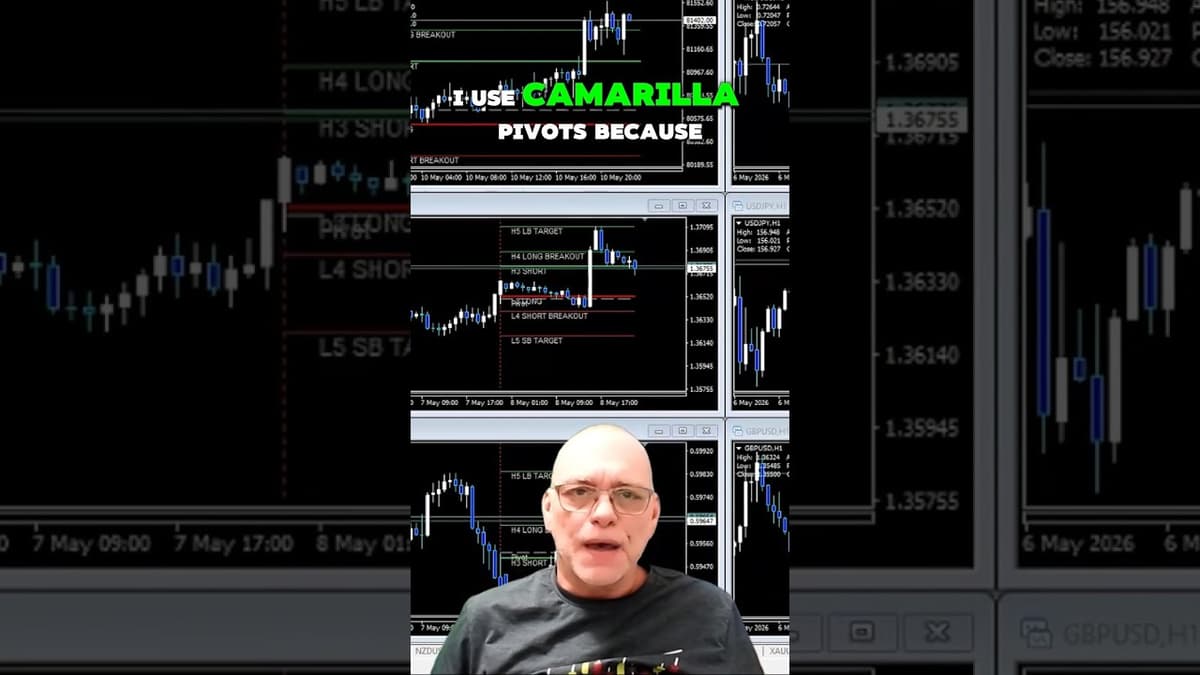
How I Trade Pivot Points Profitably: My Proven Strategy
The video walks viewers through a proven intraday strategy built around Camarilla pivot levels, explaining how each point—H3, L3, H4, L4, H5 and L5—serves a specific trading purpose. The presenter stresses that the pivot itself sets the market bias (short at...
Behind The Scenes at TradingView (Rauan Khassan)
The podcast offers a behind‑the‑scenes look at TradingView with Chief Growth Officer Rohan Khassan, covering the platform’s strategic focus, community‑driven development, and upcoming product initiatives. TradingView’s roadmap is dictated by user demand: features such as decentralized trading have been shelved due...
Define Your Goals This Way To Succeed
The video urges aspiring traders to stop chasing undefined “more money” and instead map out exactly what a richer life looks like. It argues that without quantifying goals—such as the cost of a desired car, travel destinations, or supporting friends—new entrants...
How He Builds Fully-Automated Trading Strategies (Martyn Tinsley)
Martyn Tinsley returns to discuss how he builds fully‑automated trading strategies, focusing on two major advances since his 2022 interview: a novel optimization methodology for classical algorithmic trading and a live reinforcement‑learning AI model that executes trades. He explains that eliminating...

Trading With Vs. Without Indicators: The Reality?
The video pits technical indicators against pure price‑action trading, featuring a full‑time scalper who has used both approaches. He explains why the debate isn’t about a single “best” tool but about fitting a method to one’s mindset and execution style. He...

Trading Psychology of the Best Traders in the World (Brett Steenbarger)
In this interview, clinical psychologist Brett Steenbarger explains how positive‑psychology principles translate into superior trading performance. He defines "psychological wealth" as a blend of joy, purpose, meaningful connections, and physical vitality, arguing that this well‑being expands a trader’s cognitive openness...

This ONE Indicator Made Me A Profitable Trader
The video introduces a proprietary market‑context indicator that the presenter credits with turning his systematic trading from erratic to consistently profitable. The tool condenses three core market‑context variables—trend direction, relative volatility and market noise—into a single dashboard that flashes a green...

I Went From Taxi Driver To Full-Time Day Trader (Kevin Hunt)
Kevin Hunt’s story, told from his Bangkok office, charts a dramatic shift from a London taxi driver and failed entrepreneur to a full‑time day trader and coach at Desire2Trade. After losing his business and a partner, he rebuilt his finances...

My Simple Strategy To Trade The News In Forex
The video explains a disciplined approach to trading "red" news events in the forex market, emphasizing that volatility and rapid price swings require a methodical strategy rather than speculation. Key insights include anchoring the trade range to the Tokyo open, watching...

Day Trading 15min Chart on AUD/USD
The video walks viewers through a live day‑trading setup on the AUD/USD pair, focusing exclusively on 15‑minute candles to capture short‑term momentum. The trader notes that the pair has been trending lower since the Asian session high, with roughly 26 pips still...

I’m A Full-Time Scalper. Here’s My Risk Management
Jean‑François Boucher, a full‑time forex scalper, explains why limiting risk management to a single “risk per trade” metric is insufficient. He outlines a three‑level framework that controls exposure at the trade, daily, and account levels, allowing him to capture small,...
From Journalist To Full-Time Trader: How I Did It (Glen Goodman)
Glen Goodman, a former BBC and ITV business correspondent, recounts his evolution from reporting on markets to trading them full‑time. After two decades in journalism, he leveraged his economic insight to experiment with stocks during the dot‑com boom, eventually discovering...

Scalping Trading Psychology Lessons
The video features full‑time scalper Jean‑François Boucher sharing five psychology‑focused lessons for high‑frequency traders. He argues that a trader’s edge stems more from mastering the nervous system than from perfecting chart patterns, and he outlines concrete habits to tighten that...
Indicators Didn’t Work For My Trading
A trader recounts how adopting the KISS (Keep It Simple Stupid) principle transformed his approach: he cleared cluttered charts of nonessential indicators and now uses only a minimal set that he actually needs. The simplification eliminated information overload, reduced false...