
Recent Posts
Video•Mar 1, 2026
Is Moscow Planning to Help Their Longtime Ally Iran in This Crisis? | DW News
DW News examined Russia’s diplomatic response after US and Israeli air strikes killed Iran’s Supreme Leader Ayatollah Khamenei, with President Vladimir Putin issuing a statement condemning the attacks as a violation of international law and offering condolences. The discussion highlighted that while Moscow touts a “comprehensive strategic partnership” with Tehran, the agreement stops short of a mutual‑defence clause. Russia lacks the capacity and political will to deploy ground forces or deliver advanced air‑defence systems to Iran, and any assistance would be limited to intelligence sharing, space‑launch cooperation and ISR assets. Expert Nicole Graveski noted that Russia’s support has largely shifted to technology transfer, such as the indigenisation of Iranian‑origin UAVs used in Ukraine, and that past engagements in Syria and Venezuela illustrate Moscow’s pattern of backing allied regimes without formal defence guarantees. Consequently, Tehran can count on political backing but not substantive military aid, constraining its options amid internal turmoil. For Russia, the episode underscores both the limits of its influence over allied states and the need to sustain its own war effort in Ukraine without relying on Iranian hardware.
By DW News (Deutsche Welle)
Video•Feb 28, 2026
Why Closing the Strait of Hormuz Could Have Devastating Effects on Global Oil Shipping | DW News
The DW News segment focuses on Iran’s Revolutionary Guard warning that no vessel may transit the Strait of Hormuz, a chokepoint through which roughly one‑fifth of the world’s crude oil passes. The announcement comes amid heightened military tension and a...
By DW News (Deutsche Welle)
Video•Feb 26, 2026
What Happens if the US-Iran Talks End without a Deal? | DW News
The United States and Iran resumed indirect negotiations in Geneva over Tehran's nuclear program, a session framed as the last diplomatic chance to avoid further U.S. military action. President Donald Trump has reiterated his belief that Iran seeks a nuclear...
By DW News (Deutsche Welle)
Video•Feb 26, 2026
Germany Greenlights Controversial Peter Thiel Backed Drone Deal | DW News
German lawmakers have approved a contract to purchase combat drones from a Peter Thiel‑backed startup, despite vocal opposition from several parties. The deal, valued in the low‑hundreds of millions of euros, aims to equip the Bundeswehr with advanced unmanned‑air capabilities. It...
By DW News (Deutsche Welle)

Video•Feb 26, 2026
'China Does Not Often Change Course' | DW News
German Chancellor Friedrich Merz concluded a two‑day visit to Beijing aimed at strengthening long‑standing economic ties between Germany and China. While praising cooperation, Merz urged Chinese officials to address what he described as unfair trade practices affecting German firms. The...
By DW News (Deutsche Welle)

Video•Feb 26, 2026
How Eco‑friendly Are Canals? | DW News
Canals remain vital to global trade, moving billions of tons of cargo annually, but their construction and operation can disrupt ecosystems and generate emissions. Recent studies highlight the need for smarter, greener canal designs that mitigate habitat loss and reduce...
By DW News (Deutsche Welle)
Video•Feb 26, 2026
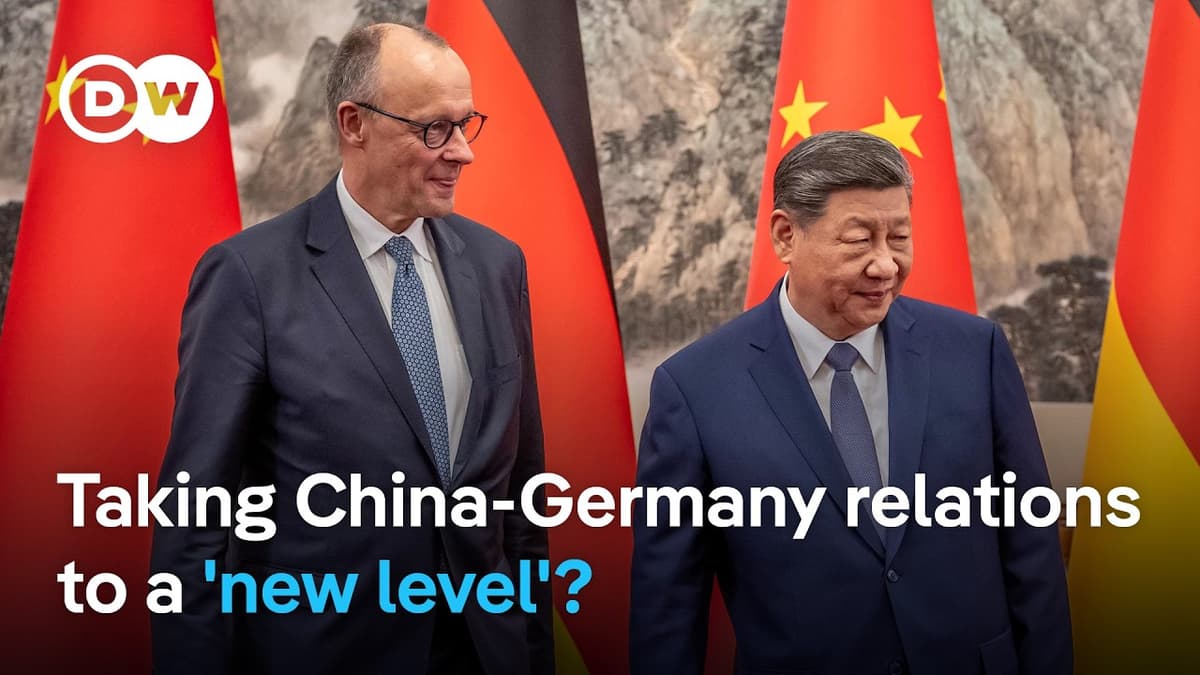
What Does Germany's Friedrich Merz Want From China During His Trip? | DW News
German leader Friedrich Merz began the second day of his inaugural state visit to China, where President Xi Jinping pledged to elevate bilateral ties to a "new level." During the talks, Merz announced that China has agreed to purchase up...
By DW News (Deutsche Welle)