How Ego Uses Difference to Survive
The video titled “How ego uses difference to survive” argues that the ego’s sense of self is fundamentally built on contrast with others. Using a thought experiment where everyone shares the same race or even the same color, the speaker illustrates how identity categories evaporate when there is no “other” to define them. The central insight is that the ego needs differentiation to survive; without perceived differences, concepts like race, gender, or even color lose linguistic and psychological relevance. The mind invents distinctions to maintain a sense of separateness, which fuels personal and collective identity. A striking line underscores the point: “If every person were green, you wouldn’t have a word for green because there’s no differentiation.” This example shows that language itself is shaped by contrast, and the ego clings to such constructs to justify its existence. Recognizing this mechanism has practical implications: it can deflate identity‑based conflict, encourage more inclusive thinking, and help leaders design cultures that emphasize common humanity over arbitrary divisions.
What Most Humans Spend an Entire Lifetime Never Discovering | Eckhart Tolle
In this short lecture, Eckhart Tolle reminds viewers that most people spend their lives identifying solely with their physical bodies, thoughts and emotions, never discovering the deeper consciousness that underlies them. He explains that the body, the thinking mind, and the...
How Culture Quietly Conditions Every Thought You Believe Is Yours | Eckhart Tolle
In this talk, Eckhart Tolle argues that the mind‑made sense of self is a curse that obscures clear thinking. He explains that culture conditions the subconscious narratives we mistake for our own thoughts, turning thinking into a vehicle of possession...
Not Knowing Is the Beginning of True Wisdom | Eckhart Tolle
In the talk, Eckhart Tolle argues that true wisdom begins with the willingness to admit ignorance. He revisits Socrates’ claim of being the wisest because he knows nothing, framing "not‑knowing" as a state of pure awareness rather than intellectual emptiness. Tolle...
Even 20 Years From Now This Moment Will Be Live | Eckhart Tolle
In this brief guided meditation, Eckhart Tolle reiterates his core teaching that the only true reality is the present moment, which he calls “the now.” He frames the video as a live‑stream that will remain “live” even decades later, underscoring...
The Secret Element that Makes Love Last | Eckhart Tolle
The video explores what Eckhart Tolle calls the “secret element” that makes love endure – a transcendent, spacious dimension that goes beyond sex, emotion, and intellect. Tolle argues that physical attraction wanes, emotional love oscillates between affection and resentment, and mental...
Why You Can’t Feel Happy for Long | Eckhart Tolle
In a recent talk, spiritual teacher Eckhart Tolle argues that the fleeting nature of happiness stems from the mind’s dominance over identity. He defines the unconscious state as complete identification with incessant thought, which he says most people experience daily. Tolle...
The Real Reason Your Life Feels Incomplete | Eckhart Tolle
Eckhart Tolle argues that the pervasive sense of life’s incompleteness stems from identifying oneself solely with a personal narrative. When the ego constructs a story of "me"—filled with expectations, failures, and possessions—it creates a fragile self that constantly seeks validation...
Who Are You Without Your Past | Eckhart Tolle
In the clip, Eckhart Tolle poses a probing question: what remains of you when you strip away every memory of past and every projection of future? He suggests that the sense of self is not a story but a living...
What Awakening Actually Does to Your Mind | Eckhart Tolle
In the clip, Eckhart Tolle explains that spiritual awakening does not silence the mind but shifts the relationship to thought, turning thinking from an unconscious driver into a witnessed process. He argues most people assume “I think” denotes a voluntary act,...

The Quiet Crisis Beneath the Surface of Modern Life | Eckhart Tolle
Eckhart Tolle warns of a quiet mental‑health crisis, noting that 23 % of U.S. college students were prescribed antidepressants last year. He ties the surge to pervasive digital distraction, arguing that constant device use fragments attention and saps vital energy. Tolle distinguishes...
You Don't Need 23 More Lifetimes | Eckhart Tolle
The video features spiritual teacher Eckhart Tolle unpacking the nature of thought, emotion and consciousness, arguing that thoughts are invisible energy patterns rather than tangible brain structures. He challenges conventional scientific explanations and Buddhist doctrines that prescribe dozens of lifetimes...
The Awareness That Ends Unhappiness
The video centers on a simple yet profound practice: cultivating awareness to dissolve unhappiness. It argues that the mind’s habitual narratives and the body’s emotional signals are the true sources of distress, not external events. By deliberately observing thoughts without trying...
How to Recognize You Are in the Dark Night of the Soul | Eckhart Tolle
Eckhart Tolle’s talk dissects the "dark night of the soul," describing it as a profound emotional state marked by dread, alienation, and a sense that everything feels meaningless. He distinguishes the experience on two levels: an emotional layer where the...
When Everything Falls Apart, Something Deeper Awakens | Eckhart Tolle
Eckhart Tolle’s talk explores the "dark night of the soul," a profound psychological state that surfaces when personal or collective suffering erodes long‑held narratives of meaning. He traces the phenomenon from its religious roots—where loss of faith in an omnipotent...
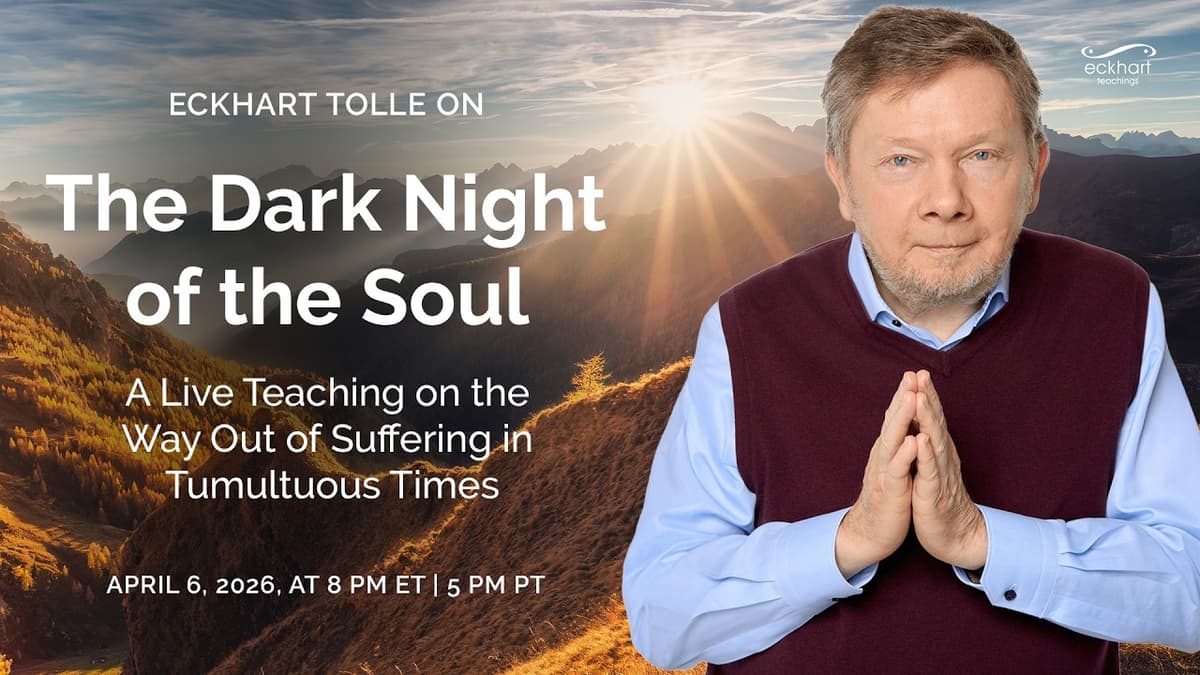
Eckhart Tolle LIVE on The Dark Night of the Soul: The Way Out of Suffering in Tumultuous Times
The live session, hosted by Tammy Simon of Sounds True, features Eckhart Tolle discussing the “dark night of the soul” and announcing a new six‑week online program that begins April 9. Tolle defines the dark night as prolonged, deep‑seated suffering that extends...
The Secret of Awakening From Suffering | Eckhart Tolle
In this short lecture, Eckhart Tolle argues that the root of human suffering is the exclusive identification with the mental story we call ‘human.’ He contrasts waiting for a ‘dark night of the soul’ with an immediate practice of shifting...

How Accepting Death Changes Everything | Eckhart Tolle
In this talk, Eckhart Tolle argues that confronting death is the catalyst for profound inner transformation, urging listeners to view mortality not as a threat but as a doorway to a reality beyond form. He highlights the ancient practice of memento...

Presence in Life's Final Chapter | Eckhart Tolle Foundation
The Eckhart Tolle Foundation video explores the final chapter of life, arguing that true freedom from death anxiety arises when we recognize our essential nature as pure consciousness rather than a story‑laden self. Tolle invites viewers to suspend their personal...

Where Do Your Thoughts Actually Come From | Eckhart Tolle
Eckhart Tolle’s talk explores the elusive source of human thought, arguing that each mind is a fragment of a single, universal consciousness that gives rise to the perceived world. He challenges the mainstream scientific narrative that treats consciousness as a...

The Truth About Meditation No One Tells You | Eckhart Tolle
Eckhart Tolle’s talk challenges the conventional view of meditation as a scheduled, goal‑oriented exercise, arguing that the very act of allocating time to “do” meditation reinforces the mental constructs it seeks to dissolve. He frames genuine meditation as the direct...

The Power of Quiet Presence
The video introduces the concept of a “frequency holder” – an individual who finds purpose in modest, everyday work performed with full attention, rather than chasing grand ventures or titles. It reframes success as the ability to sustain presence, love,...

The Secret to True Healing (It’s Not What You Think) | Eckhart Tolle
The video centers on Eckhart Tolle’s assertion that genuine healing and effective counseling arise from embodying presence rather than accumulating theoretical knowledge. He introduces the notion of a “frequency holder”—someone who works quietly, with care and awareness, and whose calm...

The Moment You Discover Your True Being | Eckhart Tolle
The video features Eckhart Tolle guiding viewers toward the discovery of their true being, emphasizing the distinction between the conditioned personality—the "surface eye"—and the deeper, non‑dual consciousness he calls the "deep eye." He frames the experience as moving from identification...

Why Your Mind Is Holding You Back | Eckhart Tolle
Eckhart Tolle’s talk explores how the mind can become a prison when thoughts lodge and form a false self‑image. He argues that every thought is an energetic entity; the ones that linger create the identity we mistake for our true...

The Illusion of “My Body”
The video explores the psychological construct that we identify not with our physical form but with the mental label “my body.” It argues that this label creates an illusion of ownership, turning a transient vessel into a source of self‑esteem...

Why the Person You Think You Are Is Invisible
The video tackles a philosophical‑scientific question: where, if anywhere, does the "person" reside? It argues that while our bodies are observable, the psychological self—our identity, memories, and consciousness—remains invisible and cannot be pinpointed within the brain’s physical tissue. The speaker illustrates...

Most People Never Truly Wake Up in Life | Eckhart Tolle
Eckhart Tolle’s talk centers on the distinction between the visible, bodily self and an invisible, multidimensional consciousness that underlies it. He argues that what we call the "person" – the ego, memories, and mental narratives – is merely a surface...
The Illusion Behind the Words “My Life” | Eckhart Tolle
In this brief talk, spiritual teacher Eckhart Tolle examines the seemingly innocuous phrase “my life,” arguing that the very grammar of ownership implants a dualistic split between the speaker and existence. Tolle explains that the word “my” creates a mental picture...
Eckhart Tolle on Why Achieving Your Goal Is Not the Point
Eckhart Tolle argues that the true purpose of any endeavor is not the achievement of a predefined goal but the cultivation of presence in every action. He illustrates this with the example of aspiring actors moving to Los Angeles: many...

The Real Measure of Success in Life
The video argues that the true measure of success lies in one’s state of presence, not in titles or external achievements. It juxtaposes a mindful gardener with a CEO lost in ego, illustrating that consciousness behind the act determines fulfillment. The...
It Doesn’t Matter What You Do, But This Does... | Eckhart Tolle
In a recent talk titled “It Doesn’t Matter What You Do, But This Does…,” spiritual teacher Eckhart Tolle argues that the quality of consciousness behind an action, not the action’s external status, determines true success. He contrasts a mindful gardener...

The Story in Your Head Is Not Your Life
The video argues that the story we tell ourselves about "my life" is a mental construct, not the lived reality. It suggests that many people remain spiritually asleep, trapped in a self‑critical narrative that fuels feelings of pointlessness. The speaker explains...
The Story in Your Head Is Not Your Life | Eckhart Tolle
In a recent video, spiritual teacher Eckhart Tolle argues that the narrative most people call “my life” is merely a mental construct, not the reality of existence. He frames the discussion as an invitation to recognize an ongoing awakening process...