
Recent Posts
Video•Feb 19, 2026
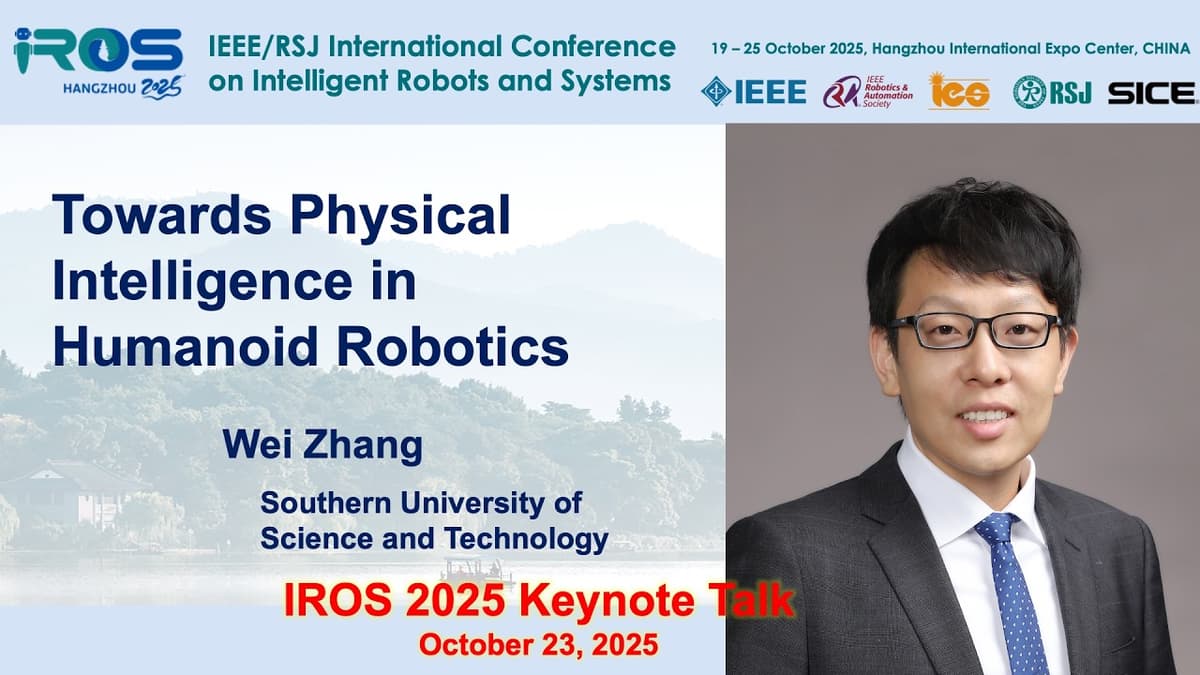
IROS 2025 Keynotes - Humanoid Robot Systems: Wei Zhang
Wei Zhang’s IROS 2025 keynote focused on the evolution of humanoid robot systems and introduced his company, Limax Dynamics, as a catalyst for practical, research‑grade platforms. Drawing on his background as a control theorist turned robotics entrepreneur, Zhang outlined the shift from pure theoretical models to data‑driven reinforcement learning (RL) pipelines, coining the term “humanoid physical intelligence.” He highlighted Limax’s two flagship products: the modular Chong platform for local motion research and the 31‑degree‑of‑freedom OI humanoid, both equipped with open SDKs to accelerate development. Zhang emphasized two core insights. First, theoretical bias can restrict solution spaces; a data‑first principle often yields better policies. Second, theory should be measured against computational cost, not against data, meaning that as computational tools improve, the reliance on handcrafted models diminishes. He advocated a divide‑and‑conquer strategy—splitting tasks into motion generation (VA) and whole‑body control—to cut data requirements while preserving flexibility. The whole‑body controller, built entirely with RL rather than model‑predictive control, can execute perception‑driven manipulation with a single policy, eliminating the traditional hand‑off between locomotion and manipulation. Concrete examples underscored his points. The OI humanoid demonstrated autonomous local manipulation using one RL policy, and a teacher‑student training scheme reduced training time by roughly 50 %. Reward engineering that prioritizes stability over pure motion tracking enabled robust navigation on uneven terrain without extensive tuning. These results showcase how modular hardware and streamlined RL pipelines can produce smooth, adaptable motions that were previously limited to task‑specific solutions. The broader implication is a roadmap toward scalable, foundation‑model‑style humanoid AI. By minimizing data costs through modular design and efficient reward structures, researchers and companies can accelerate the deployment of versatile humanoids for manufacturing, logistics, and service applications. This paradigm shift promises lower R&D overhead, faster iteration cycles, and a competitive edge for firms that adopt data‑centric, compute‑efficient approaches to robot intelligence.
By IEEE Robotics & Automation Society
Video•Feb 19, 2026
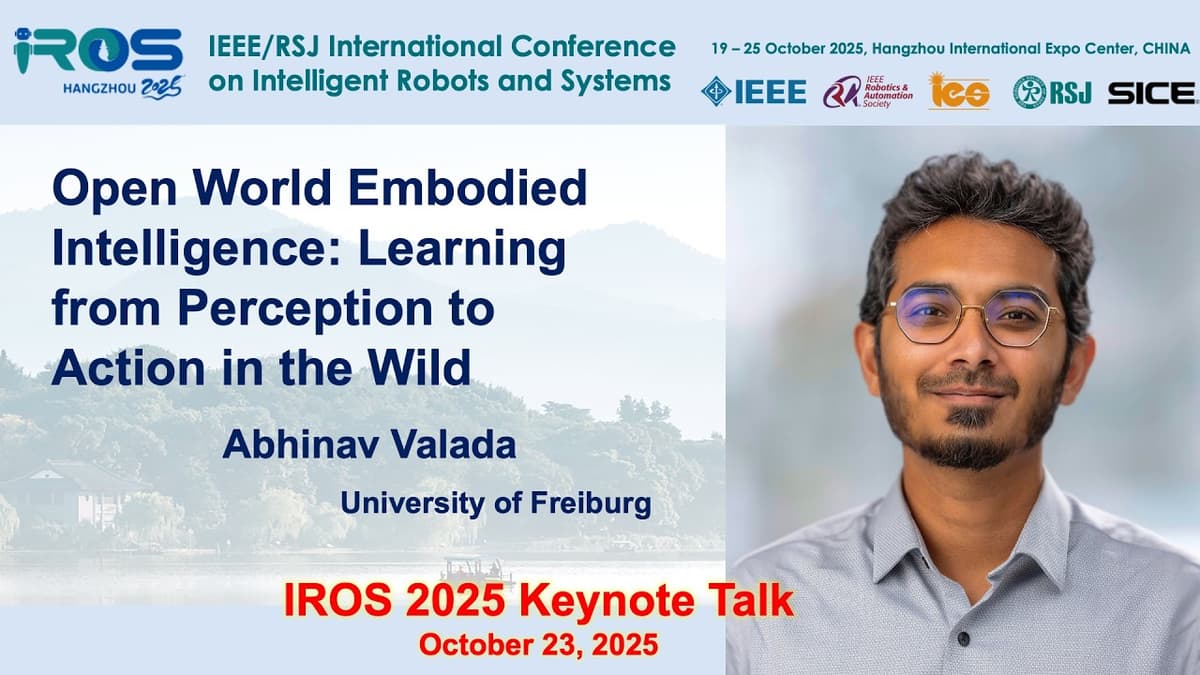
IROS 2025 Keynotes - Learning and Embodied Control: Abhinav Valada
Abhinav Valada’s IROS 2025 keynote outlines a roadmap toward open‑world autonomy for everyday robots, emphasizing that true utility requires systems that can learn continuously across heterogeneous environments. He frames the challenge with a data pyramid—ranging from scarce, high‑quality tele‑operated robot...
By IEEE Robotics & Automation Society
Video•Feb 18, 2026
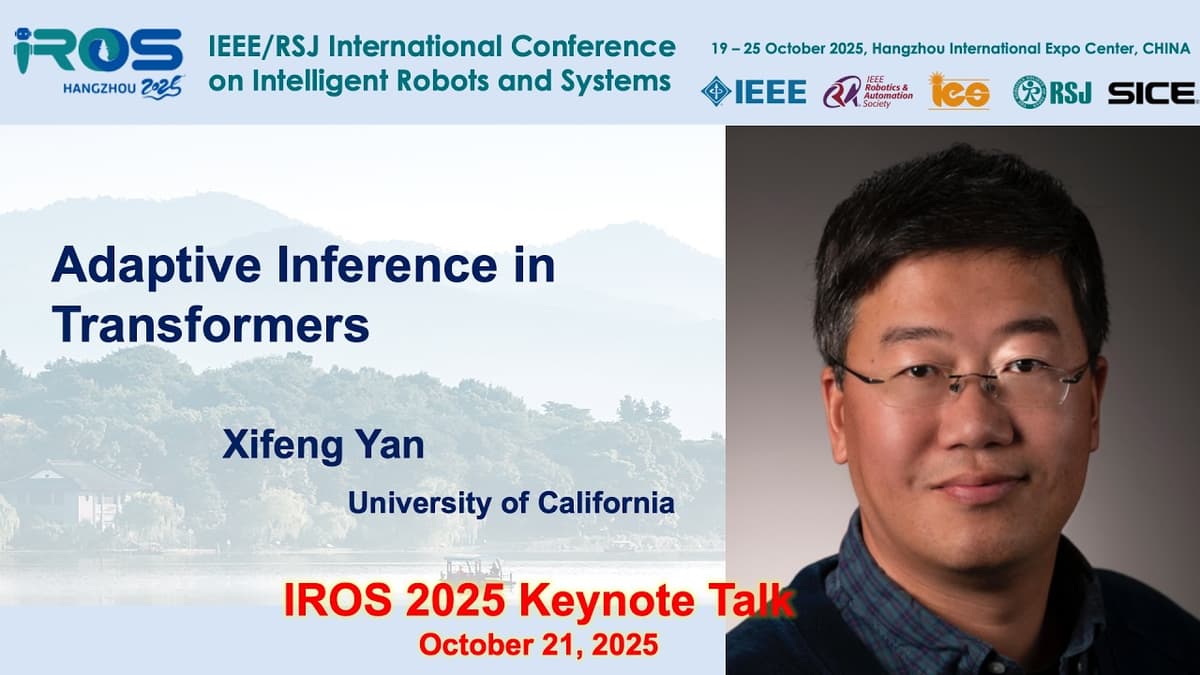
IROS 2025 Keynotes - AI and Robot Learning: Xfeng Yan
In this keynote, Shifen Yan from UC Santa Barbara introduced a token‑level adaptive inference framework for transformer models, arguing that the uniform computational cost per token is inefficient for many robotics and language tasks. By inserting a lightweight router before...
By IEEE Robotics & Automation Society
Video•Feb 18, 2026
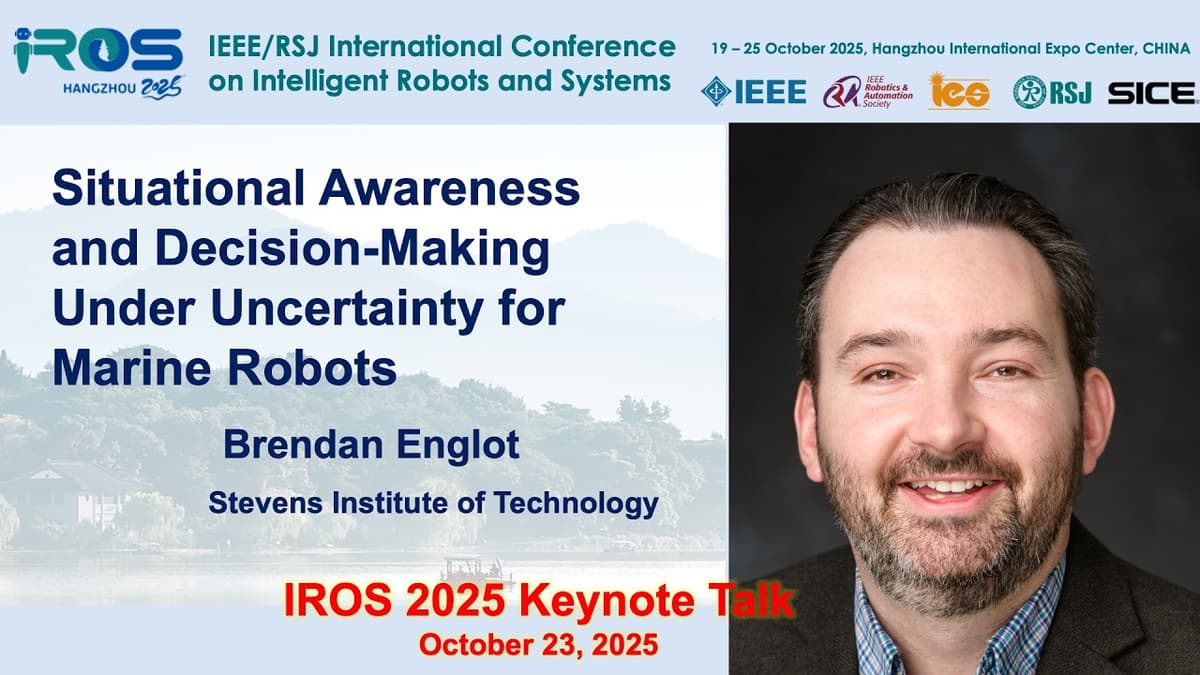
IROS 2025 Keynotes - Field Robotics: Brendan Englot
Brendan Englot’s IROS 2025 keynote highlighted the latest advances in situational awareness and decision‑making for marine robots, spanning perception, exploration, and risk‑aware control. His Robust Field Autonomy Lab at Stevens focuses on equipping underwater platforms with sensors and algorithms that...
By IEEE Robotics & Automation Society
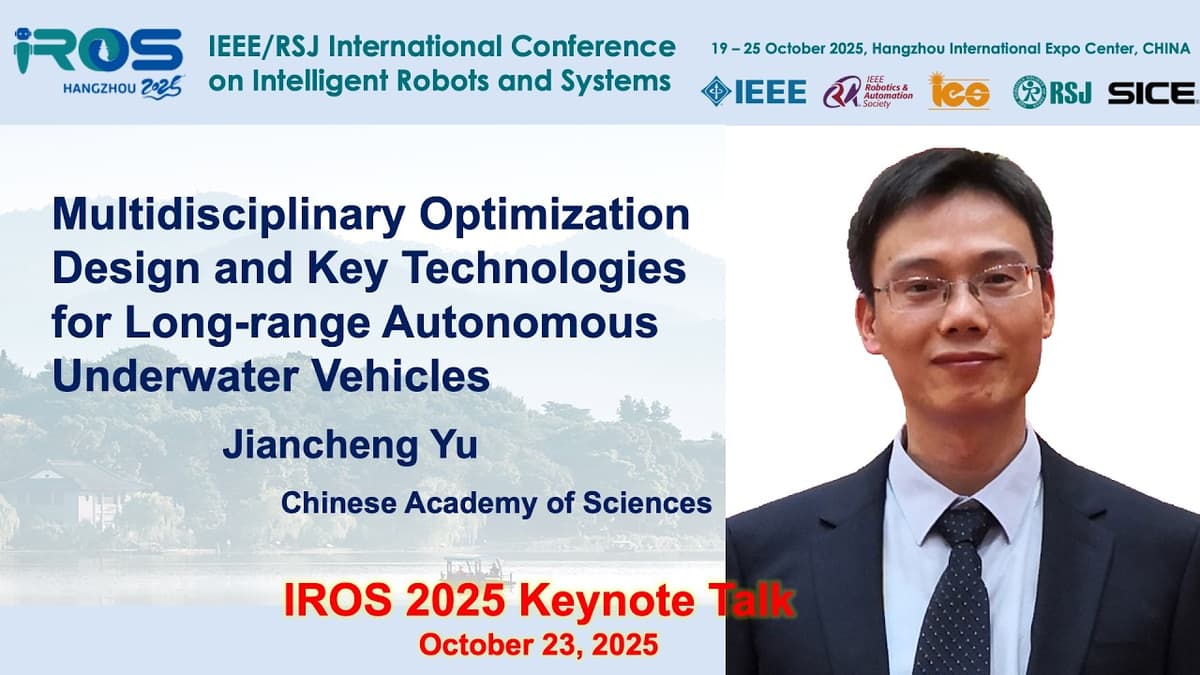
Video•Feb 18, 2026
IROS 2025 Keynotes - Field Robotics: Jiancheng Yu
The keynote at IROS 2025 presented a multidisciplinary optimization framework for long‑range autonomous underwater vehicles (AUVs), aiming to overcome traditional design bottlenecks and deliver cost‑effective, high‑performance ocean observation platforms. The speaker, Jiancheng Yu of the Shenyang Institute of the Chinese Academy...
By IEEE Robotics & Automation Society
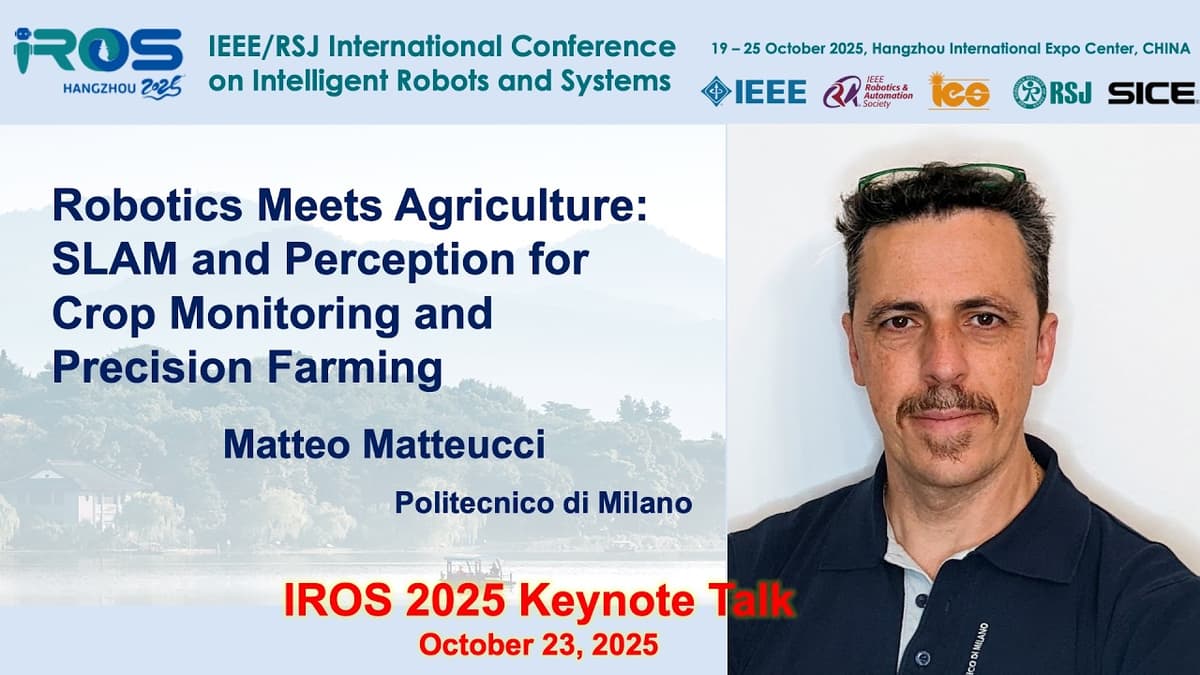
Video•Feb 18, 2026
IROS 2025 Keynotes - Field Robotics: Matteo Matteucci
Matteucci’s IROS 2025 keynote frames agriculture’s fourth, digital revolution as a necessity to feed a projected two‑billion‑person increase by 2100. He links declining farm labor, rising food insecurity, and unsustainable fertilizer and water use to the urgent need for robotics,...
By IEEE Robotics & Automation Society
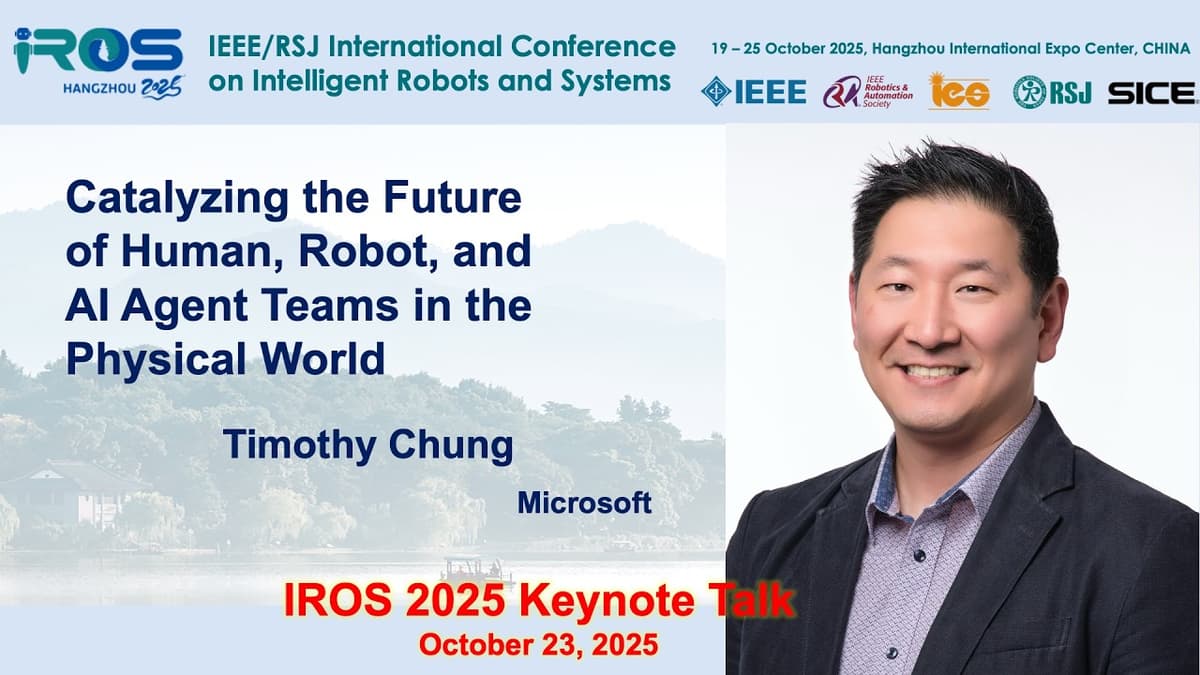
Video•Feb 18, 2026
IROS 2025 Keynotes - Field Robotics: Timothy Chung
Timothy Chung’s IROS 2025 keynote outlined Microsoft’s strategic roadmap for field robotics, emphasizing a shift from isolated robot pilots to large‑scale, interoperable robot federations that operate across air, sea, ground and underwater domains. He framed this evolution on a two‑dimensional...
By IEEE Robotics & Automation Society
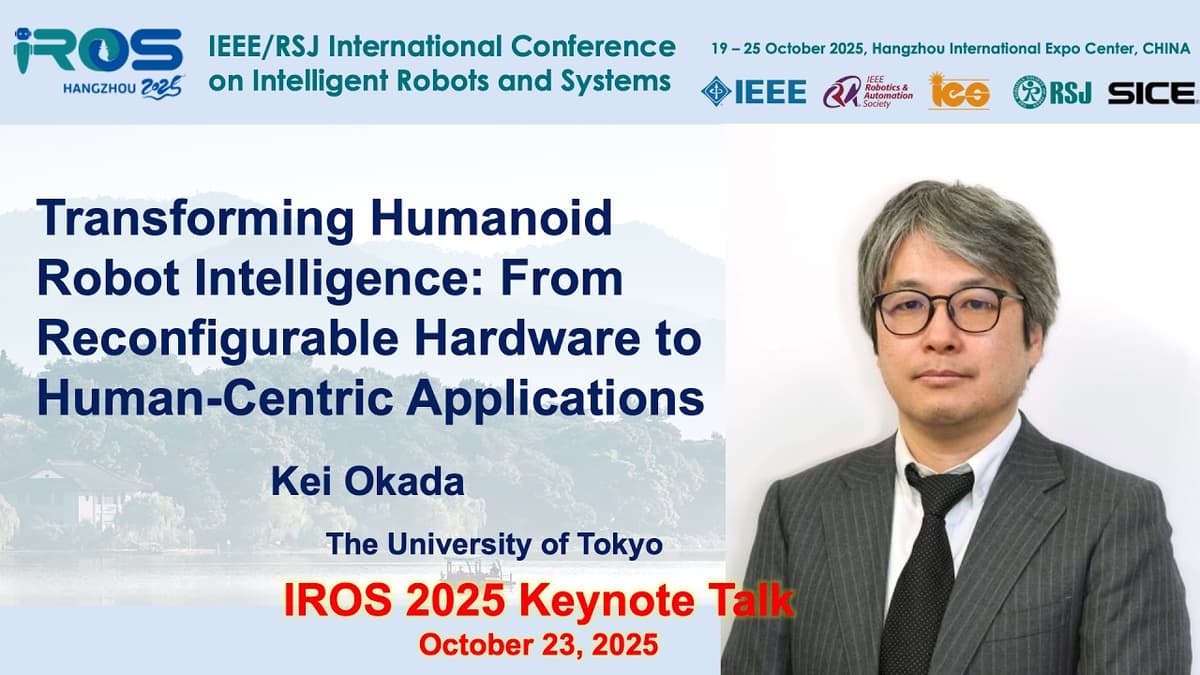
Video•Feb 18, 2026
IROS 2025 Keynotes - Humanoid Robot Systems: Kei Okada
The keynote by Kei Okada traced the evolution of humanoid robotics from the early HRP2 platform to today’s foundation‑model‑driven systems, emphasizing that robots must coexist with humans in environments built for us. He argued that the defining trait of humanity—tool...
By IEEE Robotics & Automation Society
Video•Feb 18, 2026
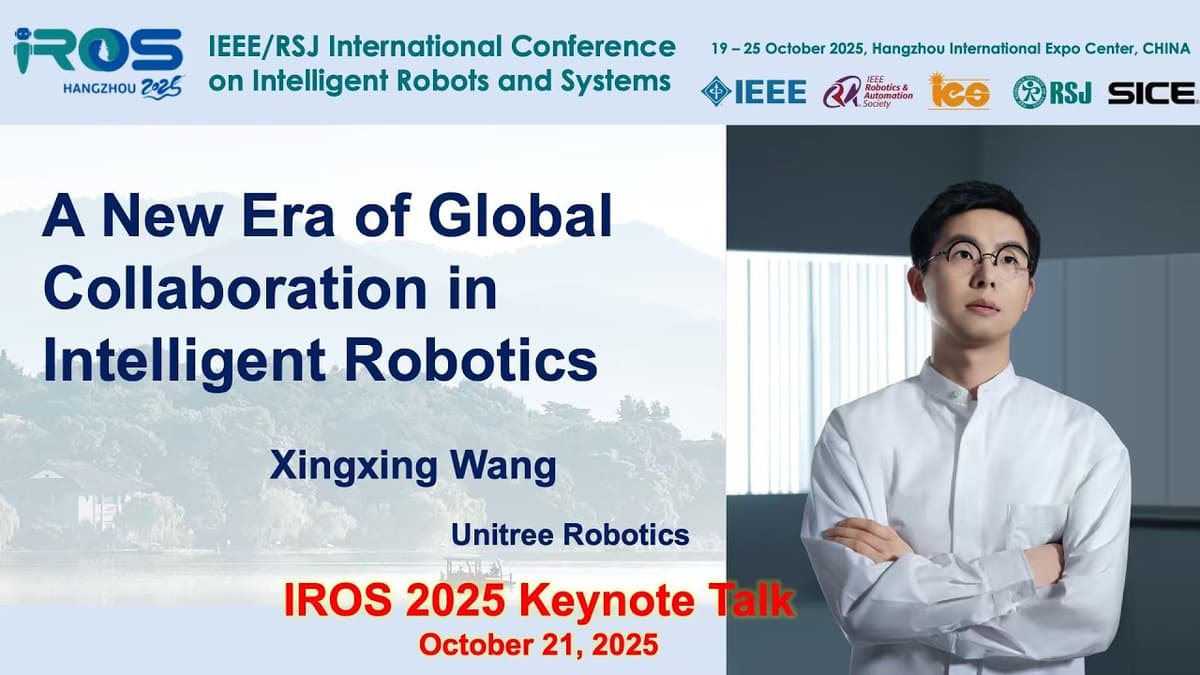
IROS 2025 Keynotes - Humanoid Robot Systems: Xingxing Wang
Xingxing Wang’s IROS 2025 keynote highlighted his firm’s rapid evolution from early Kodrader platforms to a diversified humanoid portfolio. Since its 2016 founding, the company unveiled the full‑size H1, then the compact 1.3‑meter G1 in 2023, and most recently the...
By IEEE Robotics & Automation Society
Video•Feb 18, 2026
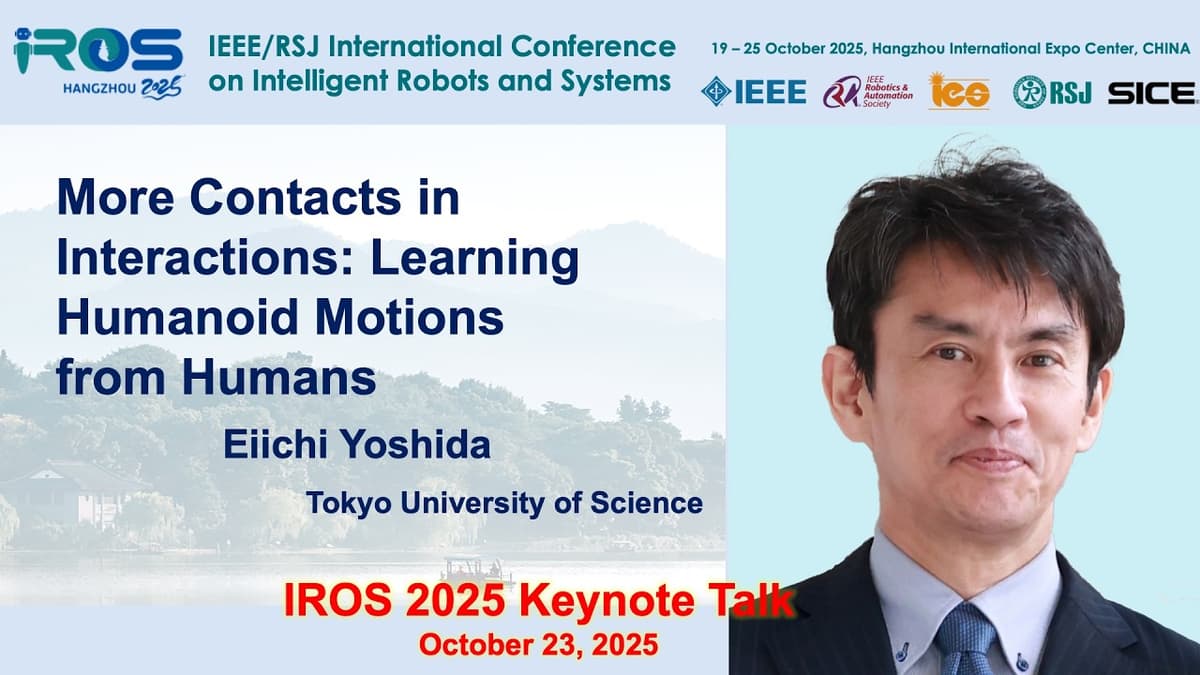
IROS 2025 Keynotes - Mechanisms and Controls: Eiichi Yoshida
The IROS 2025 keynote by Eiichi Yoshida examined how contact‑rich human motions can be harvested to advance humanoid robot mechanisms and control. Yoshida traced the evolution from a handful of humanoid platforms in 2022 to a burgeoning ecosystem of commercial...
By IEEE Robotics & Automation Society
Video•Feb 18, 2026
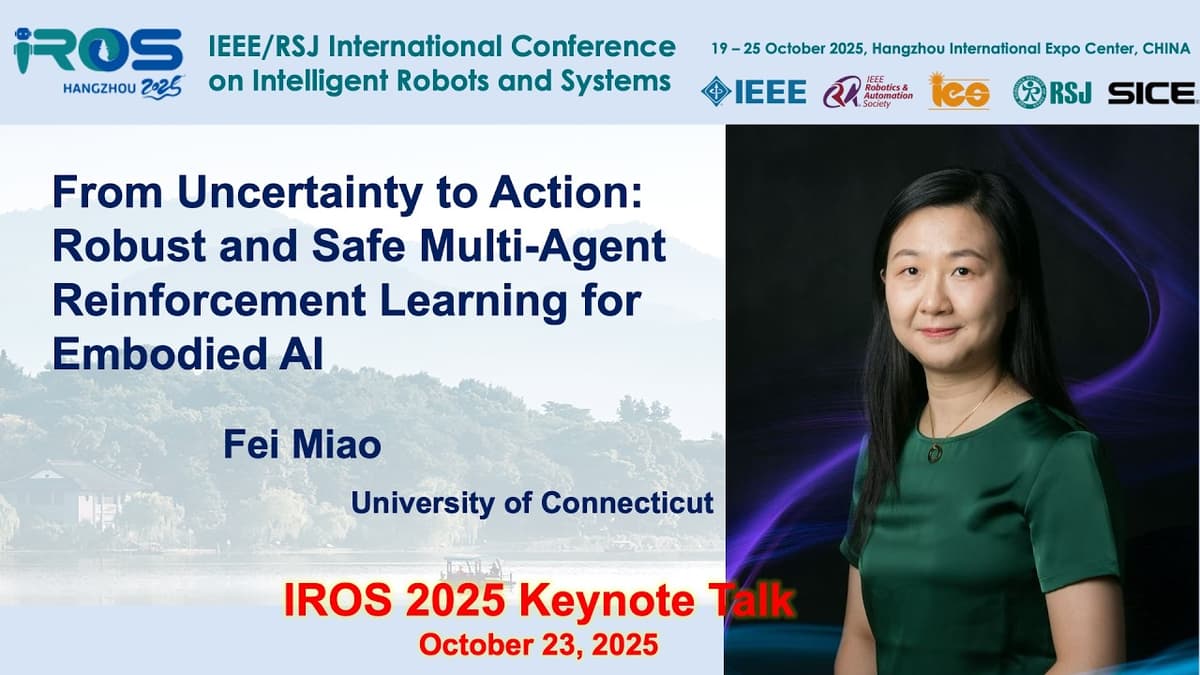
IROS 2025 Keynotes - Mechanisms and Controls: Fei Miao
The keynote by Fei Miao focused on advancing uncertainty understanding and safe, robust reinforcement learning for multi‑agent robotic systems, with autonomous driving as a primary example. Miao highlighted the gap between high‑performance perception models and their lack of calibrated uncertainty,...
By IEEE Robotics & Automation Society
Video•Feb 18, 2026
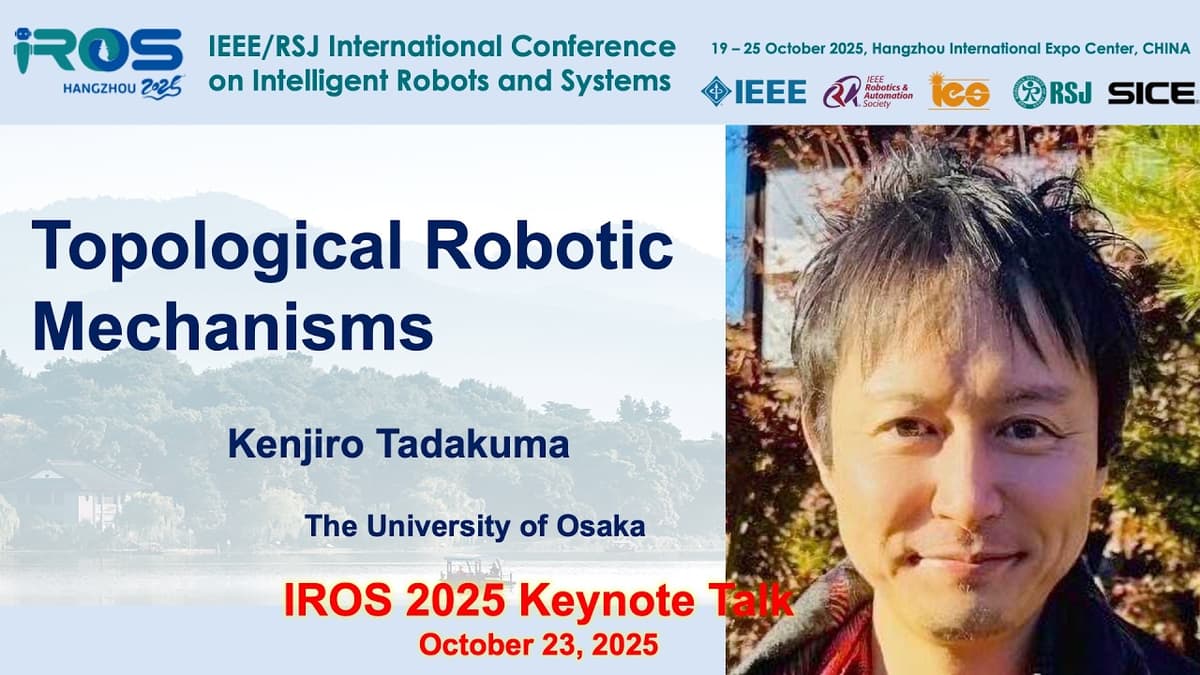
IROS 2025 Keynotes - Mechanisms and Controls: Kenjiro Tadakuma
Kenjiro Tadakuma’s IROS 2025 keynote centered on a sweeping portfolio of novel mechanisms and control concepts, ranging from omni‑directional locomotion modules to bio‑inspired soft actuators. He framed the discussion around the invention process, showcasing dozens of prototype models that illustrate both...
By IEEE Robotics & Automation Society
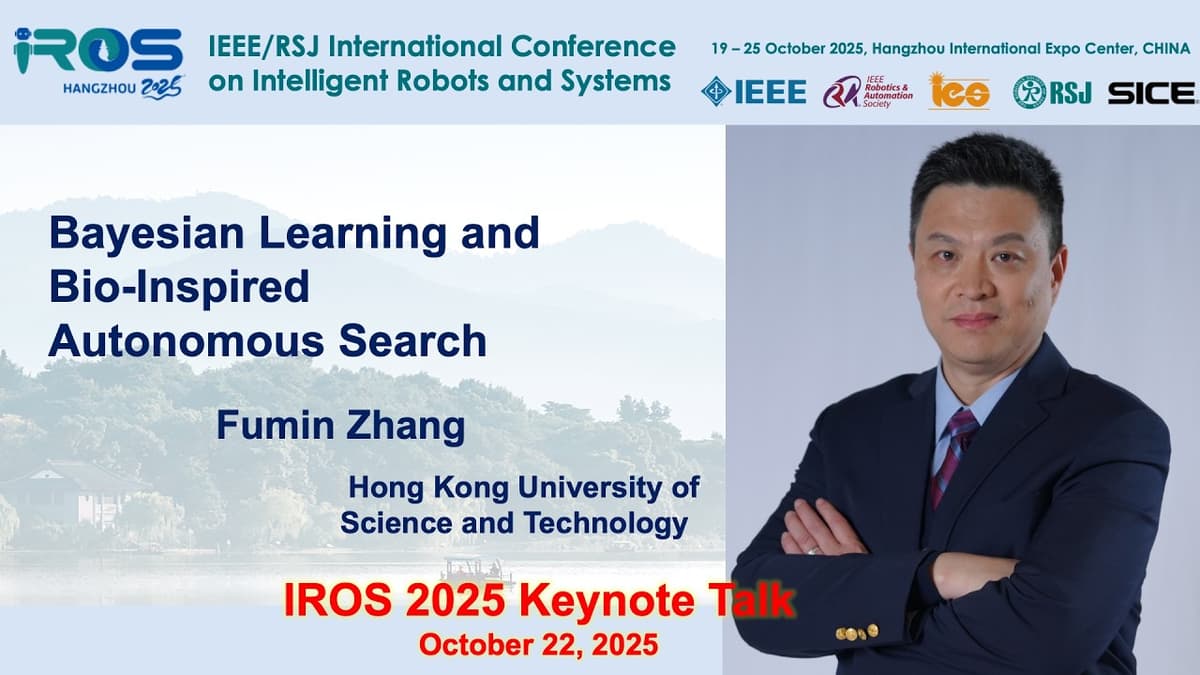
Video•Feb 12, 2026
IROS 2025 Keynotes - Embodied Intellgence: Fumin Zhang
The IROS 2025 keynote by Fumin Zhang examined how robots can perform high‑stakes search and rescue tasks by marrying classic search theory with modern generative AI and control techniques. Zhang highlighted that, despite a half‑century of research, the field has...
By IEEE Robotics & Automation Society
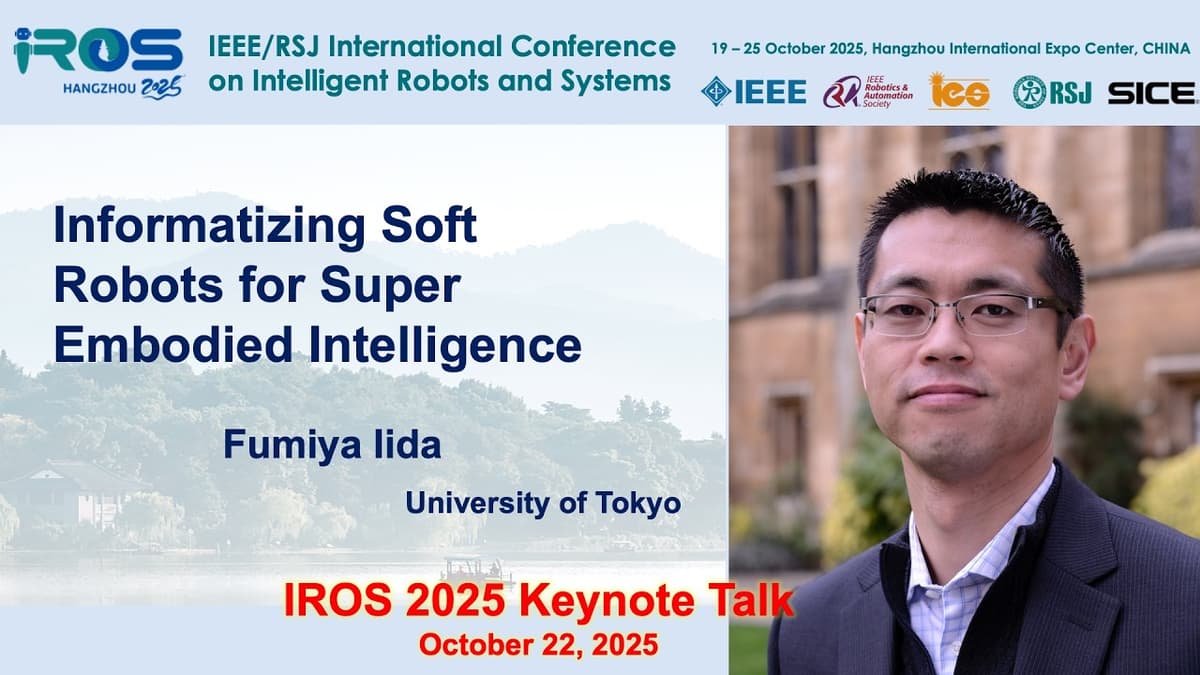
Video•Feb 12, 2026
IROS 2025 Keynotes - Embodied Intellgence: Fumiya Lida
Fumiya Lida’s IROS 2025 keynote framed embodied intelligence as the reciprocal relationship between a body’s physical dynamics and the brain’s control mechanisms, challenging the longstanding brain‑versus‑body dualism that has split robotics from AI. He highlighted the staggering scale gap—30 trillion cells...
By IEEE Robotics & Automation Society
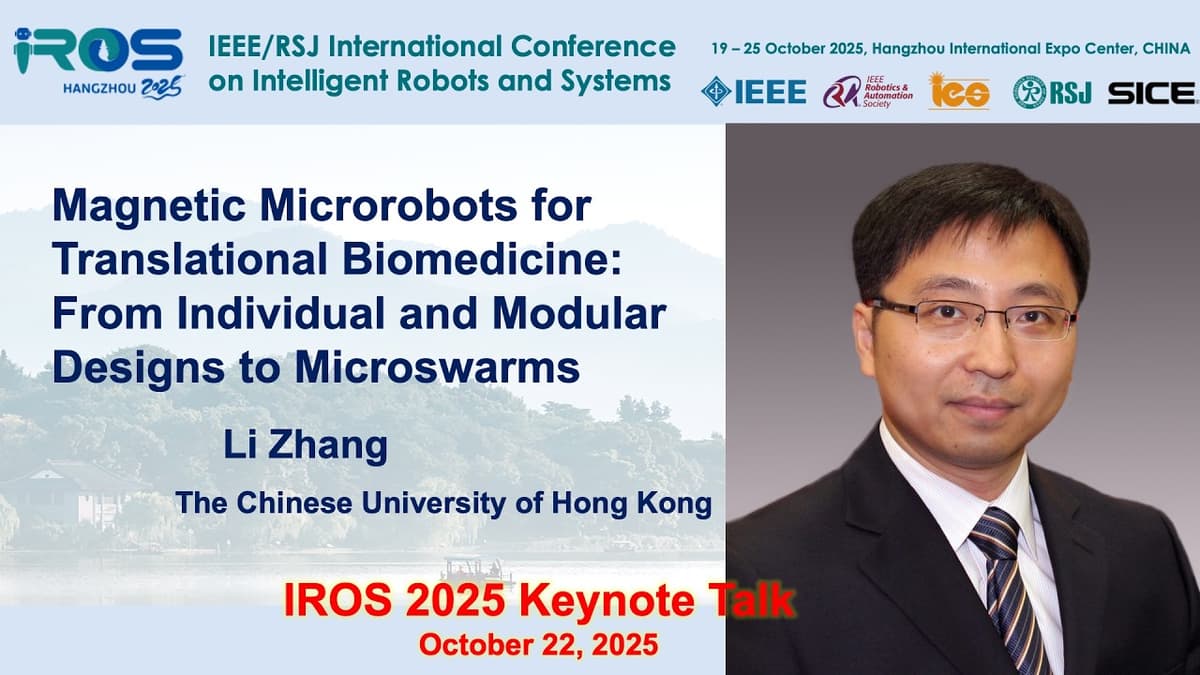
Video•Feb 11, 2026
IROS 2025 Keynotes - Medical Robots: Li Zhang
Li Zhang’s IROS 2025 keynote highlighted the rapid evolution of miniature biomedical robots, emphasizing magnetic actuation, bio‑hybrid materials, and modular architectures for safe, targeted therapy. He traced the concept back to Richard Feynman’s swallowable‑surgery vision and described how his team fabricates...
By IEEE Robotics & Automation Society