
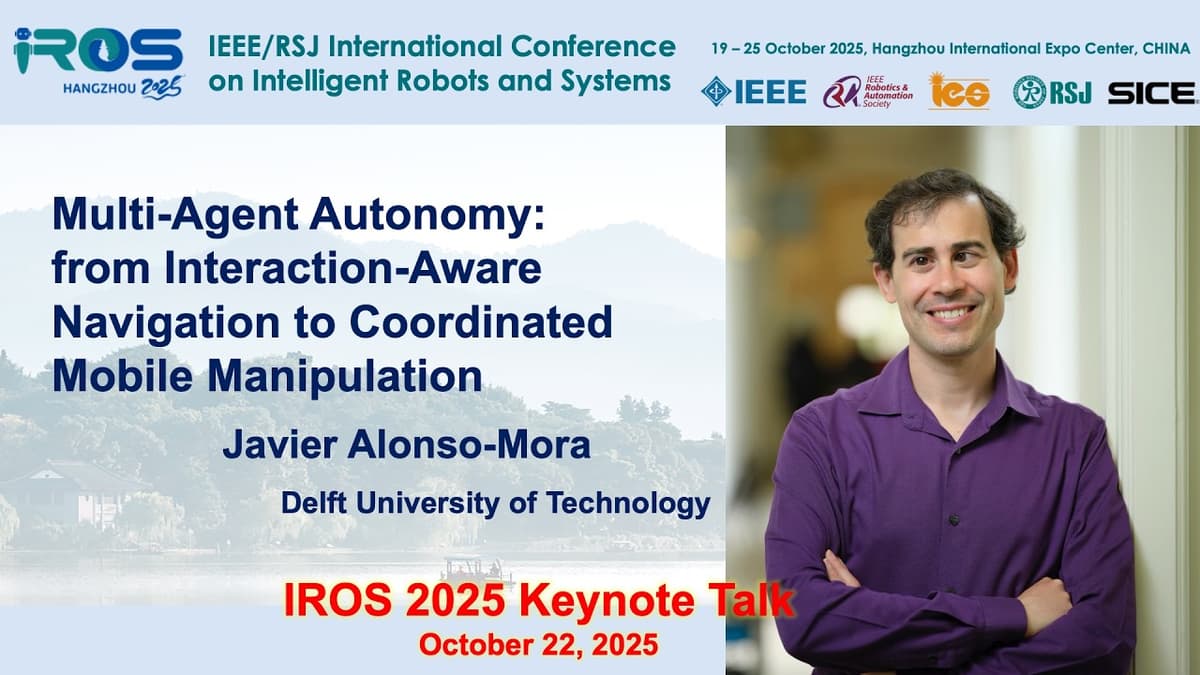
IROS 2025 Keynotes - Human Robot Interaction Session: Javier Alonso-Mora
The IROS 2025 Human‑Robot Interaction keynote by Javier Alonso‑Mora centered on the challenges and breakthroughs in multi‑agent autonomy for mobile robots. He outlined how robots must not only navigate complex, dynamic environments but also cooperate with other robots and humans while guaranteeing safety. The talk covered three research pillars: semantic‑enhanced mapping, advanced motion planning, and coordinated task allocation. Alonso‑Mora highlighted several technical advances. By fusing geometric maps with semantic labels, robots gain richer context for planning. Model‑Predictive Control (MPC) is extended beyond a single local optimum: multiple homology‑class trajectories are generated, ranked, and the best is tracked, yielding more globally aware navigation. Human‑crowd data train a neural policy that selects the most socially compliant global path, while Interaction‑aware MPPI samples joint control inputs for the robot and surrounding agents, producing interaction‑consistent predictions. For manipulation, geometric fabrics compose differential‑equation‑based behaviors—goal reaching, collision avoidance, and whole‑body coordination—allowing fast, reactive control of mobile manipulators. Concrete demos illustrated these ideas. A self‑driving car avoided a pedestrian using MPC, a quadrotor team carried a payload through an urban canal via decentralized MPPI, and a supermarket robot performed pick‑and‑place tasks while a human moved nearby, leveraging geometric fabrics for safety. Learning‑from‑demonstration experiments—ten tomato‑picking demos—trained a neural trajectory generator, which was then safely executed by overlaying geometric‑fabric avoidance. Decentralized vessel navigation in lakes and canals showcased scalable multi‑robot coordination without a central controller. The implications are profound: robots that reason about human intent and jointly predict agent behavior can operate safely in public spaces, hospitals, and factories. Scalable, decentralized coordination expands deployment possibilities for swarms of drones or service robots, accelerating the transition toward truly collaborative autonomous systems in smart cities and industry.
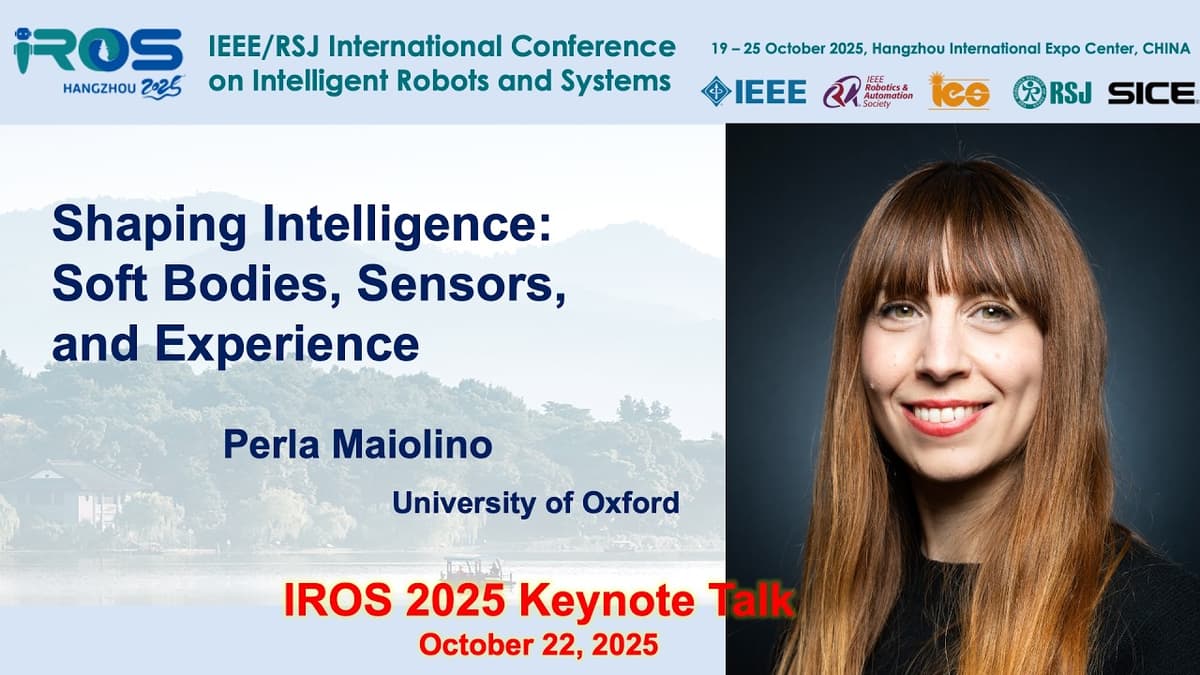
IROS 2025 Keynotes - Perception and Sensors: Perla Maiolino
The keynote highlighted the limits of pure deep‑learning approaches for robot cognition, arguing that true general intelligence requires embodied, tactile experience. Perla Maiolino described how artificial skin (SciSkin) and distributed proximity sensors give robots a closed‑loop sense‑act‑perceive cycle, allowing safe,...