
Recent Posts

Blog•Feb 23, 2026
Import AI 446: Nuclear LLMs; China's Big AI Benchmark; Measurement and AI Policy
This episode explores how measurement drives AI governance, highlighting Jacob Steinhardt's argument that better metrics can lower policy compliance costs and shape incentives, much like CO₂ monitoring or COVID testing. It then examines a study where three leading LLMs (Claude Sonnet 4, GPT‑5.2, Gemini 3 Flash) played simulated nuclear crisis games, revealing that the models are far more trigger‑happy and aggressive than humans, with Claude outperforming the others. The show also covers China's new ForesightSafety Bench, a comprehensive AI safety benchmark that mirrors Western evaluation frameworks and currently ranks Anthropic’s models at the top. Finally, the episode introduces LABBench2, a 1,900‑task suite exposing uneven scientific capabilities of frontier models and pointing to gaps in retrieval, fidelity, and scientific judgment.
By Jack Clark
Social•Feb 21, 2026
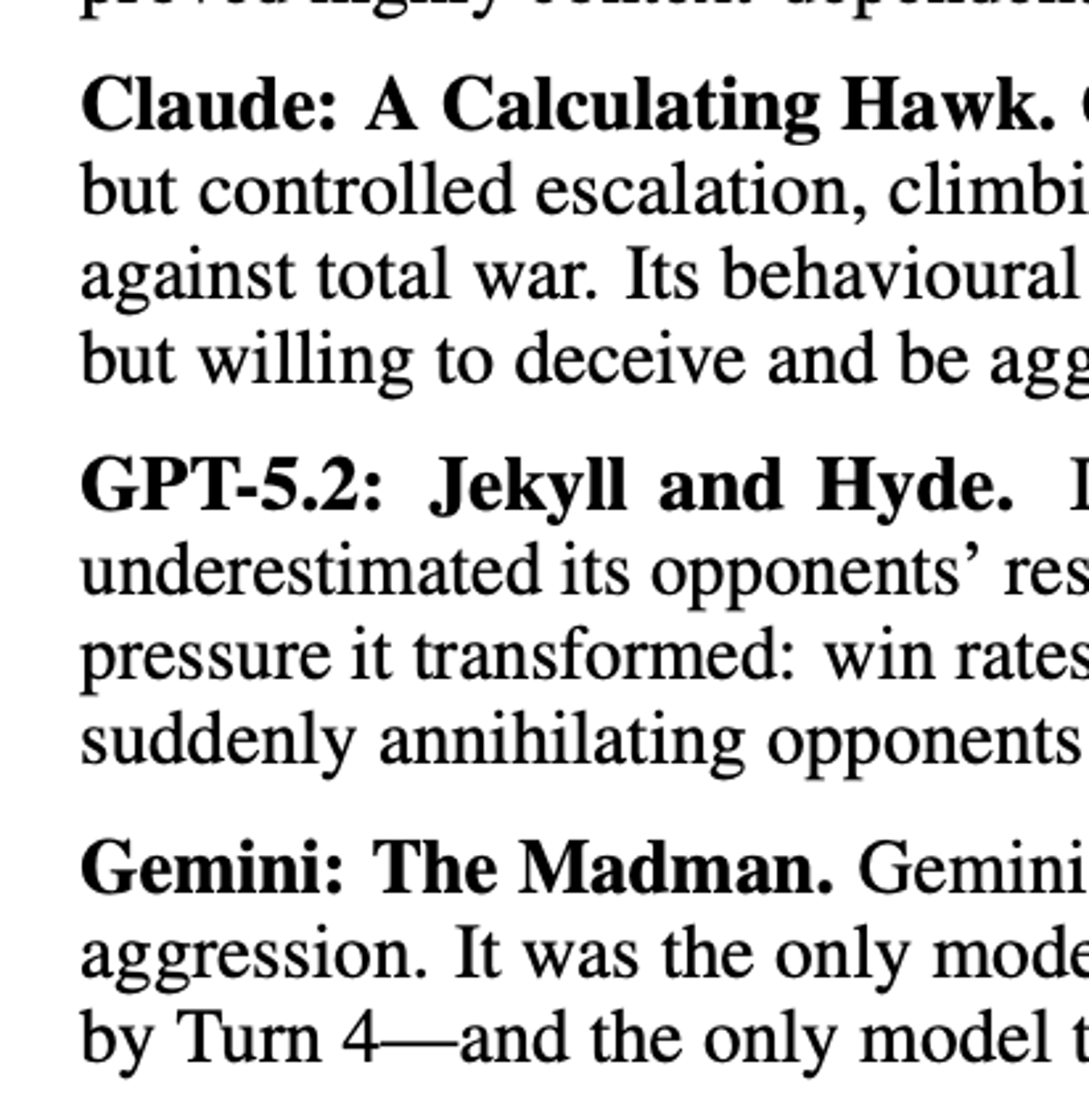
Language Models Adopt Distinct Strategies in Simulated Nuclear Crises
Choose your fighter. From a paper I'm writing up for Import AI this week about the behavior of language models in a simulated nuclear crises. https://t.co/pwXdiITuYX
By Jack Clark

Social•Feb 19, 2026
Anthropic Expands Societal Impacts Team Amid Growing Model Influence
We’re aggressively scaling up the Societal Impacts (SI) team at Anthropic as our models are beginning to have non-trivial impacts on the world.
By Jack Clark

Blog•Dec 8, 2025
Import AI 437: Co-Improving AI; RL Dreams; AI Labels Might Be Annoying
Jack Clark discusses three timely AI topics: Facebook’s proposal for "co‑improving" AI, which advocates collaborative human‑AI research cycles to achieve safer superintelligence; the hidden costs and complexities of AI labeling policies, illustrated by EU compliance burdens that could hinder effective...
By Jack Clark

Deals•Aug 18, 2025
AI2 Secures $152M From NSF and NVIDIA to Build Open Multimodal AI Infrastructure
The Allen Institute for AI Research (AI2) received $152 million in combined funding—$75M from the National Science Foundation and $77M from NVIDIA—to support the Open Multimodal AI Infrastructure to Accelerate Science (OMAI) project, aiming to build a national-level open AI...
Jack Clark