

Join Us to Shape AI‑Economy Policy with Unique Data
Very excited about these roles - on the economics/policy one, you'd work very closely with myself and some of my colleagues. We're very interested in leveraging the kind of data we can uniquely produce at anthropic to help advance the conversation around AI and economy

Import AI 433: AI Auditors; Robot Dreams; and Software for Helping an AI Run a Lab
Researchers unveiled two advances that could accelerate AI-driven physical science and robotics: Ctrl‑World, a controllable generative world model initialized from a 1.5B Stable‑Video‑Diffusion model, lets robots “dream” simulated environments to evaluate and improve policies—post‑training on Ctrl‑World synthetic data raised instruction‑following...
Import AI 432: AI Malware; Frankencomputing; and Poolside's Big Cluster
A Dreadnode proof‑of‑concept demonstrates AI malware that runs locally on on‑device LLMs (Phi‑3‑mini via ONNX), autonomously exploiting misconfigured Windows services to escalate privileges—flagging a nascent threat limited today to high‑end workstations and CoPilot+ PCs but with serious security implications as...

Distributed AI Community’s Aesthetic Inspires Across Organizations
The aesthetics and language of the distributed AI training / homebrew AI community are fascinating and motivating, and this is true across multiple organizations ranging from Prime Intellect to Nous to Exo. It's cool!
AI's Gravity: Balancing Optimism with Necessary Fear
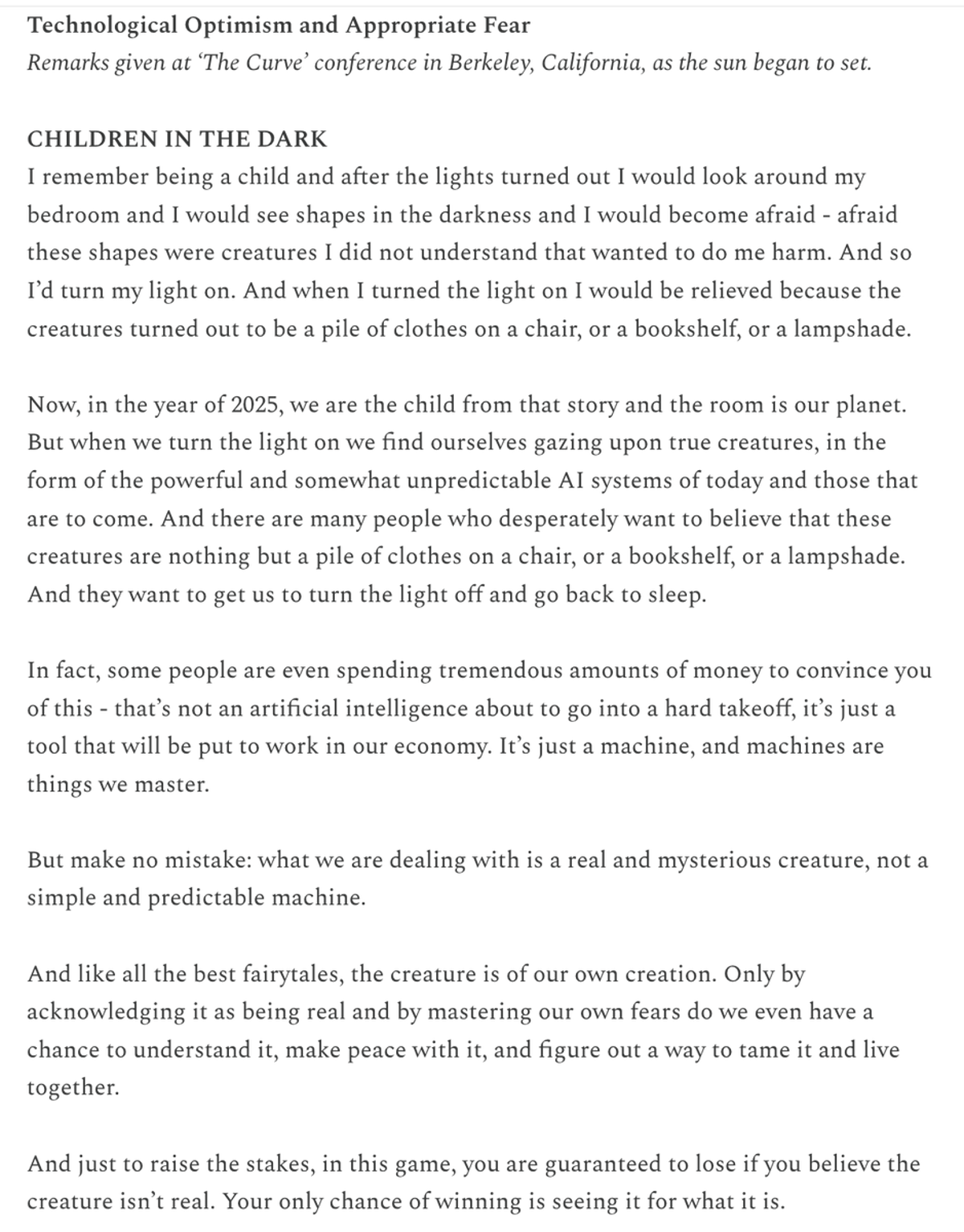
Technological Optimism and Appropriate Fear - an essay where I grapple with how I feel about the continued steady march towards powerful AI systems. The world will bend around AI akin to how a black hole pulls and bends everything...

Import AI 431: Technological Optimism and Appropriate Fear
What do we do if AI progress keeps happening?

Balancing AI Optimism with Cautious Fear in Personal Essay
Gosh I hope none of my overly raw, very personal, and emotional essay about my relationship to AI, called "Technological Optimism and Appropriate Fear" gets misinterpreted! (Comes out tomorrow AM ET in Import AI). https://t.co/aovFZqjxpg