
What Happens When Your AI Agent Gets a Wallet?
The episode explores how AI agents equipped with stable‑coin wallets are reshaping commerce, focusing on the X42 “agentic payments” ecosystem that connects cloud providers and payment processors to enable on‑chain micro‑transactions. Panelists argue that liquidity is the primary driver; stablecoins give developers instant access to DeFi yields and low‑cost settlement. The rise of “headless merchants” – API‑only endpoints rather than traditional storefronts – allows developers to pay per usage, turning AI agents into autonomous buyers. Noah Lavine cites recent partnerships between AWS, Google Cloud, Coinbase and Stripe, while Michael Blau describes building Dripstack, a prototype that lets an AI agent reserve a restaurant table and sell Substack content directly to other agents. G Money highlights the shift from subscription‑based AI access to a credit‑top‑up, pay‑as‑you‑go model. If adoption accelerates, creators and fintech firms could capture higher margins by eliminating card‑processing fees, while traders may become the first mass‑market users willing to overcome wallet friction. The trend signals a broader move toward programmable money and tokenized real‑world assets.

In Our "Collared-Shirt" Era
The video argues that crypto is leaving its garage‑hoodie origins and entering a “collared‑shirt” era where it converges with fintech and Wall Street. The speaker emphasizes that success now depends on building products customers demand and distributing them at scale,...
What AI Agents Need Before They Can Act Alone | Sreeram Kannan
The interview with Sreeram Kannan centers on the convergence of artificial intelligence and blockchain, arguing that AI agents will need decentralized, trust‑enforced infrastructure to act independently. Kannan outlines EigenLabs’ flagship offering, EigenCloud, a decentralized cloud platform built atop EigenLayer, where...
AI And The Future Of Cybersecurity
The video centers on the accelerating wave of DeFi security breaches, where $635 million vanished in April alone, and examines how artificial‑intelligence tools are reshaping the cyber‑threat landscape. Hosts Eddie Lazarin and Matt Gleason argue that attackers have already integrated AI...
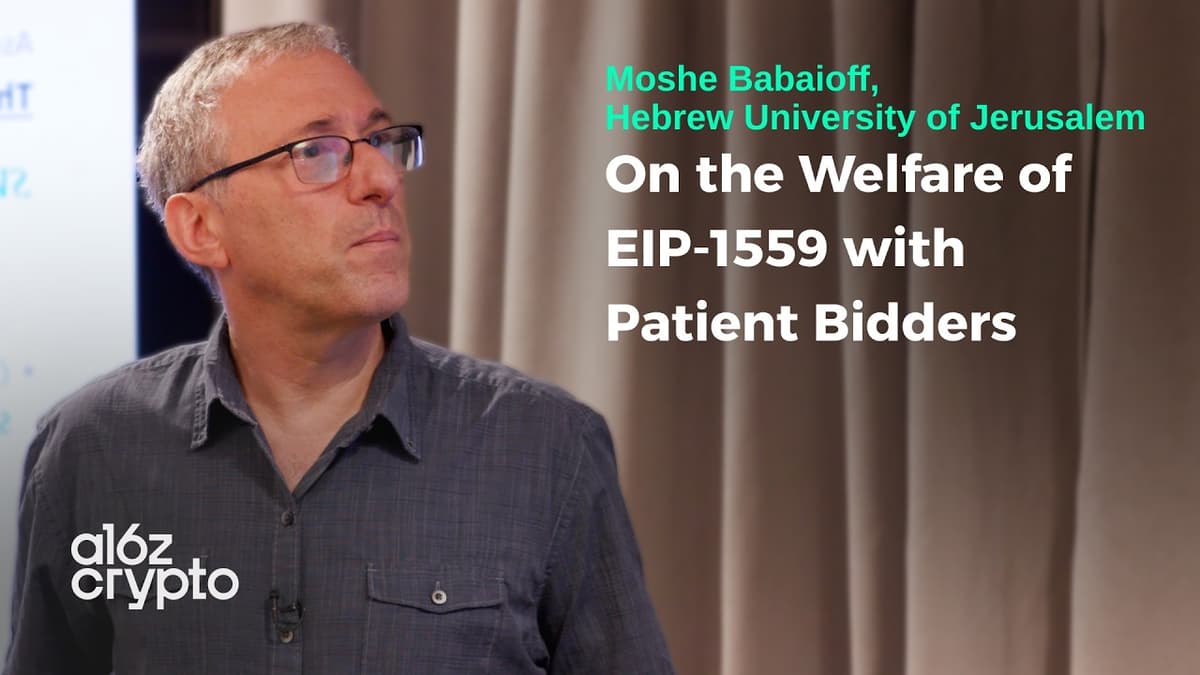
On the Welfare of EIP-1559 with Patient Bidders with Moshe Babaioff | A16z Crypto Research Series
The seminar presented recent research on the welfare properties of Ethereum’s EIP‑1559 fee mechanism when users are patient—meaning their transactions can wait in the mempool without losing value. Moshe Babaioff and co‑authors model a setting where validators are adversarial but must...
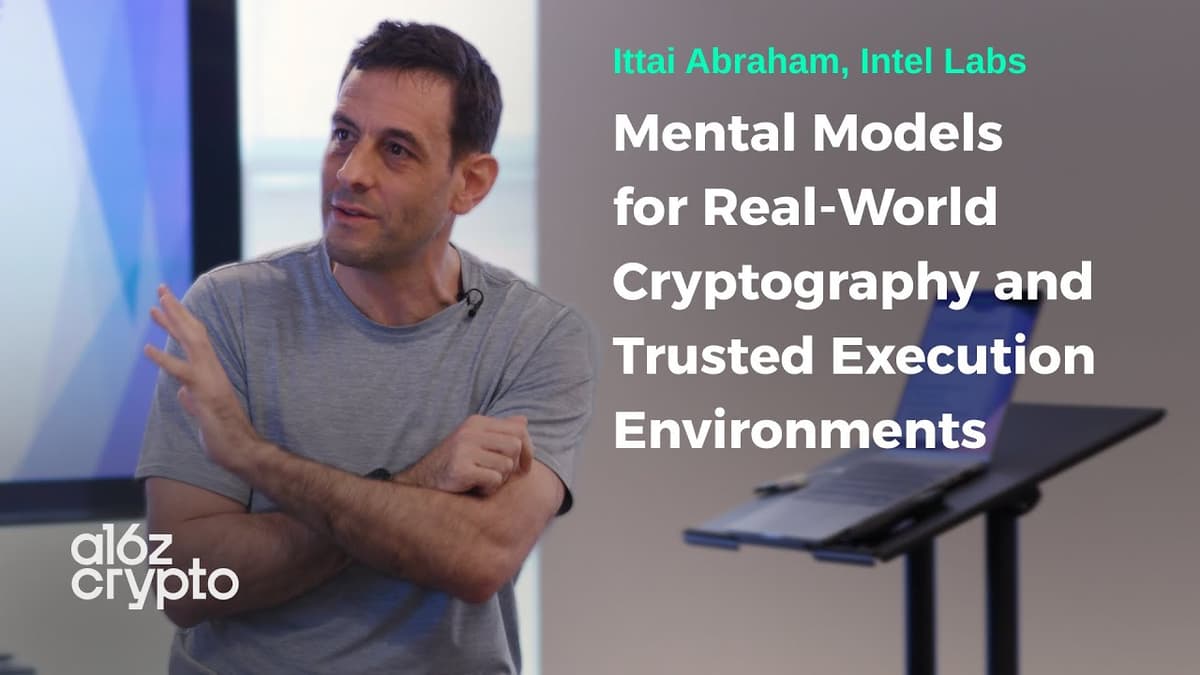
Mental Models for Real-World Cryptography and Trusted Execution Environments
The seminar, led by Itai Abraham, examined mental models for Trusted Execution Environments (TEEs) and their role in bridging the security‑friction trade‑off that hampers widespread crypto adoption. He argued that pure cryptography cannot replace physical trust; a minimal hardware root‑of‑trust is...
What Even Is an App Anymore?
The video argues that the traditional notion of an app is disappearing, replaced by AI‑driven agents that perform tasks on behalf of users. These agents can scrape product reviews, fetch images, and complete transactions without a dedicated UI, effectively acting as...
The Distraction Economy Is Dead
The video argues that the economic contract that once underpinned the open web—free content monetized through Google’s ad‑based model—is collapsing. Since Google’s rise in 2000, advertisers paid publishers per view, creating a distraction‑driven economy that generated roughly $300 billion annually. The emergence...
Why AI Is so Centralized: How It's Built, Who Controls It, and What Comes Next
The video examines the growing centralization of artificial intelligence, arguing that today’s AI services are controlled by a handful of dominant firms and that this concentration poses both technical and philosophical risks. It proposes a shift toward decentralized infrastructure that...
How to Prove Who's Human Online (Ft. Ben Horowitz and Alex Blania)
The discussion centers on the growing need to prove that an online participant is a real human rather than an AI‑driven bot. Alex Blania and Ben Horowitz explain that current verification methods—government IDs, facial recognition, or simple device checks—cannot scale...

What People Get Wrong About DeFi Lending (with Paul Frambot, Cofounder and CEO of Morpho Labs)
In a candid interview, Paul Frambot, co‑founder and CEO of Morpho Labs, tackles the biggest misconceptions surrounding decentralized finance (DeFi) lending. He argues that the industry has mistakenly pursued fully trustless, risk‑free loan engines, when the true value lies in...

We Chewed a Lot of Glass" — Building on Solana in the Bear Market (Ft. Jito Labs CEO Lucas Bruder)
In this interview, Jito Labs CEO Lucas Bruder explains how his firm, Jetto, has become the largest liquid‑staking protocol on Solana and a de‑facto validator client provider, powering roughly 80‑90% of the network’s blocks. He frames Jetto’s mission as an...

"Crypto Is Gonna Be the Coupling Between AI and Humans."
The video argues that cryptocurrency will become the essential trust‑layer linking artificial‑intelligence agents with human economic actors. It contrasts fiat money, which the speaker says is backed by state‑enforced violence, with crypto’s decentralized consensus that can verify value without coercion. By...

What Happens to Copyright in a World of Generative AI?
The video argues that copyright law, as it stands, cannot survive the rise of generative AI, suggesting the framework will eventually disappear. The speaker notes that copyright is a relatively recent invention—recording rights only emerged in the 1970s—and that early musicians...

Why AI Agents Suddenly Feel Different
The video explains why AI agents suddenly feel different, pinpointing a series of incremental upgrades that coalesced in late December to give agents the ability to manage extended, multi‑step projects without constant user prompts. These improvements enable agents to maintain context...