

4 Executive Presence Myths That Cost You Credibility
The video tackles the nebulous concept of executive presence by dismantling four common myths that often stall professionals’ credibility. It argues that presence isn’t a perk reserved for C‑suite titles but a daily influence tool needed in budget talks, client pitches, and cross‑functional meetings. Key insights reveal that executive presence is a learnable skill set—clear thinking, intentional communication, and genuine connection—rather than an innate trait. It requires deliberate practice, feedback loops, and ongoing refinement, much like mastering a language or staying physically fit. Authenticity, not imitation, is emphasized; leaders should amplify their own perspective instead of copying a perceived “executive voice.” The presenter underscores this with memorable lines: “Presence isn’t a personality trait,” and “Stop asking whether you have executive presence and start paying attention to where it shows up and where it breaks down.” Real‑world examples illustrate how presence falters under pressure or when facing senior leaders, highlighting actionable self‑assessment tools. For professionals, the takeaway is clear: map the moments where influence matters, diagnose presence gaps, and invest in continuous skill development. Organizations that embed this mindset can cultivate a broader pool of credible influencers, boosting decision‑making speed and employee confidence across all levels.

Effective Leaders Adapt, Prioritize Empathy Over Personal Style
I used to believe leaders should always show up as their authentic, natural selves. I don’t believe that anymore. As a leader, you need to be a chameleon at times, changing your approach depending on what the situation needs. For a long time,...

Clearer Presentations Start with Your Audience #presentationtips
The video stresses that crystal‑clear communication begins with understanding who you’re speaking to. Duarte’s “audience needs map” is presented as a practical tool for uncovering what each stakeholder values, fears, and requires before you craft a message. The speaker argues that...

4 Communication Habits That Quietly Kill Your Leadership
Leaders often sabotage their own authority with four subtle communication habits, according to Dewarte’s executive‑coaching video. The presenter walks through each habit—unprepared objections, hedging language, data dumping, and outdated listening frameworks—and offers concrete fixes that can be applied before the...

Embrace the Messy Middle for Authentic Connection
If you look at the story structure most movies use, you'll notice that roughly 10% of the time is for the beginning, 10% is for the ending, and 80% is the “messy middle”... which is the part leaders prefer to...

Chief Communicators Lag in AI Adoption, Need Faster IT Enablement
AI can transform how Chief Communicators communicate, and it’s surprising how few are using it. Boston Consulting Group (BCG) just surveyed more than 200 corporate affairs and communication leaders at large companies. 68% of them described their team as “AI...

AI Event Prioritizes Life Quality Over Productivity
I attended something on March 3rd that I struggled to put into words. Hosted by my friend @aaker at Stanford, it was NOT a typical “AI event.” It was something far more human. She set up tables where crazy-impressive experts sat alongside a...

The Missing Piece in Most Calls to Action #presentationtips
The video argues that the most compelling calls to action go beyond a simple request; they also paint a concrete picture of a better future that awaits the audience if they say yes. This "new bliss" concept, coined by Dwarte,...

Skip the Boring Intro, Lead with the Unexpected Hook
Most leaders make one tiny mistake within the first few seconds of their presentations that can take their audience a while to recover from. I see this constantly during updates, recommendations, or debriefs. They start with: - Background - Context...

How to Articulate Your Thoughts Like a Top 1% Communicator
The video outlines four concrete habits that separate the world’s most persuasive speakers from average presenters, promising that adopting them will make listeners pay attention and say “yes” more often. First, it stresses non‑verbal mastery—controlling tone, avoiding upward inflection, inserting strategic...

Leaders Must Pause Speed to Acknowledge Teams During Change
Speed is one of the best tools a leader has. But I’ve seen it work against many of them. (Often before we even realize it.) CEOs are fast & decisive for a reason: It helps them get results. But when...

4 Executive Presence Skills That Made Steve Jobs Unforgettable
The video breaks down executive presence as a learnable skill, using Steve Jobs as a case study to illustrate how intentional choices shape perception in high‑stakes settings. It outlines four concrete tactics: (1) shaping the story before uttering a word through...
What to Say When You Get an Objection Mid-Presentation
The video teaches four practical habits for dealing with objections that arise unexpectedly during a presentation, targeting leaders and decision‑makers who often face “but what about…” interruptions. First, identify the two or three most likely objections—cost, ROI, bandwidth, credibility—before stepping into...

Your Slides Are Stealing Attention From Your Message #slidedesign
The video tackles a common pitfall in business presentations: slides that are saturated with text and visual clutter. When a slide tries to convey every spoken word, the audience’s attention shifts to reading rather than listening, undermining the speaker’s impact. The...

How to Create a 'Winning' Presentation Deck (Rakuten Case Study)
The video walks through Dwarte’s process for crafting a "winning" presentation, using a Rakuten Optimism conference deck as a concrete case study. Ryan Orcut, the creative director, explains that a successful deck hinges on three pillars—content, visual design, and on‑stage...

Capture Attention: 3 Proven Techniques for First 30 Seconds
Many presenters lose their audience in the first 30 seconds. In this video, I'll give you 3 techniques you can use in your next high-stakes presentation to keep your audience engaged. #BusinessStorytelling #ExecutivePresence #PresentationSkills
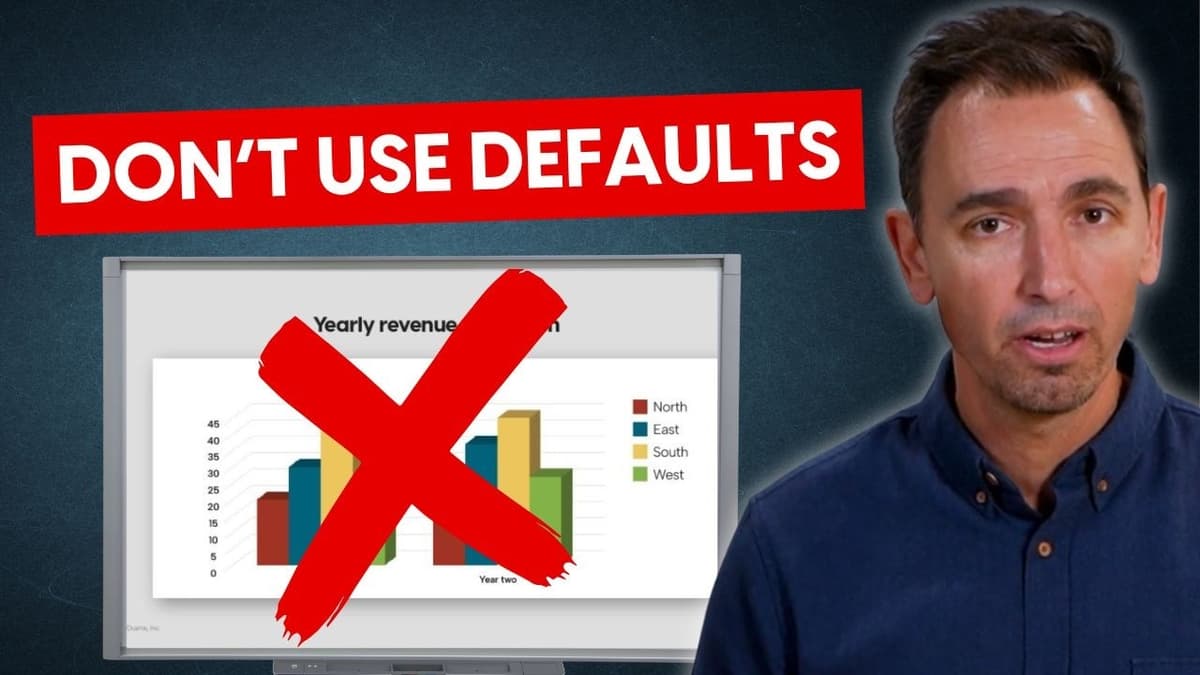
5 Ways Non-Designers Can INSTANTLY Upgrade Presentation Design
The video walks non‑designers through five practical steps to instantly elevate presentation aesthetics and effectiveness. Ryan, a creative director with two decades of executive‑level deck experience, frames the advice around common pitfalls that sap audience attention and presenter confidence. First, he...

How to Build and Maintain Executive Presence Over Email
Email is emerging as a critical venue for executives to project authority in digital‑first workplaces. Duarte outlines a four‑step framework—The Big Idea™ formula, audience segmentation, contrast storytelling, and a “new bliss” call‑to‑action—to turn routine messages into presence‑building assets. By focusing on a...

Recognize the Messy Middle to Navigate Leadership Challenges
If you’re going through a hard time as a leader (and all of us do!), here’s one question I’ve used to help make sense of difficult periods: “Where am I in the story?” I’ve spent decades studying storytelling, and every...
Your Slides Are Boring For This Reason... #slidedesign #presentationtips
The video tackles why most presentation decks feel stale, arguing that creators often default to familiar visuals—basic bar charts, stock photos, or bullet‑point lists—rather than seeking more compelling alternatives. It urges presenters to pause and generate several visual concepts before settling...

Persuasion Thrives on Flipping Between Reality and Vision
The most powerful persuasion “engine” isn’t information. It’s not just a story, either. Instead, it’s something most people never even think of. In a sales presentation, your job is to moveyour prospectsbetween two points: 1. What is (the current reality)...

Most Companies Overestimate Storytelling; New Scale Reveals Gaps
Most companies think they’re great at storytelling. That is, until they look at this… We recently created a framework called the Storytelling Maturity Scale. It rates your organization from 1 to 5 based on how well your teams can tell...

Make Your Customer the Hero, Not Your Pitch
You should never try to make yourself, your company, or your product look too good in your presentations. This is a classic mistake. Because you are not the hero. Your company is not the hero. Your product is not the...

Five Hook Formulas That Capture Audiences Instantly
Most presenters lose their audience before the first slide even appears. After studying hundreds of presentation openings, here are five that consistently work: 1. Start with a “Did you know…” Shock them with a fascinating fact or unexpected insight. Curiosity...

4 Techniques That Can Make You a Top 1% Storyteller
The video titled “4 Techniques That Can Make You a Top 1% Storyteller” teaches executives how to turn routine updates into compelling narratives. Drawing on experience with leaders at Google, Cisco and Microsoft, the presenter argues that storytelling is a...

Leaders Win by Embracing AI in the New Era
I had a great conversation on today’s episode of The World Class Leaders Show with Andrea Petrone ! We talked about how leaders can win with AI and what’s changing for CEOs and leaders in the AI era. I hope...

Skip Slides, Use Simple Diagrams to Secure Funding
A senior leader from a multinational company once came to us for help. He was flying to the U.S. to petition his CEO for a $100 million budget. His request was simple: “Can you help me with five slides?” We...

Make Your Audience the Hero, Not Your Brand
Your audience is the hero of your story...not you, not your product, not your company. Here are three ways to obsess over your audience so your message actually sticks. #BusinessStorytelling #AudienceEngagement #PresentationSkills
This Makes Your Data-Heavy Presentations 10X More Persuasive
The video argues that raw data alone fails to persuade; presenters must embed numbers within a compelling narrative to capture attention and drive action. It uses a finance department’s quarterly review as a case study, showing how a simple cost‑saving...

Make Complex Data Understandable: Frame for Audience
Your technical information doesn't matter if your audience doesn't understand it. Here's how to frame your content so it actually resonates. #TechnicalCommunication #DataStorytelling #PresentationSkills
How the Microsoft Dynamics 365 Team Doubled Their 7-Figure Deals
The video features a conversation between Duarte’s Chief Customer Officer Becky Bosman and a host discussing a 2019 engagement with Microsoft’s Dynamics 365 division. The client sought to transform fragmented, product‑specific pitches into a unified, AI‑centric narrative that could persuade senior...

Ask Two Questions Before Delivering Bad News
As a leader, the WAY you deliver bad news often matters more than the news itself. Your team could walk away feeling deflated or inspired. But many leaders barrel forward with the conversation before they’re clear on what kind of...
Why Your Brilliant Idea Dies When You Present
The video warns that countless brilliant ideas die not because they lack merit but because their creators fail to convey their importance, making presentation style the decisive factor between adoption and oblivion. It distills the communication problem into four practical tactics:...
Stop Doing This In Your Sales Presentations
The video advises sales professionals to abandon generic brand‑centric narratives in favor of buyer‑focused sales stories. It emphasizes that while a polished brand message has its place—on websites, hero videos, and executive briefings—the sales pitch must be tailored to the...

Start Strong: Vulnerability, Shock, and Curiosity Hook Audiences
Here are three of the most powerful openers you can use for your presentation (with real-life examples): 1. Relational Daniel Pink started his TED Talk with a confession: “I need to make a confession at the outset here. A little...

Pitch with Emotion, Recommend with Logic: Know the Difference
Are you pitching an idea or giving a recommendation? Knowing the difference between these two is CRITICAL for getting buy-in: A pitch requires a degree more emotion. A recommendation requires a degree more logic. A pitch: - Persuades stakeholders to invest in a new idea/project -...
5 Data Mistakes That Will Kill Your Deal
The video outlines five common data‑storytelling mistakes that can derail high‑stakes enterprise deals. It frames the problem as a gap between the effort put into gathering and visualizing data and the actual impact on decision‑makers, emphasizing that even polished decks...

Generative AI Often Degrades Business Communication Today
Generative AI has massive potential. But right now? In many cases, it’s making business communication worse… Here's what I'm seeing happen across organizations. #GenerativeAI #BusinessCommunication #BusinessStorytelling

Map Decisions by Urgency and Risk to Accelerate Action
As Duarte grew, I’d hear feedback that decisions were made too slowly, which confused me. In reality, we didn’t have a system to recognize when the team was asking for a decision. We thought they were just informing us, so...

ImageGen Delivers Quick Business Graphics, Yet Lacks Accuracy
It was fun to test Dharmesh Shah 's new ImageGen tool ( https://imagegen.ai ). It's an AI agent built specifically for AI image business use cases with the promise that you'll get a business graphic in 3 prompts. First, I...

Pitch vs Recommendation: Use Emotion for Vision, Logic for Trust
Are you pitching an idea or giving a recommendation? Knowing the difference between these two is CRITICAL for getting buy-in: A pitch requires a degree more emotion. A recommendation requires a degree more logic. A pitch: - Persuades stakeholders to...

Begin Presentations with Stakes, Not Background
Most presentations start with setup. But the best ones start with stakes. Here’s the difference: Think about how Law & Order starts. It doesn’t open with a detective at a desk. It drops you straight into the crime scene. The...
The Fatal Mistake That Makes Your Presentations Bomb
The video tackles a common pitfall in business presentations: an over‑reliance on raw analytics and statistics without tying them to the audience’s personal stakes. The speaker argues that proclaiming a product is “three times faster” or “five times more efficient”...

Adaptive Listening Cuts $2 Trillion Miscommunication Losses
Miscommunication costs U.S. businesses over $2 trillion every year . That’s millions of dollars leaking out of organizations. The cause? Easily avoidable misunderstandings, delays, and lost opportunities. Your salesperson sends a quick email to one of your biggest customers: “Hey,...

From 3D Chip Pioneer to IPO: Pixar’s Untold Story
Pixar Animation Studios went public 30 years ago next week and Duarte, Inc. made the decks! Last night at the Computer History Museum , the team that led that IPO told the story of the wild ride. Sometimes I forget...
The Sales Presentation Framework That Secured 9-Figure Contracts
In the video, the presenter unveils a three‑part sales presentation framework that has repeatedly closed nine‑figure deals for clients across industries. The method goes beyond generic best‑practice advice, focusing on a rigorously structured deck, a deep empathy‑driven discovery process, and...

Turn Data Into Decisions With Three Skill Stages
Most companies aren’t struggling with a lack of data. They’re struggling because nobody can turn that data into decisions. Brilliant analysts are producing insights that go nowhere. Dashboards sit unused. Reports gather dust in inboxes. The problem isn't the data...

A Simple Framework for Delivering Bad News Effectively
Every leader eventually faces the moment they fear.....delivering bad news. Handled poorly, it drains trust and momentum. Handled well, it preserves dignity and helps people move forward. In my latest MIT Sloan Management Review article, I share a simple framework...

7 Things You MUST Stop Saying in Presentations If You Want to Influence
The video identifies seven common phrases that undermine a presenter’s credibility and influence, such as “in today’s presentation,” “as you already know,” showing dense slides, asking “does that make sense?,” saying “I can’t hear you,” “that was a lot of...
The Communication Skill That Separates Good Managers From Great Leaders
The video contends that traditional active listening—nodding, paraphrasing, and merely acknowledging a speaker—is inadequate for high‑impact management. It introduces "adaptive listening," which goes beyond acknowledgment to actively engage the speaker, challenge assumptions, give candid feedback, and co‑create solutions. This approach...