

Enterprise Software Deals Now Driven by Rapid Customer Flux
"The deal" in enterprise software is fundamentally changing. One side of "the deal" has been written about a lot - the vendor side: * Recurring revenue => constantly re-evaluated * Finite direct competitors => everyone is a competetor * Gradually easier over time => every day is a fight But the customer side is changing too: * Decisions every few years => constant decisions * Infrequent change => daily change * Stable orgs => orgs always in flux Last night at a founder dinner we talked about * Customers that fired all of the people in the org that bought the software * Customers that switched tools 3 times in one year * Customers where other departments brought in adjacent tools that ripped the vendor out If you don't understand the changing dynamics of your customer, there's no way to make good decisions in your business.

Realistic Optimism Fuels Vibrant AI Philosophy Gathering
This was the best event I've been to in a LONG time. 90+ ppl openly talking about the complex philosophical topics in AI. I met academics, AI researchers and founders. All of them were realistic about the challenges and optimistic about...

Corporate Inequality Drives SaaS Boom and Scrappage
This is a powerful - and sobering - piece from @Noahpinion. One point he makes is about the growing "inequality" between firms. This has been true for some time (see Mag7 growth). But in some ways, this is one potential...

LLM Memory Mirrors Human Limits: No Free Lunch
This is a really nice overview post on LLM memory. Nothing is earth-shattering, but it's all laid out well. And the author highlights how there's "no free lunch" and how context windows might not save us. @yishan is spot on in...

AI Coding at 30k Feet Proves Clarke’s Magic Reality
Currently building with Claude Code at 30K feet in the air, via Starlink. Arthur C. Clarke was right. We are living in a world increasingly "indistinguishable from magic." 🪄🤯

Leaders Grapple with Mixed AI Optimism and Pessimism
It's one of the hardest times I can remember for business leaders to find the right message to communicate - in this case, around AI. On one end is optimism: * "More jobs will be created that we can't think of" * "Society...

Most AI Startups Should Bootstrap, Keep Full Ownership
The vast majority of ai startups I meet (outside of capital intensive areas like foundational models, semis, defense) would be better off bootstrapping in the long run. Best time ever to own 100 pct.

Transparent ROI Forces Price Wars, Not Value
This is spot on. One downside to business models with extremely transparent roi is that customers can then easily compare vendors and profits get competed away. The fallacy is thinking it's just "deliver customer value." It's really "deliver value...

Edge AI Boom Could Propel Apple Over Cloud Centralization
To the extent local machine agentic development, local open source models and agent frameworks like OpenClaw continue to explode, what's crazy is Apple might see a lot of the benefit and have even more upside. My 2023 MacBook Air got pegged...

Solving a 358‑Year Mystery: Pure Mathematical Triumph
This is beautiful. It's impossible to imagine what it felt like to know you had just discovered the solution to a 358 year old problem (Fermat's Last Theorem).

Discovering Feynman's Legendary Impact Through Science Perspective
Wow after reading so much Feynman from a science pov i had never come across this. He truly was a legendary human in every way.

Cut Administrator Overhead, Empower Direct Worker‑Customer Connections
I'd be interested to see this graph for "administrator"-type jobs across all industries (academia, public schools, government, corporations, etc.) over the last few decades. Administrators represent a form of tax on value and innovation. The administrators didn't do anything wrong...
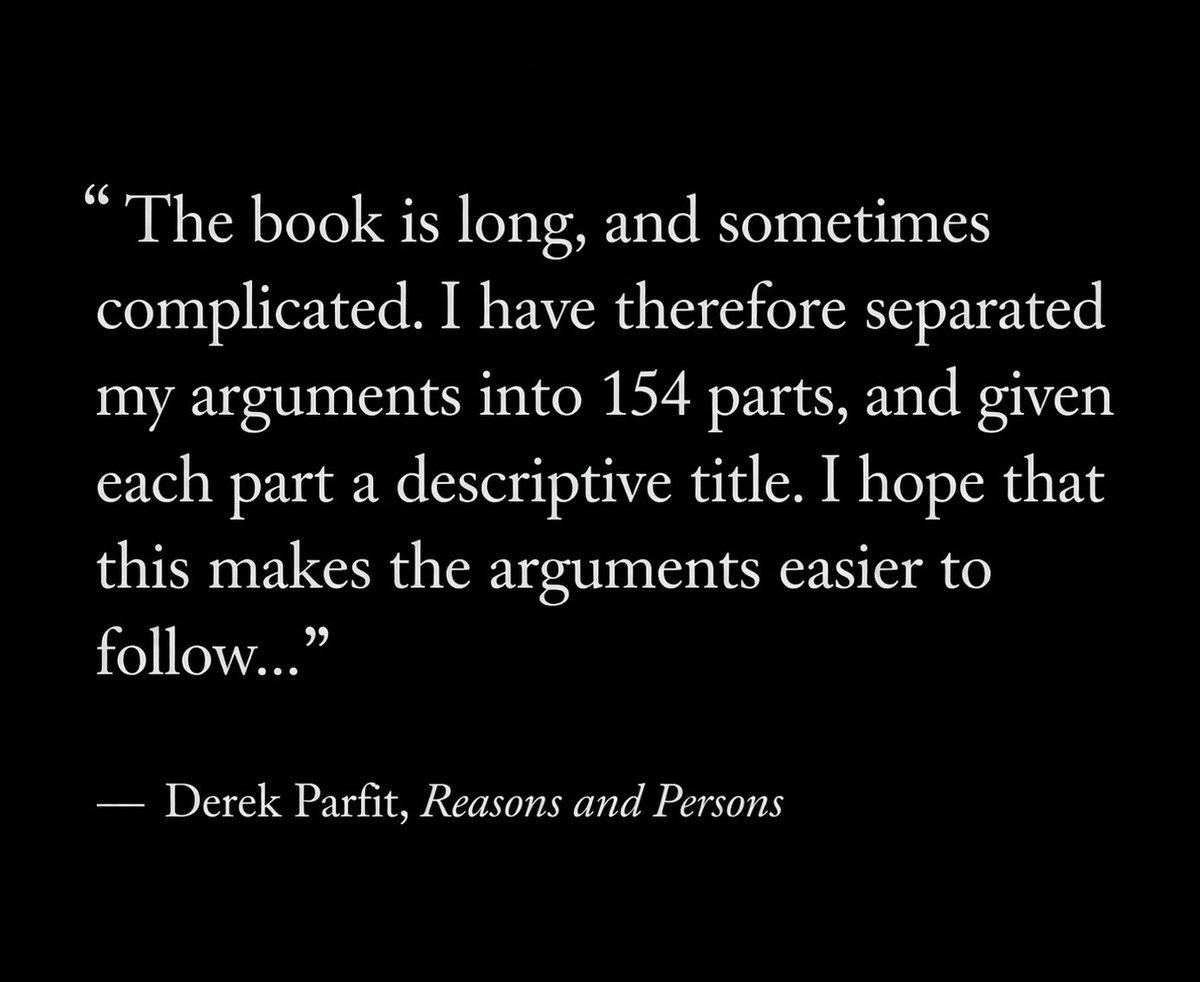
Parfit
Reading the philosophy classic "Reasons and Persons" by Derek Parfit. The introduction is so based: https://t.co/vfOoipZehp

B2B Can Build Network Effects Like B2C
Many B2B founders (including me) were always slightly jealous of the network effects and moats that emerged for B2C businesses that worked. @JayaGup10 @ashugarg write a great piece about how similar structural advantages are now possible in B2B.

Rediscovering Wonder: Exploration Restores Our Lost Purpose
I genuinely don't understand humans who aren't excited about exploration (whether it's space, the seas, knowledge, science). Something got taken from us in the last century. Without a sense of purpose, we are lost. So grateful to the people who are...

Human Purpose: Learn, Explore—Artemis II Launches Us Forward
I believe in physicist David Deutsch's vision for our purpose (in "The Beginning of Infinity"). We are here to learn and explore. So excited for Artemis II and humans starting the next journey. https://t.co/7iErXCltdt

2024 AI Race Intensifies: Mythos, Anthropic, OpenAI, Google
This year is going to be nuts (as if last year wasn't!) Mythos looks amazing if true. Couldn't imagine coding better the current Anthropic models. And no doubt OpenAI and Google will leapfrog next.

SaaS CEOs Stretched Thin, Must Prioritize Transformative Pivot
I have lots of empathy for folks leading existing SaaS cos these days. They're fighting battles on 5 fronts: 1. Defending churn from larger platform consolidators 2. Defending churn from cheaper upstarts 3. Maintaining modest growth in the core business (x-sell, etc.) 4. Pivoting...

AI Investment Deck Highlights Haunting SaaS Decline
This deck from @loganbartlett @Redpoint on AI investing trends is one of the best I've seen in recent memory. With respect to public SaaS, the newspaper chart is pretty haunting: https://t.co/2HNgJ1R3la

Top Experts Reveal Keys to Enterprise AI Adoption
Great listen about enterprise AI adoption from two of the smartest minds on the topic

More Unique Tasks Make Jobs Resistant to AI
Nice analysis by @alexolegimas on AI job displacement - looking at job "dimensionality" (number of tasks) as a key variable. More unique tasks == harder to displace. https://t.co/yuqX9RNIeF

Software Firms Must Pick Margins or Growth, Not Both
@DavidGeorge83 nails it. It's a tough reality check for software companies, but those don't pick a path between super high margins and accelerated growth won't make it. The "and" + "just a few more years" strategy no longer works.

SaaS Success Now Demands Rethinking Core Purpose
No one knows the future of SaaS, if we're being honest. But one thing I'm confident about - most of the playbooks folks relied on aren't enough anymore: * Hire a new CRO * What to look for in a sales rep * Accelerate...

Hardship Unlocks Deeper, Honest Human Connections
One of the gifts from hard personal challenges is the opportunity to connect with humans on a deeper and more honest level. For me, being totally open is one of the best feelings in life.

Ask Strong Questions, Build B2B Relationships That Close Deals
Be Curious: 5 Weak and 5 Strong Questions to Ask B2B Customers: Everyone in B2B, whether you're a brand new AI startup founder, an experienced software exec or a customer-facing individual contributor, wants one thing - stronger customer relationships. In...

Equities' Future Value Lies in Expected Cash Flows
One of the best articulations of the long-term economics question in equities right now. We sleep on a bed of prosperity lined with the expectation of future cash flows.

Sell the Buyer’s Personal ROI, Not Just Business Metrics
One of the biggest things B2B startups miss is underselling the "personal ROI" to the buyer or user of your technology. I spent time with a leadership team of a B2B startup yesterday and the topic of demonstrating ROI came up. We...

AI Disruption Will Come From Native Firms, Not Incumbents
Great piece by @davideoks about the real story around ATMs & bank tellers (TLDR mobile banking is what actually hurt the profession) Analogy is the impact of AI may not be from incumbent AI adoption but simply from AI native cos...

Enterprise AI Success Requires Coordinated Usage
Enterprises are going to have to solve the problem of coordinating AI usage to achieve any real business benefits. Good read by @gsivulka . Also - big part of why I joined the BOD of @Larridin w/ @rfradin @jlarrison who are...

AI‑native SaaS Rebirth Thrives as Legacy Valuations Collapse
What @eoghan did @intercom is one of the most impressive AI native "rebirths" in software. One upside of the massive downturn in SaaS valuations (if we're trying to be positive 😂) is the the market is estimating the residual value of...

AI App Companies Still Have Bright Future, Says Alex Imm
My friend @aleximm makes a compelling bull case that AI apps companies still have a bright future.

Find the Sweet Spot Between Overly Broad and Narrow ICP
One of the Goldilocks problems in B2B startups is defining who you are selling to. On one extreme is the entrepreneur that says "we sell to everyone." That could be every company, every role or both. The challenge is how do...

Too Many AI Tools Overwhelm Buyers, Stalling Adoption
One thing that’s interesting in the AI Apps world these days - everyone competes with everyone. And for customers, it's confusing to figure out the right approach. For example, if you're trying to grow your pipeline, do you? * Buy an AI...

Intentional Culture Shapes Future Alumni Impact
When you create a company culture, it carries forward not only into your startup but also into where your alumni go in the future. One more reason to be very intentional about it. You're putting something into the world. Make sure...

WACC, Not Terminal Value, Drives SaaS Repricing Uncertainty
W.A.C.C.: WACC Ate Cloud Companies One way to think about the repricing of SaaS is to go back to the Discounted Cash Flow formula itself. While this is an oversimplification, we can think of 3 core elements: * Expected Cash Flows * Weight...

Founders without a Defined Persona Aim at Everyone
Me: "So who's your target persona?" Early Stage B2B Founder: "Pretty much anyone" Me: https://t.co/IynLc0uSru

Startups Must Define How Their Technology Should Be Used
Excellent advice from @arampell. One of the toughest and most important turns for a startup is to have a point of view around how your technology SHOULD be used.

Disconnected Systems Cause Bad CX; AI Agents Can Fix
Behind almost every bad customer experience with a big company or government is tech systems that aren't connected to each other. This is one of the biggest opportunities for AI agents to improve CX.

CEOs Doubt Static Processes; SaaS Must Evolve Faster
A key question in the "future of software" debate entails understanding how durable enterprise business processes will be in the future. In the old world, companies could go so far as to assume their inventory management processes, for example, would be...

Agents Free Software Success From User Skill Limitations
One big problem with traditional software is it depends on the customer being great at their job. By definition most customers aren't above average in their work. A positive side effect of agents is they decouple software success from client...

Measuring AI Investment ROI Becomes Essential for All Companies
Fired up* to work w/ @rfradin @jlarrison @aktwits @arampell @a16z on the Board of @Larridin. We used Larridin at Gainsight to measure the ROI of our AI investments & this is a problem every company will need to tackle. *Russ promised to...

AI Tools Reignite Builder Passion and Personal Innovation
"I have this superpower now that has blown my mind" Just caught up with a former Gainster who is in a mid level role at a big company. He likes his job but has gotten vibe coding-pilled. He uses @Lovable non-stop and...

Skip Category Creation; Hire a Target‑audience Evangelist
Ppl often ask me for advice about "category creation" from my time at Gainsight. My first instinct is "don't!" It's expensive and Sisyphean 🤦🏽♂️. But after my warnings, I share that the biggest needle-mover for us was having an evangelist that came...

AI SaaS Lifts TAM by Cutting Implementation Overhead
Is AI constrained by software TAMs? When people think about the TAM for AI B2B software, a common refrain is "it's so much bigger because AI will automate services and labor." I think this will happen long-term, but it requires a...

Jagged vs Smooth AI: Incumbents Win Edge, Disruptors Dominate Core
Banger by @emollick. His Jagged Intelligence concept really has become one of the most important ideas in AI. In B2B AI, you could argue that it reveals a framework for disruptor versus incumbent success: * Jagged Intelligence area => advantage to incumbents,...

Avoid B2B Swap Deals; Let Product Merit Win
There are few pieces of advice that I feel strongly about - one is near the top of the list: be careful about swap deals. In B2B, there is a temptation early on to do the old "I'll buy your product...

Choose Early B2B Clients Wisely; They Shape Your Future
One of the biggest decisions for a B2B startup is picking the right early clients. There is path dependency from those customers as you build your company for them. Selling to anyone who wants to buy can be dangerous.

Great Product Alone Won’t Guarantee Startup Success
One of the worst pieces of advice in startups is telling people that the best product always wins. There is a graveyard of companies that followed that advice. "Great products" are necessary but not sufficient.

AI Point Solutions Face Massive Churn After 2026
The AI gold rush is covering up a painful truth: most point solutions won’t be retained. In 2026, as “buy all the AI tools” mandates disappear, churn will become the toughest Bitter Lesson.

Ask if Your Startup Can Become a Legal Monopoly
A big question I ask myself if someone is thinking of raising a lot of venture money: "Can this idea eventually become a (legal) monopoly?" People don't like to talk about it because it sounds bad, but the truth is the...