
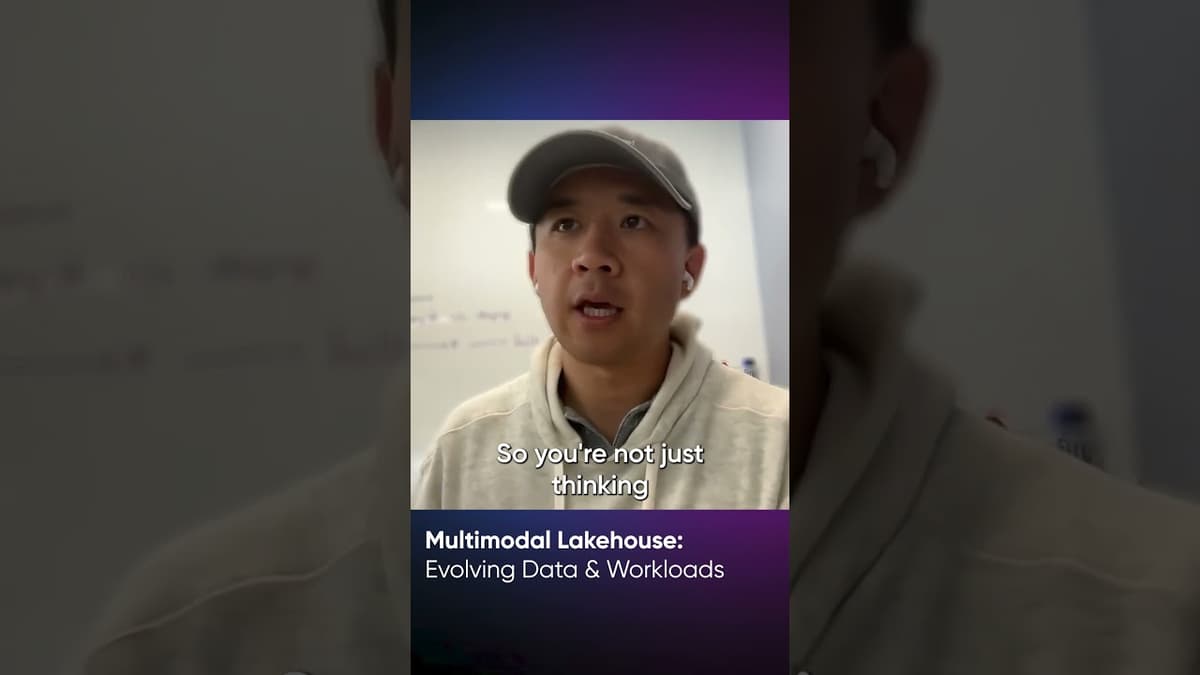
Multimodal Lakehouse: Evolving Data & Workloads with Chang She
In the talk, Chang She outlines a “multimodal lakehouse” that extends traditional data‑lake architectures to handle not only tabular records but also embeddings, images, video and other rich media. He explains three shifts: first, data formats now span multimodal types, demanding new read/write engines and metadata synchronization. Second, workloads move beyond pure SQL analytics to include vector search, model training, and GPU‑intensive feature engineering. Third, conventional lakehouses excel at batch processing but require separate OLTP systems for real‑time serving; the multimodal lakehouse aims to unify both. She cites the Last DB format as a concrete innovation that lets the same storage layer support online and offline queries simultaneously, eliminating the need for a separate serving database. This unified approach simplifies pipelines that ingest embeddings, run similarity searches, and feed results into downstream AI models. For enterprises, the ability to store, process, and serve multimodal data from a single platform can cut infrastructure costs, accelerate AI product cycles, and open new revenue streams that rely on real‑time, media‑rich insights.
Generative AI in the Real World: Faye Zhang on Using AI to Improve Discovery
The podcast features Faye Zhang, a staff AI engineer at Pinterest, discussing how generative AI is being deployed to solve the massive "discovery crisis" in online retail. She explains PinLanding, a system that semantically organizes billions of catalog items to...
Generative AI in the Real World: Understanding A2A with Heiko Hotz and Sokratis Kartakis
The podcast features Google Cloud’s Heiko Hotz and Sokratis Kartakis explaining the emerging Agent‑to‑Agent (A2A) protocol, a stateful communication layer designed to let autonomous AI agents talk to each other without code rewrites. They argue that as developers proliferate agents...
Generative AI in the Real World: Jay Alammar on Building AI for the Enterprise
Jay Alammar, director and engineering fellow at Coher, explains how enterprises can move from experimental large‑language‑model (LLM) labs to production‑grade AI solutions. He stresses that companies should begin with predictable, low‑risk tasks—such as summarization or entity extraction—rather than launching full‑blown...
This Week in AI with Christina Stathopoulos and Miguel Fierro
This week’s AI roundup, hosted by Christina Stodolski and guest Miguel Fierro, covered rapid industry developments and a deep dive into next‑generation recommendation systems. The discussion highlighted Anthropic’s meteoric rise—securing a Series H round that values the firm at $965 billion, filing...
Generative AI in the Real World: Agentic Systems Fundamentals with Maarten Grootendorst
Maarten Grootendorst, the BERTopic creator and Google DeepMind developer‑relations engineer, describes agentic AI systems as large language models operating in a loop with tools, memory, and guardrails. He emphasizes that embeddings and topic modeling remain essential even as LLMs dominate...

Making AI Relatable: Harper Carroll Live with Tim O’Reilly
The interview with Harper Carroll on Tim O'Reilly’s livestream explores how AI is becoming a tool for personal empowerment and mass education. Carroll recounts her journey from Stanford algorithms to Meta, then founding a startup that simplified GPU access. Her how‑to...
Generative AI in the Real World: Phillip Carter on Where Generative AI Meets Observability
The podcast features Philip Carter, a Salesforce product manager, discussing how generative AI reshapes observability. He begins with a concise definition: observability is the practice of collecting telemetry to understand complex, distributed systems that cannot be debugged step‑by‑step on a...
Silicon Valley Is Spooked by Its Own Technology with Aaron Levie
Aaron Levie warns that Silicon Valley’s own AI tools are reshaping where software talent is needed. He notes that only tens of millions of developers exist, and they’ve historically clustered at Google, Apple, and high‑growth startups, leaving the vast majority...
Organizational Capacity Is the Bottleneck with DJ Patil
DJ Patil argues that the biggest obstacle to overhauling the U.S. health‑care system is not technology but the limited capacity of existing organizations to change. He notes that while innovators talk about “rebuilding” the system, more than 500,000 members already rely...
From Automation to Augmentation: Designing AI Coaches That Amplify Expertise with Mike Amundsen
In a recent talk, Mike Amundsen contrasted automation with augmentation, arguing that generative AI is being deployed primarily as an answer‑machine rather than a tool that expands human expertise. He introduced “AI coaches”—software agents that structure the human‑AI interaction, slowing...
Exploring Subagents in Claude Code with Addy Osmani
In this walkthrough, Addy Osmani demonstrates Claude Code’s sub‑agent feature by prompting the model to build a simple bookmarks manager called Link Shelf using Express and SQLite. The parent orchestrator reads the single request, decomposes it into three sub‑agent briefs, and launches...
This Week in AI: Rethinking the Agent Harness
The inaugural episode of O'Reilly’s “This Week in AI” introduced the series and previewed a lineup of expert guests, while host Eric Freeman set the stage by surveying major AI developments—from security breakthroughs to infrastructure expansions and emerging agent frameworks. Freeman...

AI Divorce Agent: $2M Startup Journey with Ryan Carson
Ryan Carson, former Maple executive, launched an AI‑powered divorce platform, positioning himself as the sole full‑time employee while the rest of the workforce consists of artificial‑intelligence agents. The venture, dubbed the AI Divorce Agent, recently closed a $2 million seed round. Carson...
Generative AI in the Real World: Stefania Druga on Designing for the Next Generation
Stefania Druga, former DeepMind research scientist, explains how generative AI must be re‑engineered for the next generation of users—primarily Gen Z learners. She contrasts the typical utilitarian, task‑automation mindset of adult‑focused tools with the playful, exploratory ways children experiment, such as...