

Naked Mole Rats Have Bloody Battles for Power—But Not These Queens
The video reports a recent study on naked mole‑rat colonies that demonstrates a non‑violent transition of reproductive dominance. When the long‑standing queen, named Té, was rendered infertile after a relocation, her daughter Arwin assumed breeding responsibilities, effectively becoming the new queen. Researchers documented the succession process, noting that aside from a single minor biting incident, the power shift occurred without the brutal “queen wars” typical of these rodents. Notably, the former queen, Terra, was observed guarding Arwin and her pups, indicating cooperative behavior rather than rivalry. The study highlights a hidden flexibility in naked mole‑rat social organization, contrasting with the previously assumed inevitability of violent takeovers. By showcasing a peaceful handover, the findings challenge the notion that eusocial mammals are strictly bound to aggressive hierarchies. These insights broaden our understanding of mammalian eusociality and suggest that environmental conditions can modulate social dynamics, with potential implications for captive breeding programs and evolutionary biology research.
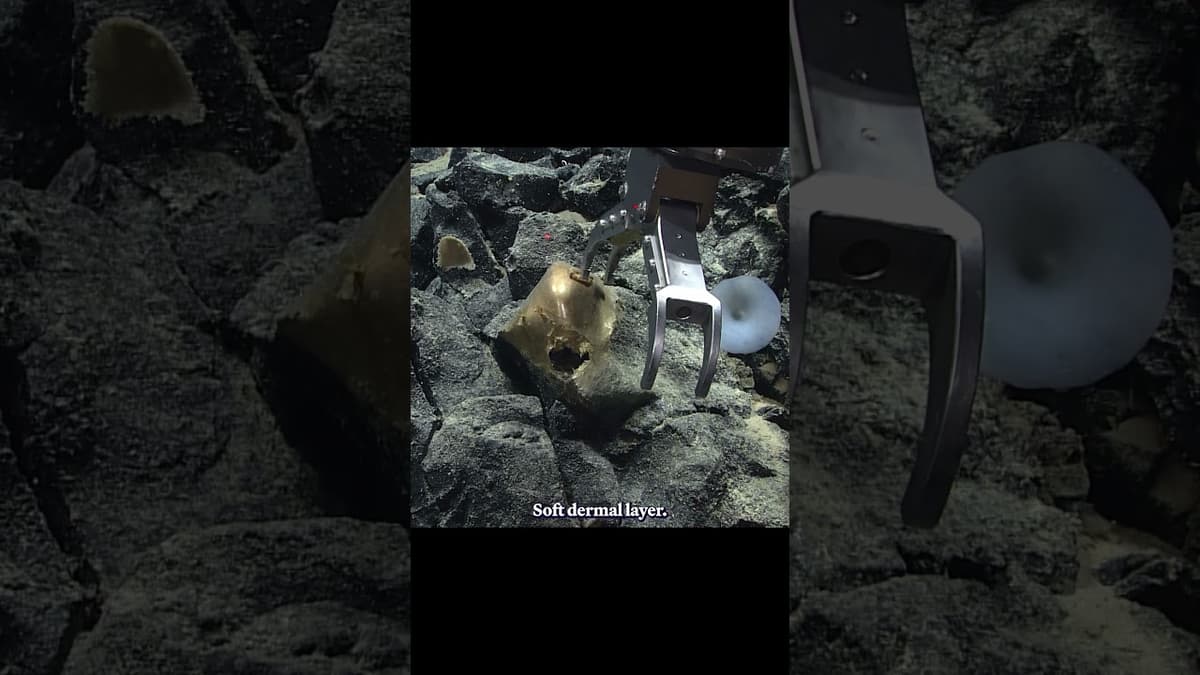
Scientists Solve Mystery of a Deep-Sea Golden Orb
The video captures a team of marine scientists handling a newly recovered deep‑sea golden orb, a mysterious object retrieved from a hydrothermal vent region. The researchers aim to determine its composition and biological significance. Using gentle probing, they note the orb’s...

Reid Wiseman "Needed to Hug" Heat Shield Engineer
Astronaut Reid Wiseman described a post‑flight stop on the USS John Pura, where the Orion crew inspected their spacecraft and sought out Luis, the engineer who led the CharLoss investigation after Artemis 1. The team learned that Artemis 1’s heat shield suffered extensive char...

Sperm Lost in Space
NASA’s long‑standing claim that no one has ever had sex in space sparked a new study examining whether human sperm can navigate in reduced‑gravity environments. Researchers placed sperm in a chamber simulating lunar and Martian gravity and guided them through a...

Astronaut Victor Glover Gives Post-Mission Remarks in Houston
Astronaut Victor Glover delivered his post‑mission remarks in Houston after the crew’s return, reflecting on a flight that launched on April 3. He opened by admitting the experience was still hard to process, underscoring the emotional weight of the mission. Glover repeatedly...

"Planet Earth: You Are a Crew."
The speaker opens by confronting a common question: what distinguishes a crew from a team? He admits his initial answer fell flat, then reframes the discussion around a crew’s constant, all‑weather presence and unified purpose. He defines a crew as...

Is the Moon Protecting Us?
The video examines whether the Moon acts as a shield for Earth, focusing on impact flashes and micrometeoroid strikes observed on the lunar surface. It explains how the Moon both absorbs interplanetary debris and, through its gravity, can alter trajectories...

Artemis Astronauts Saw Meteoroids Crash Into the Moon
During a recent Artemis mission, astronauts reported seeing bright flashes on the lunar surface, which they identified as impact events caused by meteoroids striking the Moon. The crew logged four distinct flashes—two observed by one astronaut and two by another—occurring south...

Artemis Astronauts Return From Far Side of the Moon
The video reports the safe return of the Artemis crew after a historic mission that took astronauts to the far side of the Moon, marking the first time humans have operated on that hidden hemisphere. NASA’s Houston control confirmed the...

Artemis II Crew Enters “Loss of Signal” On the Far Side of the Moon
On April 6, NASA’s Artemis II crew will experience a communications blackout lasting roughly 40 minutes as the Orion spacecraft traverses the Moon’s far side. The loss of signal is scheduled to begin at 6:44 PM EDT and will end when Orion...

The "Pokey" Parts of the Moon
The video offers a vivid, on‑the‑ground description of a specific lunar region, focusing on its unusually low albedo and the “pokey” texture that distinguishes it from surrounding terrain. Measurements indicate the area’s average albedo hovers around 0.3, notably darker than adjacent...

Artemis II Proposes Moon Feature Name "Carroll"
The Artemis II crew has put forward a personal tribute by proposing to name a small, bright feature on the Moon “Carroll.” The suggestion emerges from the mission’s close‑knit astronaut family, who wish to honor Carol—Reed’s spouse and mother of Katie...

Why "Mirror Cells" Could Reset Life on Earth
The video dramatizes a sci‑fi mission where "mirrored" agents infiltrate a body‑like corporation, using the concept of molecular chirality to illustrate a potential bio‑threat. It explains that most biomolecules exist in a single handedness—left‑handed (L) forms—while their mirror images (D)...

Antimatter Successfully Transported for the First Time Ever
Physicists at CERN announced the first ever transport of antimatter particles—specifically antiprotons—out of their production vault, moving them along a sand‑filled track inside a Penning trap. The experiment required an autonomous, battery‑powered trap that stayed cryogenically cold while preserving ultra‑high vacuum....

How Your Circadian Rhythm Could Change How Effective Medical Treatments Are
The video explores how the body’s internal clock—its circadian rhythm—can dictate the success of medical interventions, especially cancer therapies. Researchers have observed that patients receiving chemotherapy or other treatments in the morning often experience better outcomes than those treated later...

Andy Weir on How He Built Rocky's Biosphere
Andy Weir explains that before crafting the characters of his upcoming novel “Rocky,” he first designed the planet’s entire biosphere, grounding it in real exoplanet science. He chose the hypothetical 40 Aerodani AB—a super‑Earth eight times Earth’s mass orbiting its star every 46...

How Your Kidneys Actually Work — and What Happens when They Fail
The video explains how kidneys act as the body’s filtration system, processing roughly 150 quarts of blood each day through millions of microscopic units called nephrons. It breaks down the two‑part structure—glomerulus and tubule—and shows how waste is removed while...

Ryan Gosling Says Project Hail Mary Final Gets Zero G Right
Ryan Gosling said portraying zero gravity in the film Project Hail Mary was physically demanding, uncomfortable and intentionally inelegant. He described the work as frustrating because real weightlessness never matches cinematic expectations, and he drew inspiration from Charlie Chaplin’s Modern...

Ryan Gosling Considers a Career in Science
Actor Ryan Gosling visited NASA’s Jet Propulsion Laboratory while promoting Project Hail Mary, the film adaptation of Andy Weir’s novel, and spoke with scientists and creatives about bringing the story to screen. He described why the book’s solution-oriented, optimistic take...