
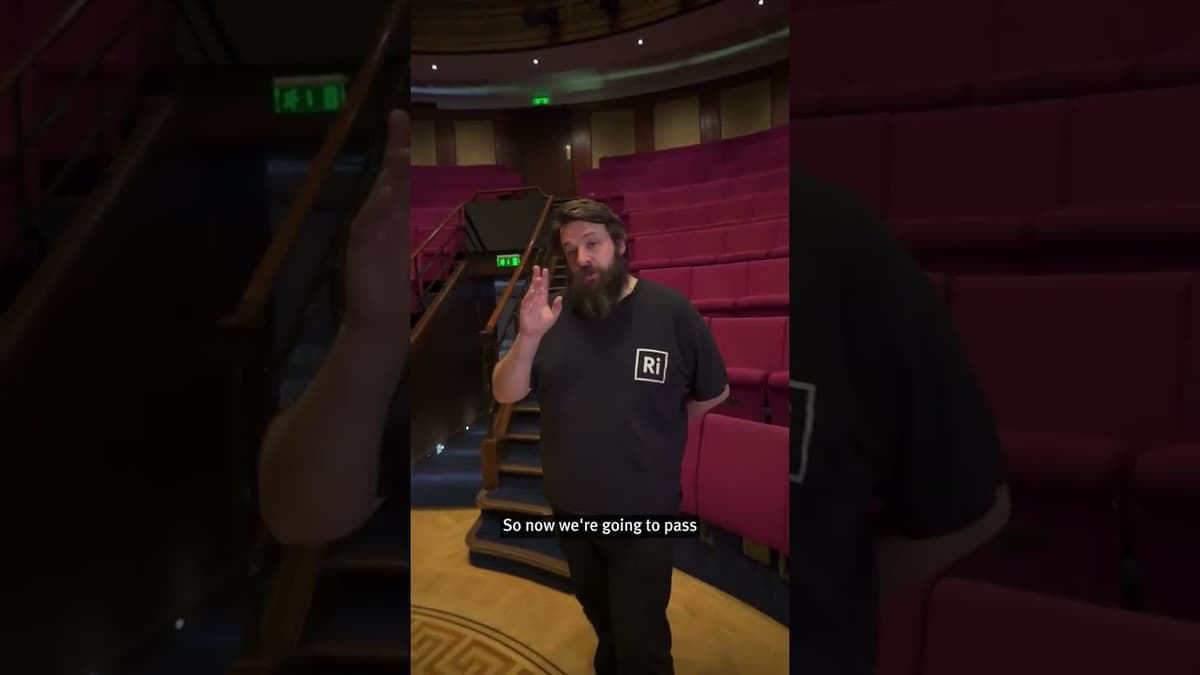
The Solar System in Scale with The Royal Institution #shorts #space #science #solarsystem
The video by the Royal Institution uses a 5‑centimetre sphere called Clementine to represent the Sun, then walks through a London theater and street to place the planets at true‑to‑scale distances, revealing how conventional textbook diagrams compress the solar system. At this scale Mercury sits roughly two metres from the Sun, Venus three‑point‑eight metres, Earth five‑point‑four metres and Mars eight‑point‑two metres. The asteroid belt follows, and the model forces the presenter to leave the building to locate Jupiter at twenty‑eight metres, Saturn at fifty‑one‑point‑five metres, Uranus one‑hundred‑three metres and Neptune one‑hundred‑sixty‑two metres away. The narrator notes that if planetary diameters were also scaled, Mercury would shrink to a 0.17‑mm grain of sand, essentially invisible, underscoring that distance, not size, dominates perception. He also references Voyager 2’s twelve‑year journey to Neptune, equating the 162‑metre model gap to 4.5 billion kilometres in reality. By translating astronomical distances into walkable lengths, the demonstration makes the vastness of the solar system tangible for audiences, reinforcing the need for perspective in education and inspiring curiosity about space exploration.

1985 Cell Phone Demo - Christmas Lectures 1985 with David Pye #shorts #sciencetalks
The short clip revisits a 1985 Christmas Lectures demonstration where David Pye showcases one of the earliest handheld cellular phones, built on a desk at the Royal Aircraft Research Institute (RARI). The reenactment mimics the original set‑up, complete with the...

The History of Space Science with Maggie Aderin Pocock #shorts #spacescience
The short video traces the early history of space science, spotlighting Galileo Galilei’s pioneering lunar observations and the broader quest to picture the Moon. Using his telescope, Galileo revealed craters and rugged terrain, overturning the prevailing belief that the Moon was...

Why Should We Care About Space Science with Anu Ojha #shorts #spacescience #scienceshorts
The short video by astrophysicist Anu Ojha uses a simple string‑tether experiment to illustrate the true scale of the Earth‑Moon system and the broader distances of near‑Earth space. By wrapping a string ten times around a globe he represents the average...

Cosmic Inflation: Is It How the Universe Began? With David Mulryne #shorts #sciencedemo #space
The short video tackles the concept of cosmic inflation, describing how the universe originated from an infinitesimally small, ultra‑dense state and then underwent a rapid expansion that set the stage for everything we observe today. The presenter emphasizes that space‑time itself...

Why Are Tortoishell Cats Mostly Female? Christmas Lectures 1984 with Walter Bodmer #shorts #science
The video from the 1984 Christmas Lectures, hosted by Walter Bodmer, explains why tortoiseshell (tortie) cats are almost exclusively female, using a simple visual demonstration with a patchwork cat and mice. The lecturer outlines the genetic basis: females carry two X...

Quantum Fields: The Real Building Blocks of the Universe - with David Tong #shorts #quantumphysics
In a concise short, physicist David Tong revisits Michael Faraday’s groundbreaking insight that electric and magnetic fields are real, invisible entities threading through every point of space. The video frames this idea as one of the most radical abstractions in...

#Shorts The History of Explosive Experiments at the Ri #scienceexperiment #sciencehistory
Public science demonstrations at the Royal Institution have long featured spectacular, sometimes hazardous, experiments. Historically, lecturers used explosives and dramatic effects to captivate audiences, a practice illustrated by a historic painting of a Friday Evening Discourse celebrating the series’ 200th...

A New Revolution - Danielle George's 2014 Christmas Lectures 3/3
The Christmas Lectures finale showcased a "robot orchestra" built from simple electric motors, 3‑D‑printed parts and repurposed household devices, all programmed to perform the Doctor Who theme alongside the London Contemporary Orchestra. Professor Danielle George framed the project as a...

Making Contact - Danielle George's 2014 Christmas Lectures 2/3
Danielle George’s 2014 Christmas Lecture explores the future of communication by hacking three everyday components – the light bulb, the telephone and the motor – to demonstrate how we might interact beyond sight and sound. She begins with a live...

The Light Bulb Moment - Danielle George's 2014 Christmas Lectures 1/3
In the opening segment of the 2014 Royal Institution Christmas Lectures, Professor Danielle George frames the evening around the idea that everyday components—light bulbs, phones and motors—can be repurposed into sophisticated technology. She begins with a simple fire‑exit sign and...

How Engineers Can Crack Science's Toughest Mysteries - with Shini Somara
Shini Somara opens her talk by recounting a personal journey from a mechanical‑engineering degree to an industry‑based PhD in computational fluid dynamics, highlighting how that experience revealed stark gender and diversity gaps in engineering. Determined to change the narrative, she...