
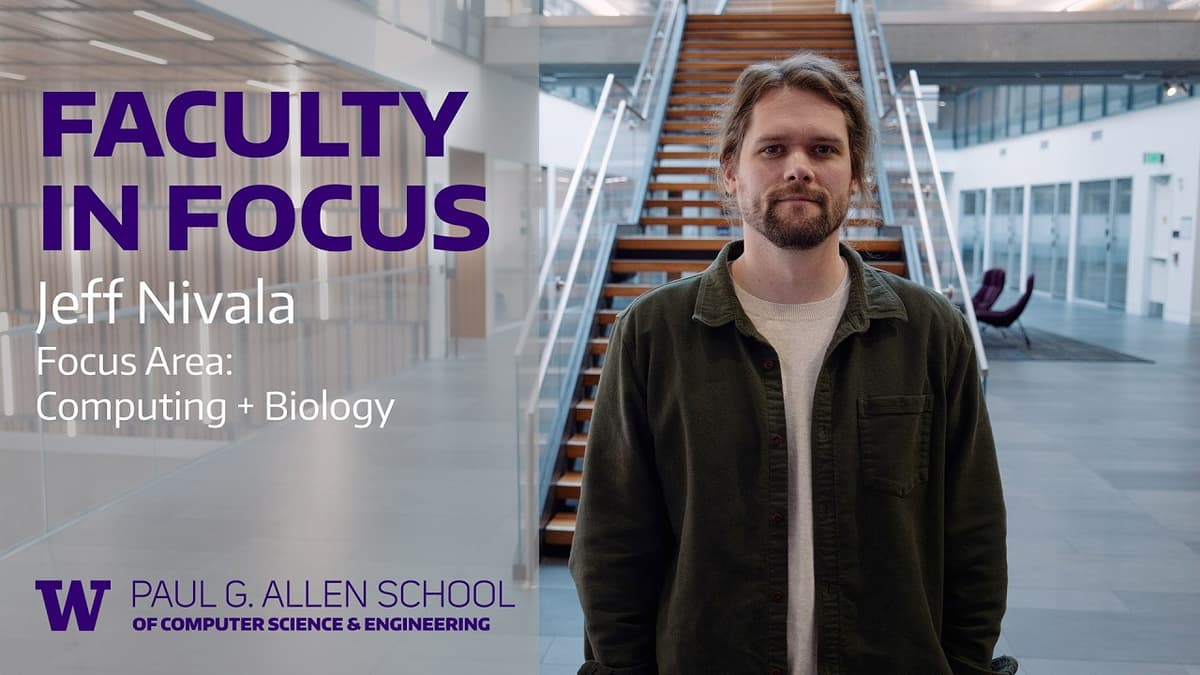
Faculty In Focus: Jeff Nivala
Assistant Professor Jeff Nivala of the Paul G. Allen School outlines a new technology that reads individual protein molecules end‑to‑end, preserving their native structure. The Molecular Information Systems Lab sits at the crossroads of computer science and biotechnology, aiming to make the invisible complexity of nanoscale biology observable. Current protein‑sequencing methods fragment proteins into short peptides and computationally reassemble them, discarding crucial information about full‑length conformation and post‑translational modifications. Nivala’s approach captures whole proteins directly, providing a more accurate view of how genes translate into functional molecules. “The rubber really meets the road at the level of proteins,” Nivala says, emphasizing the shift from gene‑centric to protein‑centric analysis. His interdisciplinary team—spanning molecular biology, biochemistry, microbiology, machine learning, and hardware engineering—has already demonstrated proof‑of‑concept experiments that read intact proteins in a CS‑building wet lab. If scaled, the technology could transform diagnostics by detecting disease‑related protein changes earlier, accelerate therapeutic design, and give researchers a universal tool for fundamental biology. Nivala envisions widespread adoption by biologists, clinicians, and engineers within the next decade.
Distinguished Seminar in Optimization & Data: Santosh Vempala (Georgia Tech)
In a seminar on why language models hallucinate, Santosh Vempala (with collaborators from OpenAI) argued that the standard pre-training objective—maximizing likelihood over a training distribution—mathematically encourages models to produce plausible but false outputs even when the training data itself is...
2026 Spring Robotics Colloquium: David Held (Carnege Mellon University)
David Held of Carnegie Mellon outlined research toward robot manipulation that is both precise and generalizable, arguing that foundation models have achieved broad world knowledge but lack the task-level accuracy specialist systems provide. He presented ArticuBad, a simulation-generated dataset of...
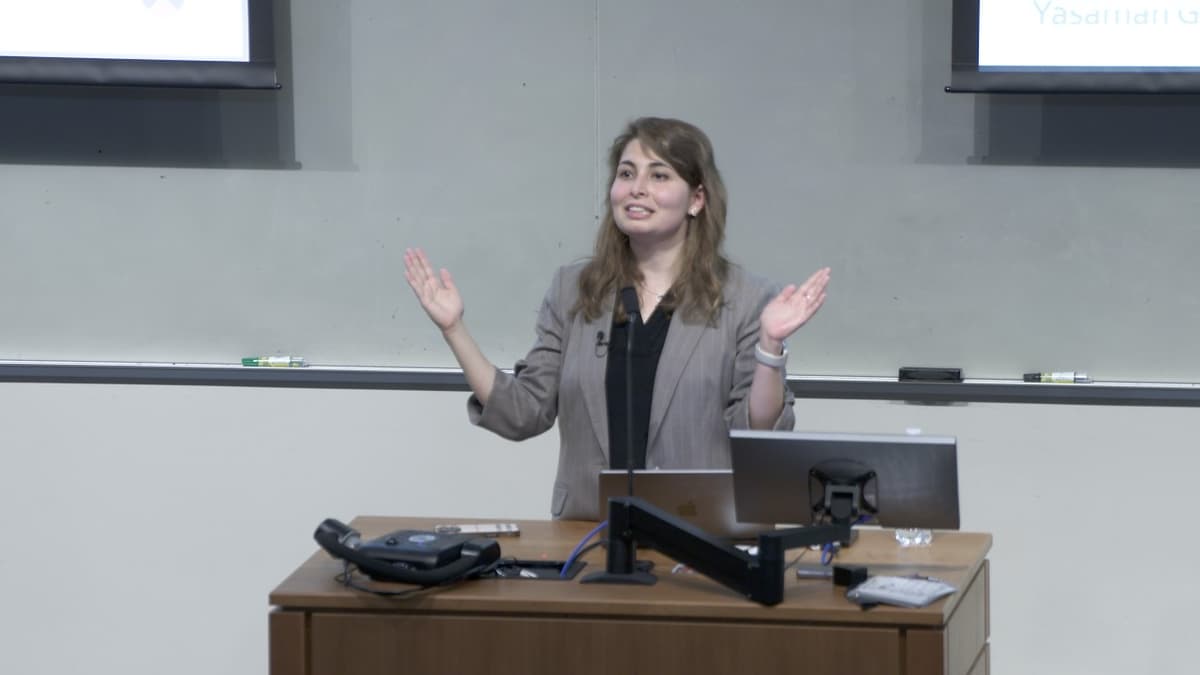
Allen School Colloquium: Physics-Guided Intelligent Wireless Systems Above 100 GHz
The Allen School colloquium highlighted cutting‑edge research on physics‑guided intelligent wireless systems operating above 100 GHz. Researchers argue that the looming AI‑driven traffic surge—projected to multiply data demand fivefold—requires gigahertz‑scale spectrum unavailable in sub‑6 GHz and traditional millimeter‑wave bands. Key innovations include...
Spring Robotics Colloquium: Tapomayukh Bhattacharjee (Cornell)
The Spring Robotics Colloquium featured Tapo Bhattacharjee of Cornell, who outlined his lab’s work on physical robot caregiving—particularly robot‑assisted feeding—and why such technology must be built around real users, not abstract algorithms. He emphasized that caregiving is highly contextual: tasks, user abilities,...
Spring Robotics Colloquium: Chuchu Chen (George Washington University)
In this colloquium, Assistant Professor Chuchu Chen of George Washington University outlines her visual‑inertial navigation research, arguing that any AI‑enabled device with a physical body— from AR glasses to drones— qualifies as a robot. She stresses that robots must be...
![[Audio Descriptions] ArticuTool: A Modular Active End-Effector for Robot Assisted Feeding](/cdn-cgi/image/width=1200,quality=75,format=auto,fit=cover/https://i.ytimg.com/vi/rSqVBN42ZG0/maxresdefault.jpg)
[Audio Descriptions] ArticuTool: A Modular Active End-Effector for Robot Assisted Feeding
The Assistive Dextrous Arm (ADA) project at the University of Washington aims to let a robot place a full plate of food in front of a user and feed them autonomously. By mounting a modular active end‑effector on a robotic...
What Happens to Software When Proof Is Cheap?
In July 2025 three AI systems earned gold‑medal scores at the International Math Olympiad, with Harmonic’s Aristotle generating formal proofs in the Lean proof assistant. Six months later collaborative AIs used Lean to solve an open problem posed by Paul...

ArticuTool: A Modular Active End-Effector for Robot Assisted Feeding
The video introduces ArticuTool, a modular active end‑effector designed for the Assistive Dextrous Arm (ADA) project, which aims to let robots autonomously deliver a plate‑full of food to users. By swapping interchangeable tools, the system can handle a variety of...

Winter Robotics Colloquium: Marynel Vázquez (Yale University)
In this Winter Robotics Colloquium, Marynel Vázquez from Yale University argues that the next wave of generalist robots must combine physical dexterity with social intelligence. Using the household robot Rosie as a touchstone, she illustrates how today’s manipulation‑focused systems are...

Allen School Colloquium: Why Can’t We Classically Describe Quantum Systems?
The colloquium centered on a fundamental question: why classical computers cannot efficiently describe quantum many‑body systems. Chin‑Mai highlighted the recent breakthrough on the No‑Low‑Energy‑Trivial‑States (NLTS) conjecture, which shows that even approximate low‑energy ground states of certain local Hamiltonians resist...

Allen School Colloquium: Aligning Computing Education with Modern Software Development
Anchel Shaw, a computing‑education researcher at UC San Diego, presented a colloquium on aligning university programming instruction with the realities of modern software development. He highlighted the persistent academia‑industry gap, where students learn green‑field coding and are graded solely on...

Allen School Colloquium: Physics-Grounded World Models
In his March 9, 2026 colloquium, Stanford PhD candidate Hong‑Xing (Koven) Yu introduced physics‑grounded world models that fuse deterministic physics engines with generative AI. The hybrid framework can reconstruct full 3‑D environments from a single image and simulate how those...

Allen School Colloquium: Test-Time Training
The colloquium introduced test‑time training, a paradigm where models continue to learn while being deployed. Yan, a post‑doctoral researcher at Stanford and Nvidia, traced the idea back to his 2019 PhD work and explained how it mirrors the "take‑home test"...

2026 Winter Robotics Colloquium: Marynel Vázquez (Yale University)
In this colloquium, Marynel Vázquez of Yale University argues that the next wave of generalist robots must combine sophisticated manipulation abilities with genuine social intelligence. Using the household robot "Rosie" as a running example, she illustrates how future robots will...