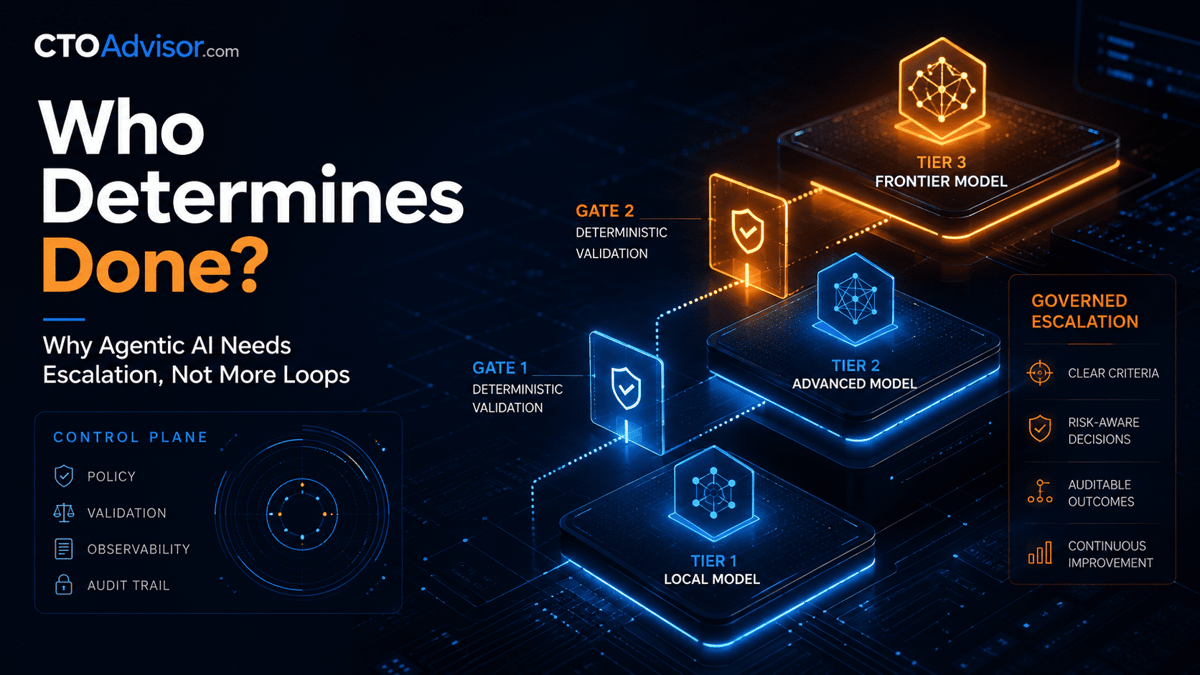
Who Determines Done? Why Agentic AI Needs Escalation, Not More Loops
Key Takeaways
- •Deterministic local models solve ~25% of real bug-fix tasks first try
- •Same-tier deterministic repair loops add no value, repeat wrong answers
- •Escalation chain (local → o3 → gpt‑5.5) raises pass rate to ~75%
- •Average cost per task drops to $0.13 versus $4,000 hardware spend
- •Validators act as authority; their quality defines system correctness boundaries
Pulse Analysis
The current hype around agentic AI centers on ever‑more complex loops—tool‑calling, ReAct, self‑reflection—under the assumption that additional iterations inevitably converge on the correct answer. In practice, most enterprises run these loops on deterministic, temperature‑zero models that produce identical outputs regardless of feedback. The experiment described in the article shows that such same‑tier repair loops rarely move the needle; they either succeed immediately or remain stuck at a capability ceiling, offering no incremental value while consuming compute and latency.
A more pragmatic approach treats the loop as plumbing and focuses on the decision point that determines when a task is truly "done." By coupling deterministic validators—test suites, schema checks, and diff analyses—with a tiered escalation policy, the author built a three‑tier cascade: a free, self‑hosted local model, a non‑deterministic frontier model (o3), and the most capable model (gpt‑5.5). The validator gates promotion, ensuring that each tier only runs when the previous one fails. This simple ladder lifted the overall success rate to roughly 75% and reduced the average cost per task to $0.13, a stark contrast to the $4,000 hardware investment and $4.60 API bill for the entire study.
For enterprise architects, the lesson is clear: design agentic systems that emulate traditional L1/L2/L3 support structures. Let cheap, deterministic workers handle easy cases, escalate to more capable models when validators flag failure, and reserve the most expensive tier for truly hard problems. This "cost‑per‑finished‑job" mindset not only cuts spend but also provides auditable exit gates, reducing governance risk. As AI adoption matures, organizations that replace endless looping with disciplined escalation will achieve higher reliability, lower total cost of ownership, and clearer accountability across their AI‑driven workflows.
Who Determines Done? Why Agentic AI Needs Escalation, Not More Loops
Comments
Want to join the conversation?