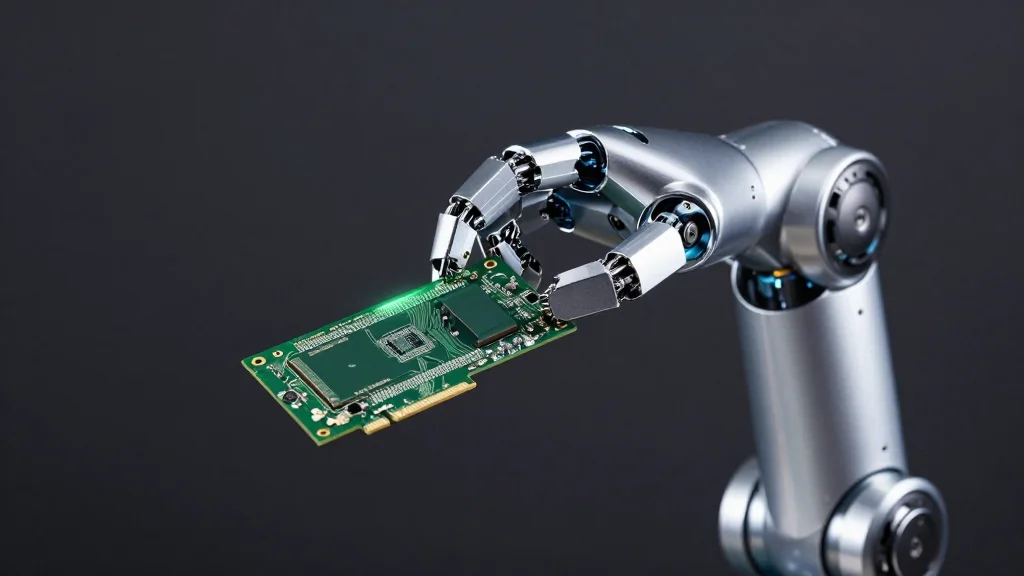
Nvidia CEO Jensen Huang Touts Robotics as Next Growth Engine in South Korea

Companies Mentioned
Why It Matters
Nvidia's declaration that robotics will drive its next growth phase in South Korea matters because it aligns the company's cutting‑edge GPU and AI infrastructure with a sector poised for rapid expansion. Robotics workloads demand high‑throughput compute and low‑latency memory—areas where Nvidia's HBM‑based GPUs excel. By partnering with Korean automotive and electronics giants, Nvidia can embed its technology directly into the supply chain, accelerating time‑to‑market for next‑generation robots and autonomous systems. For CTOs, this signals a shift in procurement and development strategies: hardware choices will increasingly be dictated by AI‑ready platforms that can handle both data‑center training and edge inference in robotics. Furthermore, the hiring push for an AI research center in Seoul creates a local talent pipeline, reducing reliance on overseas engineering resources and fostering ecosystem synergies. As Korean firms roll out robotics solutions across manufacturing, logistics and consumer devices, Nvidia's hardware will become a de‑facto standard, influencing design decisions for years to come.
Key Takeaways
- •Jensen Huang announced robotics as Nvidia's next major growth sector in South Korea
- •Four new AI products unveiled, including the Vera Rubin supercomputer and RTX Spark platform
- •Nvidia launched an AI research and engineering hiring drive for a new center in Seoul
- •Partnerships highlighted with Hyundai Motor, LG, SK hynix, Samsung and Naver
- •Robotics focus aims to lock in GPU and HBM memory leadership for automotive and industrial AI workloads
Pulse Analysis
Nvidia's pivot toward robotics in South Korea reflects a broader industry trend where AI hardware vendors are moving beyond pure data‑center sales into verticals that require tightly integrated compute, memory and software stacks. Historically, Nvidia's growth has been anchored in gaming GPUs and, more recently, AI training accelerators. The robotics announcement marks a strategic diversification that mirrors the rise of AI‑enabled automation in manufacturing and mobility—a market projected to exceed $200 billion by 2030. By aligning with Hyundai's robotics ambitions and leveraging Korea's HBM supply chain, Nvidia is positioning itself to capture a larger share of the hardware spend that will flow into robot control units, edge inference devices and autonomous vehicle platforms.
For CTOs, the implication is clear: the next wave of high‑performance compute will be judged not just on raw FLOPS but on how seamlessly it integrates with robotics software stacks, sensor fusion pipelines and real‑time control loops. Nvidia's RTX Spark, billed as a "new form of PC platform," could become the de‑facto standard for development kits, much as CUDA did for AI research. The company's emphasis on local talent also hints at a longer‑term commitment to co‑development, which could lower integration costs for Korean OEMs and their global partners.
However, the move is not without risk. Robotics adoption timelines can be longer than pure AI software deployments, and the sector remains sensitive to macro‑economic cycles and regulatory scrutiny around automation. Nvidia will need to demonstrate clear ROI for its robotics processors, perhaps by delivering turnkey solutions that reduce the engineering burden for OEMs. If successful, the partnership model could be replicated in other high‑tech hubs, extending Nvidia's influence beyond the traditional GPU market and reshaping the hardware landscape for the next decade.
Nvidia CEO Jensen Huang Touts Robotics as Next Growth Engine in South Korea
Comments
Want to join the conversation?
Loading comments...