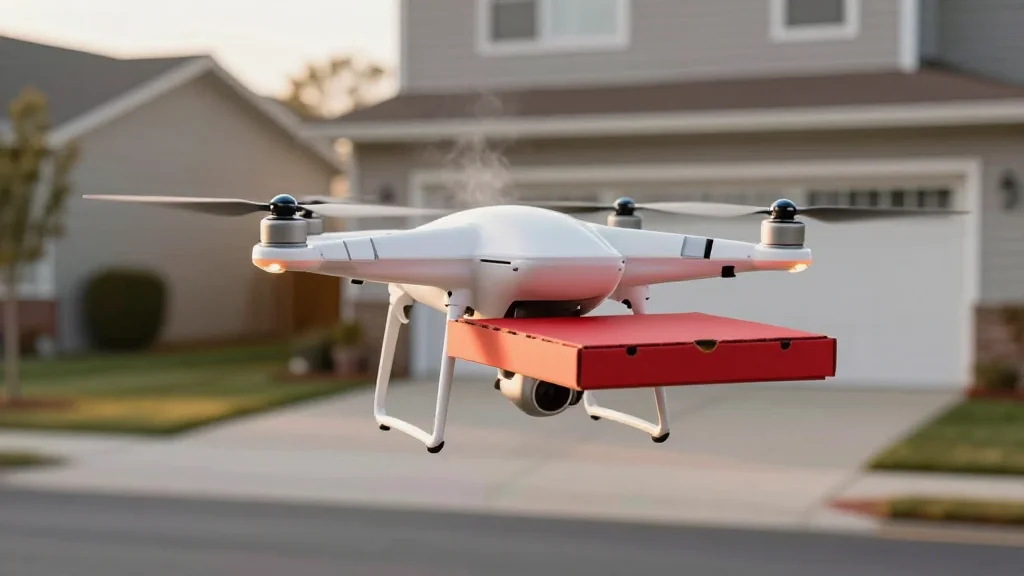
Papa John’s Tests Wing Drone Delivery of Sandwiches in North Carolina

Companies Mentioned
Why It Matters
The Papa John’s‑Wing pilot illustrates how legacy food brands are turning to autonomous aerial logistics to meet rising consumer expectations for speed and convenience. By tackling packaging and payload constraints early, the test could unlock a new distribution layer that reduces reliance on road‑based couriers, cuts delivery costs, and opens underserved suburban markets. Success would also validate Alphabet’s strategy of pairing its cloud AI capabilities with physical delivery assets, potentially reshaping the competitive dynamics among restaurant chains, third‑party delivery platforms, and logistics startups. Beyond the immediate operational insights, the trial signals a shift in how food‑service companies view technology partnerships. Rather than merely outsourcing delivery to gig‑economy apps, they are co‑creating end‑to‑end solutions that embed AI, data analytics, and autonomous hardware into the core ordering experience. This could accelerate consolidation in the delivery ecosystem, as brands that master the integration may gain a defensible edge in customer loyalty and cost structure.
Key Takeaways
- •Papa John’s began a drone delivery pilot with Alphabet’s Wing in Indian Trail, NC.
- •The test currently offers three Oven Toasted Sandwiches via the Wing app.
- •Wing’s Chief Business Officer Heather Rivera highlighted the collaboration as a "true partnership".
- •The pilot focuses on aerodynamic packaging to overcome drone payload limits.
- •Future plans include app integration, expanded menu, and broader geographic rollout.
Pulse Analysis
The Papa John’s‑Wing experiment is a micro‑test that could have macro implications for the food‑delivery market. Historically, the sector has been dominated by road‑based gig platforms that charge high commissions and struggle with last‑mile inefficiencies. Drones promise a lower‑cost, faster alternative, especially in suburban corridors where traffic congestion is less severe but delivery distances remain significant. By starting with a compact sandwich menu, Papa John’s sidesteps the aerodynamic challenges of pizza boxes, allowing the company to gather performance data without risking large, costly payload failures.
From a competitive standpoint, the pilot puts Papa John’s ahead of many peers that have yet to explore aerial delivery, while Little Caesars’ full‑pizza tests remain limited to a single state. If Papa John’s can demonstrate reliable, on‑time deliveries that meet food‑safety standards, it could force rivals to accelerate their own drone programs or partner with established UAV operators. The integration of Google Cloud’s AI ordering agent further differentiates the offering, potentially enabling predictive demand modeling that optimizes drone dispatch and reduces idle time.
Regulatory scrutiny will be a decisive factor. The Federal Aviation Administration has been gradually opening low‑altitude airspace for commercial drones, but scaling a nationwide network will require clear rules on flight paths, noise, and privacy. Papa John’s and Wing’s ability to navigate these constraints while maintaining a seamless customer experience will determine whether the pilot evolves into a commercial rollout or remains a niche experiment. In the short term, the test will generate valuable data on order latency, packaging durability, and consumer willingness to pay for aerial delivery, informing both the company’s roadmap and the broader industry’s expectations.
Papa John’s Tests Wing Drone Delivery of Sandwiches in North Carolina
Comments
Want to join the conversation?
Loading comments...