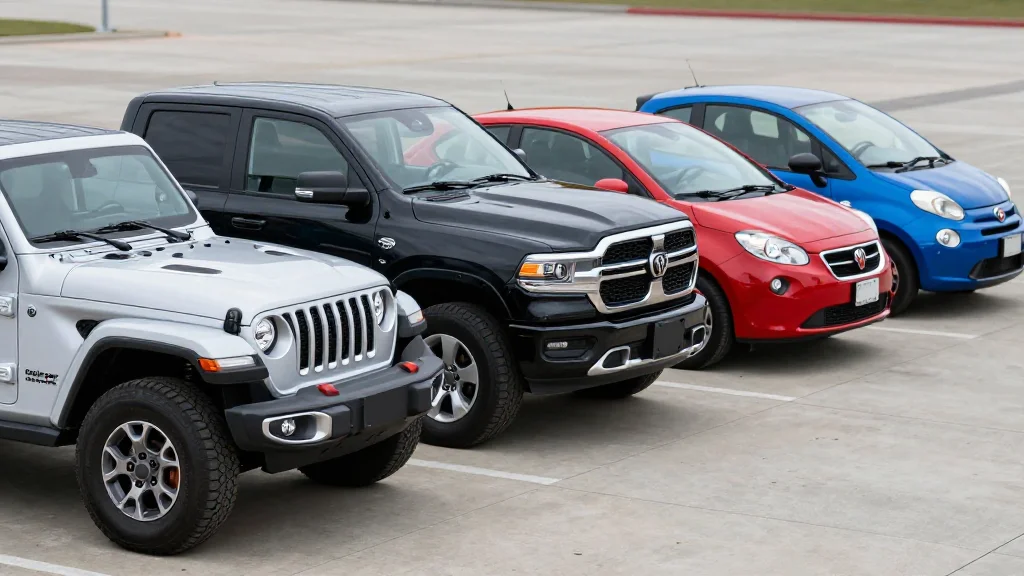
Stellantis Unveils 20 New Models, Shifts 70% Funding to Jeep, Ram, Peugeot and Fiat

Companies Mentioned
Why It Matters
The preview signals a decisive pivot toward platform consolidation at one of the world’s largest automakers. By funneling the majority of its R&D budget into four core brands, Stellantis aims to achieve economies of scale that can offset the high capital costs of electrification, while still delivering brand‑specific experiences. For CTOs, the move highlights the growing necessity of modular vehicle architectures that support multiple powertrains, enabling faster integration of software updates, OTA capabilities, and data‑driven services across diverse product lines. Moreover, the introduction of a 700‑horsepower Hellcat engine alongside a flexible ICE platform illustrates Stellantis’ intent to serve both performance enthusiasts and the broader market transitioning to electric mobility. This dual‑track strategy could set a template for other OEMs grappling with the trade‑off between legacy internal‑combustion revenue streams and the push toward zero‑emission fleets.
Key Takeaways
- •Stellantis showcased 20 new models at its May 21 investor day.
- •Company will allocate 70% of R&D funding to Jeep, Ram, Peugeot and Fiat.
- •Goal to launch 60 new and 50 refreshed vehicles by 2030.
- •New Chrysler Airflow can host electric, hybrid, or ICE powertrains.
- •Dodge Charger Hellcat will feature a >700 hp supercharged HEMI V‑8.
Pulse Analysis
Stellantis’ platform strategy mirrors a broader industry trend where scale and flexibility are becoming the twin pillars of competitive advantage. By converging multiple powertrains onto a single chassis, the automaker reduces the engineering headcount required for each new model, cuts tooling costs, and accelerates software rollout—a critical factor as vehicles become increasingly connected. This approach also mitigates the risk of over‑investing in a single technology pathway at a time when market adoption of full‑electric vehicles remains uneven across regions.
Historically, large OEMs have struggled with platform sprawl, leading to higher per‑unit costs and slower innovation cycles. Stellantis’ decision to concentrate 70% of its budget on four brands is a pragmatic response to that legacy, allowing the company to leverage shared components while preserving brand identity through distinct styling and performance tuning. The inclusion of a high‑output Hellcat engine suggests the firm will not abandon its profitable ICE segment immediately, but rather use it to fund the transition to electrified models.
Looking ahead, the success of this strategy will hinge on execution. CTOs will need to ensure that the modular architecture can support rapid OTA updates, cybersecurity safeguards, and data analytics platforms that power new services. If Stellantis can deliver on its promise of a "future‑proof" vehicle line‑up, it could set a new benchmark for how legacy automakers reinvent themselves in the electrification era, forcing competitors to accelerate their own platform consolidation efforts.
Stellantis Unveils 20 New Models, Shifts 70% Funding to Jeep, Ram, Peugeot and Fiat
Comments
Want to join the conversation?
Loading comments...