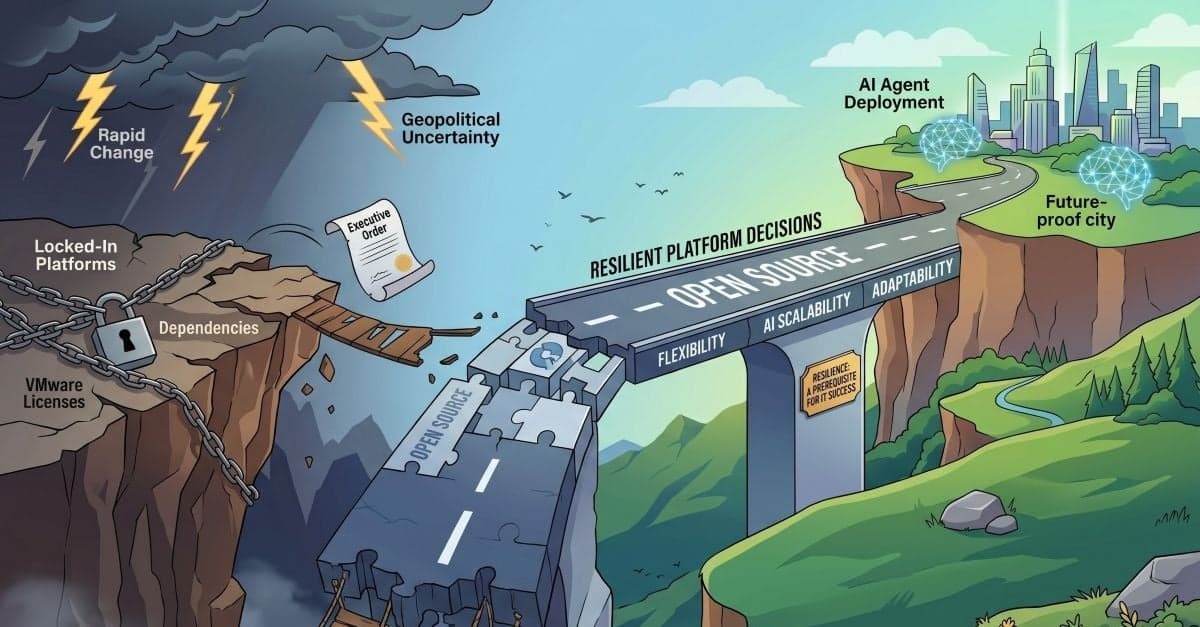
SUSE CTO: IT Teams Need to Become More Resilient in the Face of Rapid Change
Why It Matters
Resilient, open‑source‑based architectures protect enterprises from costly lock‑in and enable rapid AI deployment, a competitive differentiator in today’s volatile tech landscape.
Key Takeaways
- •Open source reduces lock‑in risk from licensing or geopolitical shifts
- •AI agents demand scalable, modular architectures beyond traditional user‑centric platforms
- •Rigid legacy stacks increase costs and slow AI deployment timelines
- •IT leaders must treat resilience as a prerequisite, not an afterthought
- •Modular, open platforms enable rapid pivots amid licensing or policy changes
Pulse Analysis
The pace of change in enterprise IT has reached a tipping point. Licensing terms for dominant virtualization vendors can flip overnight, while geopolitical events—such as new export controls or executive orders—can instantly render a technology stack non‑compliant. In this environment, SUSE’s CTO argues that reliance on proprietary, monolithic platforms is a strategic liability. Open‑source solutions, by design, distribute control across communities and reduce the single‑point‑failure risk associated with vendor‑specific contracts, giving organizations the flexibility to adapt without massive renegotiations.
Artificial intelligence further amplifies the need for architectural agility. Deploying thousands of AI agents requires a platform that can scale horizontally, orchestrate dynamic workloads, and expose APIs that evolve in real time. Legacy infrastructures, built for human end‑users, struggle to meet these demands, leading to inflated operational expenditures and delayed time‑to‑market for AI‑driven products. The financial stakes are high: building AI‑ready platforms can run into the tens of millions of dollars, yet indecision or premature commitment to a rigid stack can waste a comparable sum in sunk costs.
To future‑proof their operations, IT leaders should adopt a modular, open‑source‑first strategy. By decoupling compute, storage, and networking layers and leveraging community‑driven projects, enterprises gain the ability to swap components as standards evolve or regulatory pressures mount. This approach not only curtails lock‑in risk but also accelerates innovation cycles, allowing teams to experiment with emerging AI frameworks without overhauling the entire stack. In short, resilience, powered by openness and modularity, is fast becoming the baseline for competitive advantage in the AI era.
SUSE CTO: IT Teams Need to Become More Resilient in the Face of Rapid Change
Comments
Want to join the conversation?
Loading comments...