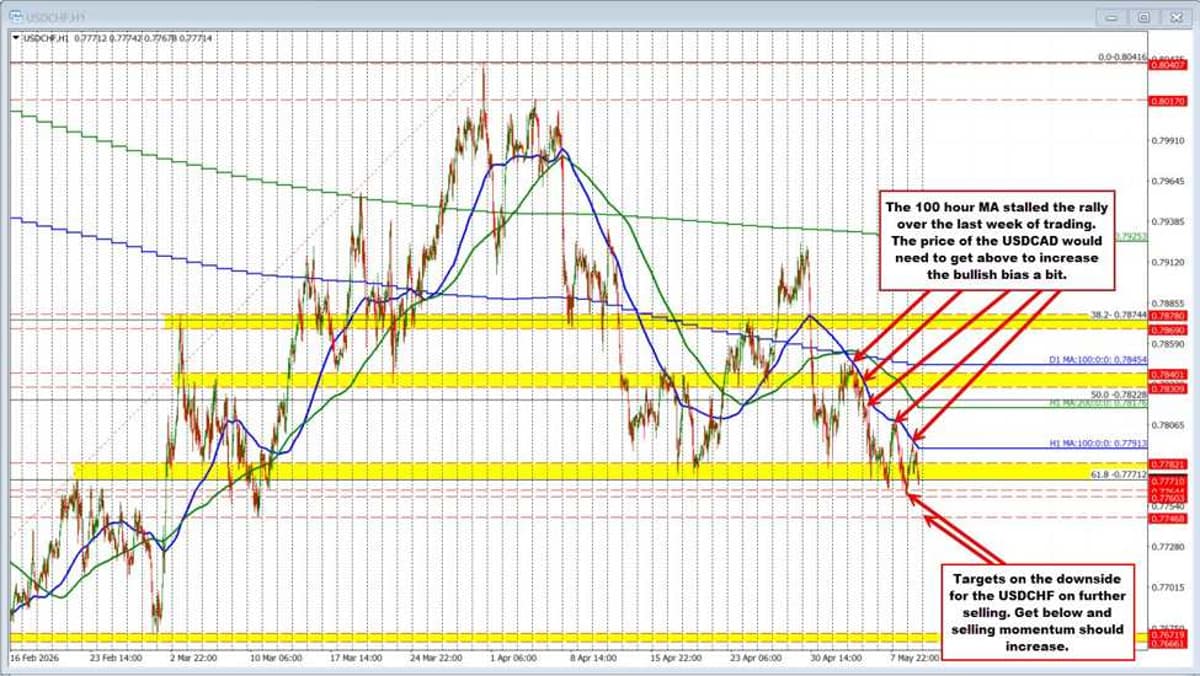
USDCHF Trades to New Day Lows. USDCAD Lower as Well. What Are Key Levels for Each Now?
Key Takeaways
- •USDCHF stuck below 100‑hour MA at 0.77913, sellers in control
- •Break above 0.77913 needed for bullish reversal
- •USDCAD faces resistance near 1.3710‑1.3720; downside bias persists
- •Next USDCAD support at 1.3642, then 1.3631 moving averages
- •Traders watch 61.8% retracement zones for both pairs
Pulse Analysis
The latest technical read on USDCHF underscores a classic bearish pattern: the pair has repeatedly failed to breach its 100‑hour moving average at 0.77913, a level that now acts as a decisive resistance barrier. With price hovering between the 61.8% Fibonacci retracement zone of 0.7771‑0.7782, market participants are pricing in continued downside momentum, targeting the recent low of 0.7760 and the March trough at 0.77468. This behavior reflects heightened risk aversion, as traders favor safe‑haven assets amid lingering uncertainty over global growth and central‑bank policy paths.
On the Canadian dollar front, USDCAD’s brief rally was capped by a confluence of technical obstacles. The pair tested the 38.2% retracement of its early‑April decline at 1.37085 and ran into the falling 200‑day moving average near 1.3719, creating a robust resistance cluster around 1.3710‑1.3720. With sellers dominating, the next downside target aligns with the rising 100‑hour moving average at 1.3642, followed by the 200‑hour average at 1.36314 and a swing zone near 1.36199‑1.3630. These levels are critical for traders managing exposure to the U.S. dollar’s strength and commodity‑linked risk.
Beyond chart patterns, macro fundamentals reinforce the technical outlook. The Federal Reserve’s policy stance, still anchored in a higher‑for‑longer rate environment, sustains dollar upside pressure, while the Bank of Canada’s dovish tilt and weaker oil prices add to CAD depreciation. Consequently, both USDCHF and USDCAD are likely to remain in sellers’ favor until clear catalysts—such as a shift in Fed policy or a rebound in risk appetite—break the prevailing technical barriers. Traders should monitor central‑bank commentary and commodity price movements for early signals of a potential trend reversal.
USDCHF trades to new day lows. USDCAD lower as well. What are key levels for each now?
Comments
Want to join the conversation?