🎯 Today's Currencies Pulse

Iran‑Israel conflict sends Asian currencies to record lows
The war has lifted oil prices and strengthened the U.S. dollar, pushing the Indian rupee, Philippine peso and Indonesian rupiah to historic lows. Japan and South Korea have intervened, spending billions to buy back their currencies, while India and the Philippines face the steepest import‑price spikes. Central banks across the region are tapping foreign‑exchange reserves built after the pandemic.

🚀 Top Currencies Headlines

How AI Stock Performance Is Reshaping Forex Strategy: What Currency Traders Should Watch in 2026
…
eCommerce Fastlane

Asia Week Ahead: Rate Decision in Korea and Key Data From Japan, China, Taiwan
ASIA/PACIFIC: South Korea will announce a rate decision as global inflation pressures intensify. Key data releases include Japan's inflation and unemployment, China's industrial profits and Taiwan's output
ING — THINK Economics

Philippine Central Bank Governor Says It Is Considering Off-Cycle Rate Hike
Spiralling fuel costs have raised concerns that pump prices could trigger hikes in other consumer goods
The Business Times (Singapore) – Companies & Markets
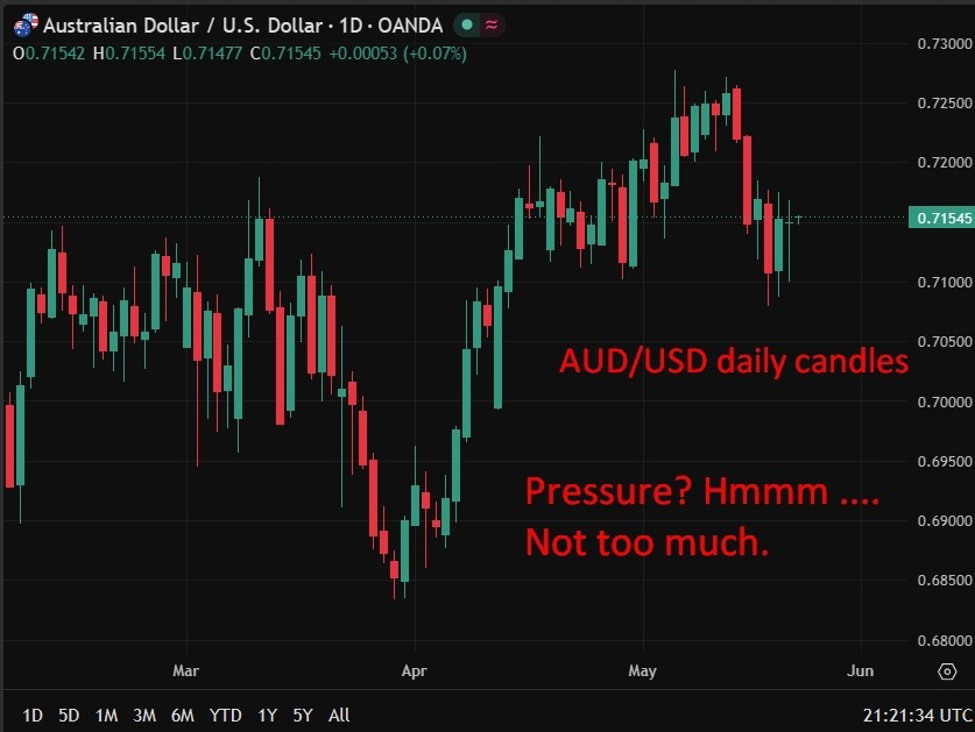
Australian Dollar Under Pressure Say Analysts as RBA Rate-Hike Cycle Seen Nearing Its End
The Australian dollar is under pressure after weak Chinese and domestic labour data, with analysts warning the RBA rate-hiking cycle may be over, removing a key support for the currency. Summary: Source: Commerzbank The AUD pulled back from a four-year high of 0.726 against the USD reached last Wednesday Soft Chinese economic data at the start of the week (China April data misses badly, Iran war and weak demand weigh. Retail sales growth plunge.) delivered the first blow to the currency Domestic labour market figures released Thursday (Australia unemployment jumps to 4.5% in April, highest since November 2021) added to the pressure The RBA has raised rates three times in its last three meetings, setting it apart from other G-10 central banks still in wait-and-see mode on the Iran conflict and inflation RBA Chief Economist Sarah Hunter struck a hawkish tone (Hunter: Inflation expectations drifting higher is an elevated risk RBA cannot ignore) in a speech this week, with meeting minutes pointing toward a pause (August hike favoured over June) Analysts warn the rate-hiking cycle may already be over, which would progressively erode AUD support The Australian dollar is under mounting pressure after pulling back sharply from a four-year high, with analysts now questioning whether the Reserve Bank of Australia has finished raising interest rates altogether. The currency climbed to 0.726 against the US dollar last week, its strongest level in four years, before a run of discouraging data began to chip away at the advance. Weak Chinese economic readings at the start of the week delivered the first blow. Then, on Thursday Australian time, domestic labour market data landed softer than many had hoped, reinforcing the sense that conditions in Australia are beginning to cool. For much of the recent period, the AUD had drawn clear support from the RBA's unusually assertive stance. While other G-10 central banks have adopted a cautious, wait-and-see approach in the face of the Iran conflict and the renewed inflation it has stoked, the RBA moved decisively, delivering three consecutive rate increases. That divergence gave the Australian dollar a distinct advantage and attracted flows accordingly. But Commerzbank analysts now suggest that advantage is being eroded, noting A speech this week by RBA Chief Economist Sarah Hunter was notably less hawkish than her recent communications had been. Minutes from the central bank's latest monetary policy meeting, released Tuesday, reinforced the impression that policymakers are leaning toward a pause, preferring to allow the cumulative effect of their tightening to work through the economy before moving again. The question is whether that pause becomes a full stop. Labour market data is notoriously volatile from month to month, and reading too much into a single set of figures carries its own risks. But the signals are accumulating. If the RBA's rate-hiking cycle has genuinely run its course, the currency loses the policy premium that has sustained it, and the AUD faces a less supportive environment in the months ahead. With Chinese demand already softening and domestic momentum showing cracks, the burden of proof is shifting. The four-year high reached last week may, in retrospect, mark the peak of the policy-driven rally. --- The Australian dollar faces a more challenging backdrop after retreating from its recent four-year peak above 0.726. The prospect of a prolonged RBA pause, or an outright end to the tightening cycle, removes a key pillar of AUD support that has distinguished it from other G-10 currencies in recent months. Further weakness in Chinese economic data would compound the pressure, given the sensitivity of the Australian economy to demand from its largest trading partner. This article was written by Eamonn Sheridan at investinglive.com.
investingLive – Asia-Pacific News Wrap
💬 Top Currencies Social Posts

Thread by @Twistie_bites
ASIAN CURRENCIES PERFORMANCE AGAINST USD IN LAST 2 YEARS 🇮🇳 India INR : -15% 🇮🇩 Indonesia IDR : -8% 🇰🇷 South Korea KRW : -7% 🇹🇭 Thailand THB : -6% 🇯🇵 Japan JPY : -6% 🇵🇭 Philippines PHP : -4% 🇲🇾 Malaysia MYR : -3% 🇨🇳 China CNY : -3% 🇸🇬 Singapore SGD : -3% 🇵🇰 Pakistan PKR : -2% Why “Vishwaguru Economy” is leasing in depreciation chart too?

Tweet by @Steve_Hanke
Hong Kong’s inflation rate comes in at 1.7%/yr in April, JUST A TAD below its de facto 2%/yr inflation target. Hong Kong’s Dollar-Based Currency Board is WORKING LIKE A CHARM. https://t.co/WDKxEE8okk