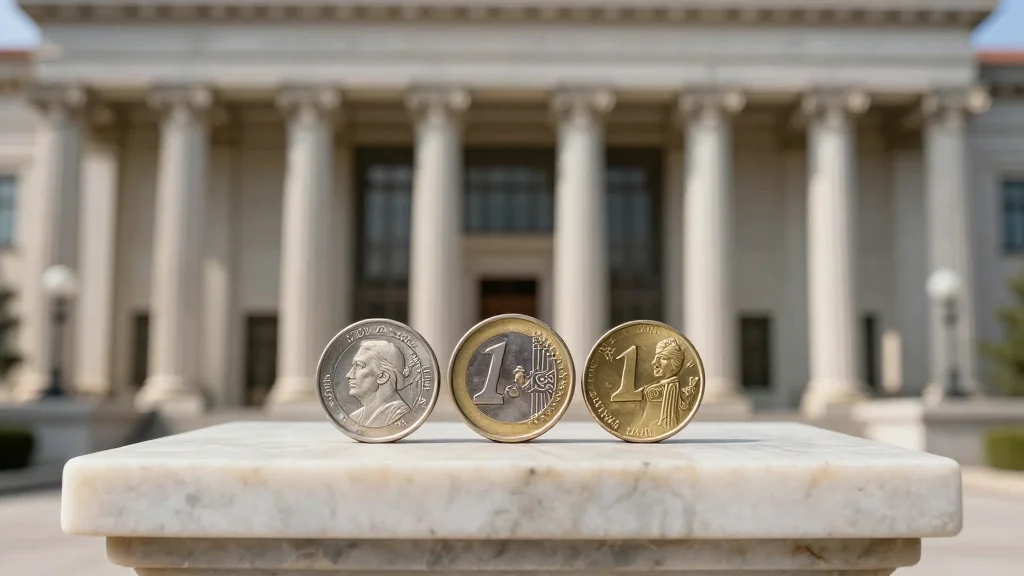
Azerbaijan’s Central Bank Holds USD Rate at 1.7 Manat, Signals Policy Steadiness

Why It Matters
The CBA’s decision to keep the dollar rate unchanged at 1.7 manat offers a clear reference point for the country’s monetary policy, reinforcing confidence among importers, exporters, and foreign investors. A stable exchange rate helps contain inflation, supports the budgeting process for businesses reliant on dollar‑priced inputs, and underpins the broader economic strategy that leverages oil revenues to maintain macro‑stability. In the regional context, Azerbaijan’s steady rates contrast with the volatility seen in neighboring currencies, such as the Turkish lira’s recent depreciation. By maintaining a predictable benchmark, the CBA positions the manat as a relatively safe conduit for cross‑border trade, especially with Russia and the European Union, where price stability is a prerequisite for sustained investment.
Key Takeaways
- •CBA kept the USD rate at 1.7 manat on April 22
- •Euro rate unchanged at 1.9957 manat per euro
- •Turkish lira priced at 0.0378 manat per lira
- •100 Russian rubles valued at 2.2716 manat
- •Stable rates signal continuity in Azerbaijan’s monetary policy
Pulse Analysis
Azerbaijan’s decision to hold the dollar rate at 1.7 manat reflects a deliberate choice to prioritize exchange‑rate stability over aggressive monetary easing. Historically, the CBA has intervened during periods of oil‑price shocks to prevent sharp manat depreciation, a strategy that helped anchor inflation expectations in the early 2020s. By keeping the rate flat, the bank signals that recent oil inflows are sufficient to sustain the current peg without resorting to additional foreign‑exchange market operations.
The broader regional picture underscores the significance of this move. While the Turkish lira has been under pressure from high inflation and unconventional monetary policy, the manat’s modest lira rate suggests that Azerbaijan is insulated from some of those dynamics, likely due to its more diversified foreign‑exchange reserves and a tighter fiscal stance. The unchanged ruble rate also hints at a measured approach to managing the country’s historic trade ties with Russia, avoiding the kind of abrupt devaluations that could destabilize bilateral commerce.
Looking forward, the CBA’s next policy decision will hinge on two variables: global oil price trajectories and domestic inflation data. Should oil revenues dip or inflation accelerate beyond the 5‑percent target, the central bank may consider a modest appreciation of the manat to curb price pressures, or conversely, a controlled devaluation to protect export competitiveness. For now, the steady rates provide a rare moment of predictability in a region marked by currency turbulence, offering both businesses and investors a clearer horizon for planning and risk assessment.
Azerbaijan’s Central Bank Holds USD Rate at 1.7 Manat, Signals Policy Steadiness
Comments
Want to join the conversation?
Loading comments...