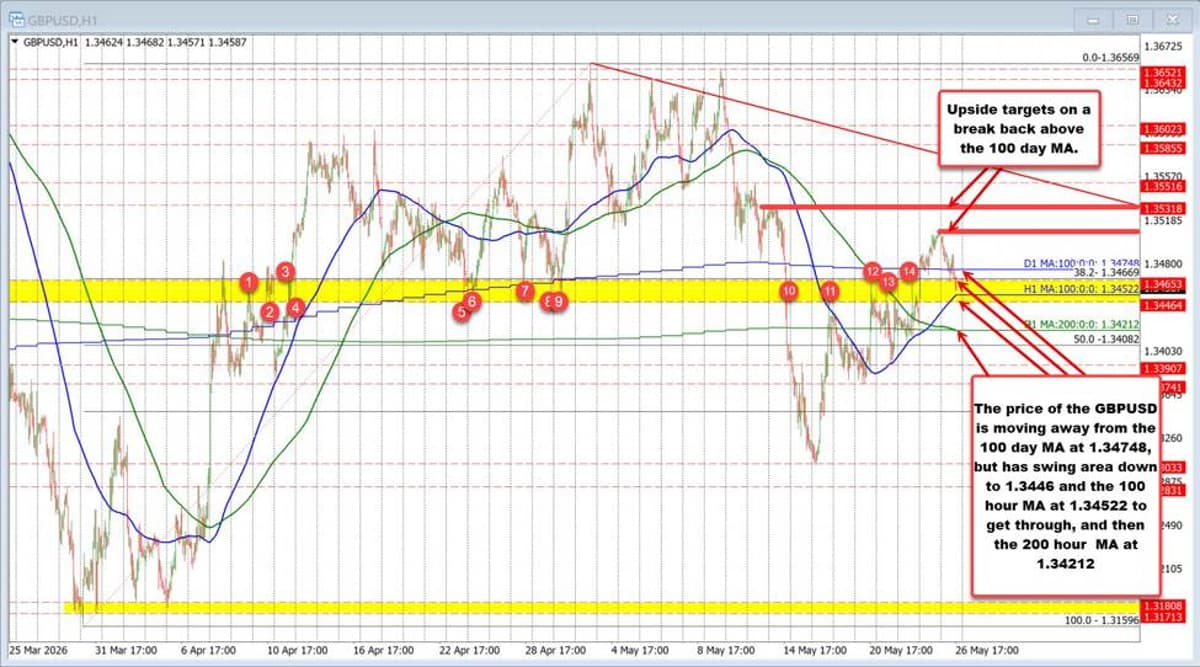
The GBPUSD Sellers Are Making a Play with the Price Back Below the 100 Day MA
Why It Matters
The price’s position relative to key moving averages determines whether the pair will continue its recent decline or reverse into a short‑term rally, influencing forex traders’ risk exposure and carry‑trade strategies.
Key Takeaways
- •GBP/USD fell below 100‑day MA at 1.34748, signaling seller confidence.
- •Next resistance lies at 100‑hour MA 1.34522, then swing low 1.3446.
- •Break below 200‑hour MA 1.34212 would deepen bearish bias.
- •Buyers could retake 100‑day MA, targeting 1.3507 and 1.3532 levels.
- •Moving‑average cluster remains pivotal for short‑term direction.
Pulse Analysis
The British pound versus the U.S. dollar (GBP/USD) is once again testing a key technical barrier, slipping beneath its 100‑day moving average at 1.34748. Traders watch this level as a barometer of medium‑term momentum; a sustained breach often precedes a broader downtrend. The pair’s price action is now anchored to a cluster of moving averages—the 100‑hour at 1.34522 and the 200‑hour at 1.34212—creating a tight range that amplifies the importance of each candle. In this environment, even modest price moves can trigger sizable position adjustments.
For market participants, the immediate risk‑reward calculus hinges on whether sellers can push the pair below the 200‑hour average. A decisive break would validate bearish sentiment, opening the door to deeper retracements toward the 1.34 zone and potentially reigniting carry‑trade flows that favor higher‑yielding currencies. Conversely, a bounce back above the 100‑day MA would restore buyer confidence, prompting short sellers to cover and nudging the price toward the recent high of 1.3507 and the next resistance at 1.3532. Tight stop‑loss placement is essential given the recent volatility around these averages.
Beyond the chart, macro fundamentals are feeding the technical narrative. The Bank of England’s recent dovish commentary and weaker UK inflation data have eroded the pound’s upside, while the Federal Reserve’s higher‑for‑long stance keeps dollar funding attractive. These policy divergences reinforce the technical bias toward the downside, especially if upcoming UK GDP figures miss expectations. Forex strategists therefore treat the GBP/USD moving‑average cluster as a litmus test: a sustained breach could signal a broader shift in risk appetite, while a recovery may hint at a short‑term rally ahead.
The GBPUSD sellers are making a play with the price back below the 100 day MA
Comments
Want to join the conversation?
Loading comments...